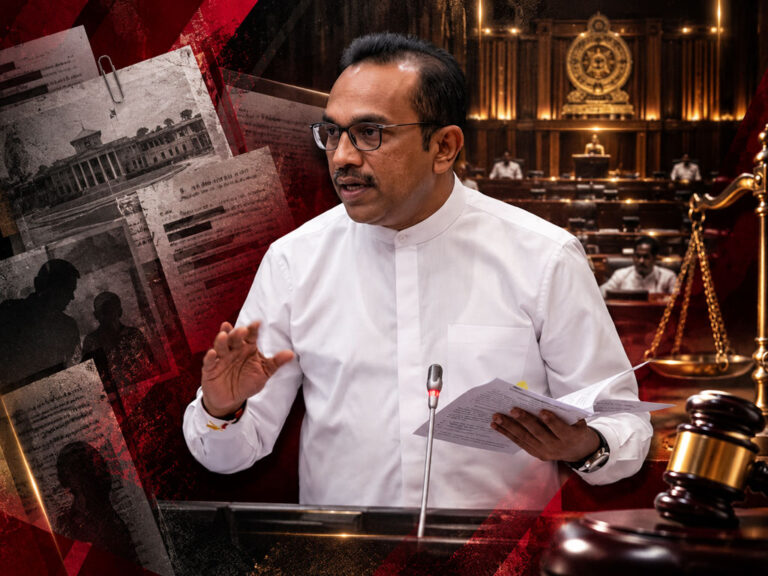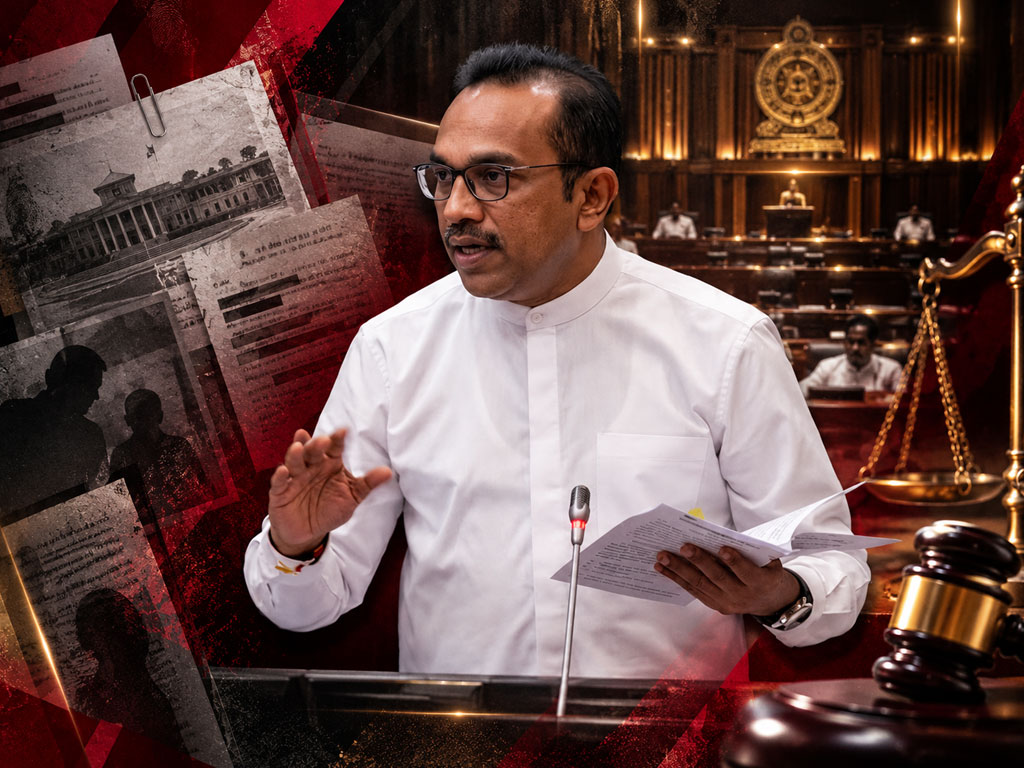
Bimal Rathnayake tabled details of 50 corruption, fraud and criminal cases in Parliament, rejecting claims of political revenge by the Government.
COLOMBO — Minister of Transport, Highways and Urban Development Bimal Rathnayake has presented a 10-page document to Parliament listing 50 corruption, fraud and criminal matters involving former ministers, politicians, members of the Rajapaksa family and senior State officials, while rejecting accusations that the Government is pursuing political revenge against its opponents.
Rathnayake said the matters were not newly created by the present administration, but involved complaints, investigations and legal proceedings dating largely from the 2015-2019 period.
He alleged that previous administrations had used political influence to suppress or obstruct investigations and said the present Government had instead allowed investigators to perform their duties without interference.
The Minister also denied that opposition politicians were being selectively targeted.
The document, as described in Parliament, covers a broad range of cases and allegations. Inclusion in such a list does not establish guilt, and criminal responsibility in any individual matter must ultimately be determined through the judicial process.

“Not Political Revenge, but Suppressed Cases”
Rathnayake’s central argument was that renewed activity in long-running investigations should not be interpreted as a campaign of political retaliation.
He maintained that many of the matters had existed for years and that the difference under the current administration was that investigative authorities were being permitted to proceed without political obstruction.
According to the Minister, this had allowed several previously unresolved cases to move forward.
His claim that earlier governments suppressed investigations through political influence remains an allegation made in Parliament and would require evidence in each individual case.
The Government’s position, however, is that investigators are being given greater operational independence and that cases are not being selected according to party affiliation.
Former Ministers and Rajapaksa Family Members Named
The document includes a number of prominent former ministers and political figures.
Among those named are Johnston Fernando, Wimal Weerawansa, Mahindananda Aluthgamage, Basil Rajapaksa, Rajitha Senaratne, Ravi Karunanayake, Prasanna Ranatunga, A. H. M. Fowzie, Bandula Gunawardena and Rohitha Bogollagama.
Several members of the Rajapaksa family are also referred to in connection with investigations or legal matters.
They include Namal Rajapaksa, Yoshitha Rajapaksa, former President Gotabaya Rajapaksa, Shiranthi Rajapaksa, Rohitha Rajapaksa, Chamal Rajapaksa and Shasheendra Rajapaksa.
The document’s inclusion of an individual should not be read as a finding that he or she committed an offence. Some of the matters listed concern allegations, investigations or proceedings that may be at different stages of the legal process.
Cases Range From Financial Allegations to Major Crimes
The 50 matters are not confined to allegations of financial misconduct.
They span several categories:
- Large-scale financial irregularities: Matters cited include the Central Bank bond transactions, the Krrish deal, the MiG aircraft procurement, the Divi Neguma Fund case, the silk cloth distribution case and allegations involving Carlton Sports Network.
- Serious crimes and killings: The document refers to investigations connected to the Easter Sunday attacks, the killing of rugby player Wasim Thajudeen, the murder of journalist Lasantha Wickrematunge, the disappearance of journalist Prageeth Eknaligoda and attacks on journalists Keith Noyahr and Upali Tennakoon.
- Misuse of State resources: The list also includes allegations concerning the use of public employees for political activity, illegal accumulation of assets and misuse of public funds during election periods.
The legal status of these matters differs considerably. Some may involve completed proceedings, some continuing investigations and others allegations that have yet to be judicially determined.
Senior Officials Also Included
The list extends beyond elected politicians.
Former Central Bank Governor Arjuna Mahendran, businessman Arjun Aloysius, former Defence Secretary Hemasiri Fernando, former Inspector General of Police Pujith Jayasundara and former Presidential Secretary Lalith Weeratunga are among the officials and other individuals referred to in the document.
Their inclusion broadens the Government’s argument from political accountability to the responsibility of senior public officials and others who exercised influence over major State institutions.
It also reinforces the need to distinguish parliamentary allegations from judicial findings.
Accountability cannot be established merely by naming individuals in the legislature. Each matter must be examined through the appropriate investigative and judicial process.
Rule of Law or Political Strategy?
Rathnayake’s intervention is likely to be interpreted in sharply different ways.
Supporters of the Government may view the document as evidence of a renewed effort to pursue cases that remained unresolved for years.
Sri Lanka has repeatedly faced public criticism over delays in major corruption and criminal investigations, particularly those involving politically influential individuals.
Allowing investigators to proceed independently, if consistently applied, would therefore address a longstanding demand for accountability.
Political opponents, however, may argue that highlighting dozens of cases involving former ministers and opposition figures could also serve a political purpose, particularly if prosecutions and investigations appear concentrated on one side of the political divide.
That is why the ultimate test will not be the number of names presented in Parliament.
It will be whether investigators, prosecutors and courts handle each matter independently, transparently and according to evidence.
Attention Also Turns to Ranil Wickremesinghe
A separate question raised in the supplied commentary concerns allegations and legal proceedings involving former President Ranil Wickremesinghe.
Public attention, it argues, is also focused on whether matters involving Wickremesinghe will receive the same level of scrutiny as those included in Rathnayake’s 50-case document.
The source does not identify the specific allegations or proceedings being referred to in this section, so no conclusion can safely be drawn about their present legal status.
The commentary nevertheless questions why the level of political attention previously surrounding those matters appears, in its view, to have diminished.
That creates a further test for the Government’s claim of impartiality.
If its position is that investigations should proceed free of political interference, the same principle must apply regardless of whether the subject is a member of the opposition, a former President, an ally or an official associated with any particular administration.
The Courts, Not Parliament, Must Decide Guilt
Rathnayake’s 10-page document may intensify political pressure around some of Sri Lanka’s most controversial unresolved cases.
But Parliament is not a court.
A minister may identify investigations, question delays and demand accountability, but criminal guilt can only be determined through due process.
The significance of the 50-case list will therefore depend on what follows: whether investigations are completed, whether prosecutors act where evidence supports charges, whether accused persons are given a fair opportunity to defend themselves and whether courts are able to reach decisions without political pressure.
If the Government intends the document to demonstrate a break from past interference, the clearest measure will be consistency.
The public will ultimately judge not how many names were read out in Parliament, but whether the justice system applies the same standards to everyone.