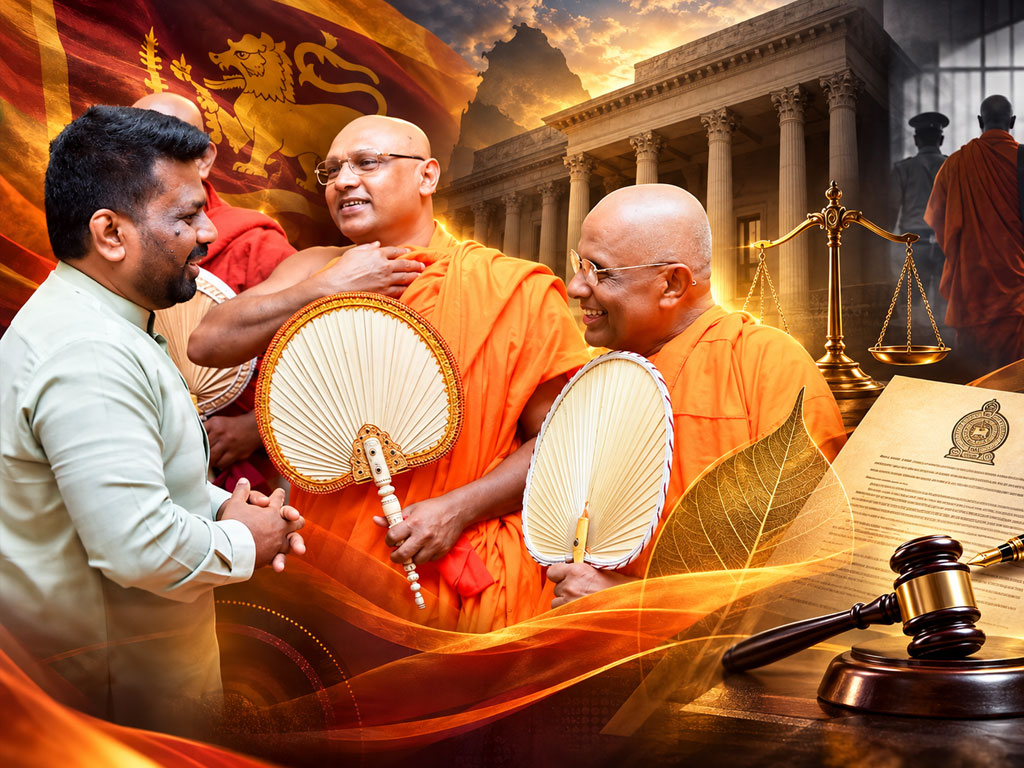
Gnanasara Thero prison regulations will be reviewed by a special committee after concerns over producing Buddhist monks in court without robes.
COLOMBO — President Anura Kumara Dissanayake has ordered the appointment of a special committee to review and amend prison regulations governing the detention of Buddhist monks, following controversy over Ven. Galagodaaththe Gnanasara Thero being produced before court without his robe.
The intervention followed concern expressed by sections of the Maha Sangha and wider public discussion over Gnanasara Thero appearing in court dressed in lay clothing after his robe had been removed.
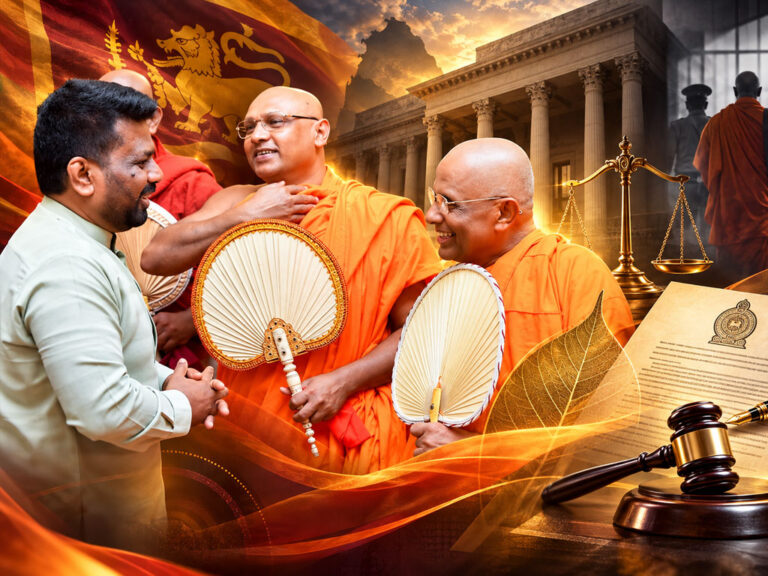
Taking those concerns into account, the President convened a special discussion at the Presidential Secretariat with senior members of the Maha Sangha representing the four main Nikayas.
The meeting focused on whether existing prison laws and regulations should be updated to address the treatment of Buddhist monks while in custody and when they are taken outside prison for court proceedings or other official purposes.

Two-Week Deadline for New Recommendations
Dissanayake instructed officials to expedite a review of the existing legal and regulatory framework relating to the detention of Buddhist monks.
A special committee is to be appointed comprising senior representatives of the Attorney General’s Department, the Ministry of Justice, the Ministry of Buddhasasana, the Ministry of Public Administration and the Department of Prisons.
The President set two principal requirements:
- Time limit: The committee must submit its report containing proposed amendments to the President within two weeks.
- Consultation with the Sangha: The recommendations are to be presented to the Maha Sangha, with the final regulations to be drafted after taking their views and agreement into consideration.
The proposed process is intended to replace ad hoc administrative decisions with a formal legal framework governing how Buddhist monks are treated while in State custody.
“I Am By No Means Prepared to Make My Wish Into Law”
During the discussion, the President referred to the existing legal framework and said prison officials had acted under the general law contained in the Prisons Ordinance of 1877.
On that basis, he said officials should not be blamed for following the law as it currently stands.
Dissanayake nevertheless stressed that, where existing law is no longer appropriate, the proper response should be to amend it through established legal procedures rather than issue personal directions from the Executive.
“When laws exist, I do not like to give orders saying do it this way. Even if in ordinary politics it is said that law is the ruler’s wish, I am by no means prepared to make my wish into law. If the law does not suit the present, what should be done is to amend it through the proper procedure.”
His position places the emphasis on institutional reform rather than a one-off presidential instruction applying only to the present controversy.
Fundamental Rights Petition Filed in Supreme Court
The dispute has also reached the Supreme Court.
Retired Air Force officer Shantha Jayatilaka has filed a fundamental rights petition seeking an order directing prison authorities to produce Ven. Gnanasara Thero in his robe when he is brought before court in connection with other cases.
The Commissioner General of Prisons, the Secretary to the Ministry of Justice and the Attorney General have been named as respondents.
The petition introduces a separate legal dimension to the debate, with the courts now being asked to consider the treatment of an ordained Buddhist monk in custody.
No determination on the petition is stated in the supplied material.
Silent Protest Held in Balapitiya
Public reaction has also extended beyond legal proceedings and discussions between the Government and Buddhist clergy.
A silent protest was held in the centre of Balapitiya in the Southern Province over the treatment of Gnanasara Thero.
Members of the local Shasanarakshaka Balamandala and area residents participated in the demonstration.
The protest reflected the sensitivity surrounding the Buddhist robe and the symbolic significance attached to the treatment of members of the Sangha while in State custody.
Reform Instead of Temporary Intervention
The controversy has brought into focus the interaction between ordinary prison law and religious tradition.
The President’s approach, as outlined at the meeting, is to address the issue by reforming the applicable legal framework rather than overriding existing regulations through an individual political order.
That distinction could become important beyond Gnanasara Thero’s case.
Any amended regulations would potentially establish a uniform procedure governing Buddhist monks held in prisons and produced before courts or other authorities in future.
The next significant step will be the committee’s report, which is due within two weeks.
Its recommendations will then be placed before the Maha Sangha before the proposed new rules are finalised.