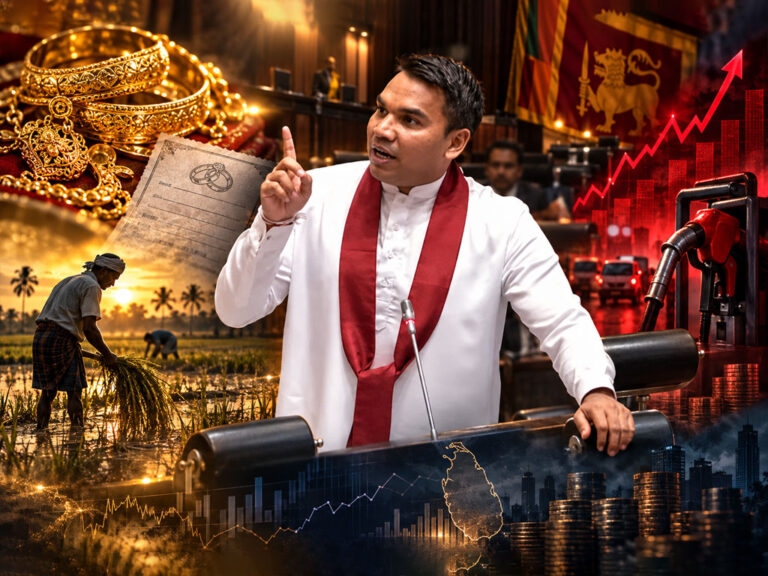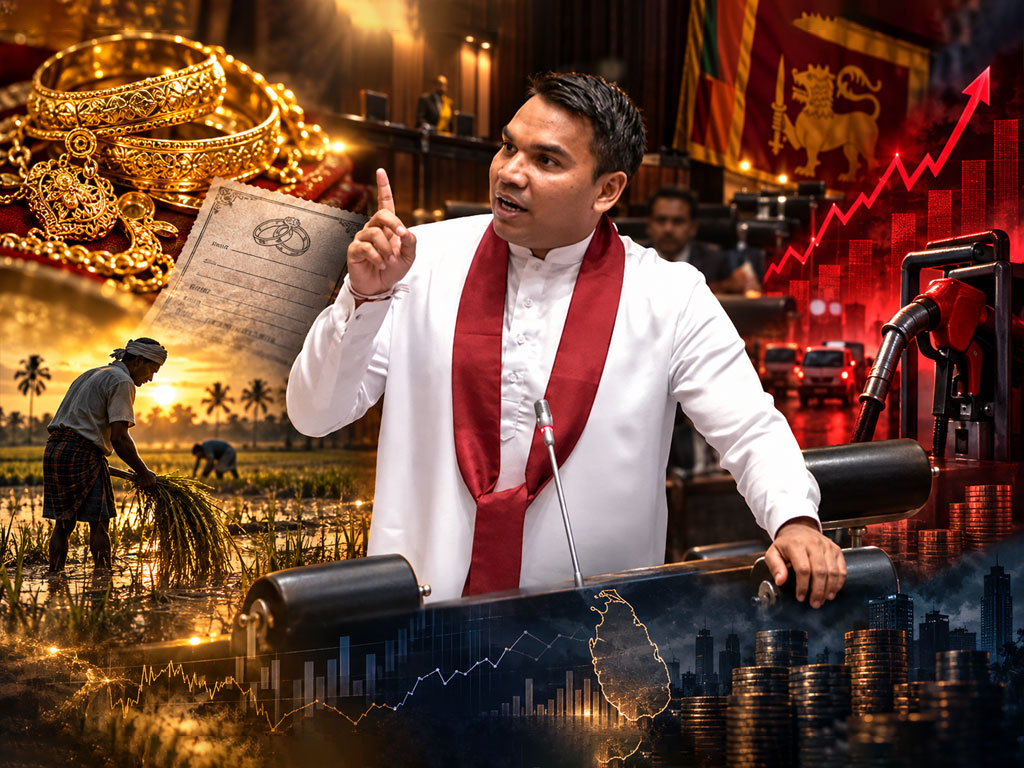
Namal Rajapaksa says pawned gold worth nearly Rs. 150 billion reflects the economic pressure facing Sri Lankan families, farmers and workers.
COLOMBO — Opposition MP Namal Rajapaksa has told Parliament that Sri Lankans have pawned gold jewellery worth nearly Rs. 150 billion, arguing that the scale of pawning reflects the financial strain faced by households despite signs of broader economic stabilisation.
Rajapaksa drew a comparison between the value of pawned jewellery and an IMF loan instalment, using the figure to highlight what he described as a widening gap between macroeconomic recovery and the financial reality confronting ordinary families.
His remarks came during a heated parliamentary exchange over farmers, fishermen, daily wage earners, fuel prices, healthcare and the cost of living.
The figures and allegations cited during the debate were presented by the opposition and were not independently substantiated in the source material supplied for this article.

Rs. 150 Billion in Gold Pledged for Cash
Rajapaksa said people had pawned jewellery worth nearly Rs. 15,000 crore, equivalent to approximately Rs. 150 billion, or around USD 500 million according to the figures cited in Parliament.
He argued that pawning household gold had increasingly become a last source of liquidity for families struggling with debt, rising living costs and weak income growth.
For many lower-income and lower-middle-income households, jewellery can function as an emergency financial reserve. Pawning it may provide immediate cash for food, education, medical bills, debt repayments or other urgent expenses.
The opposition used the figures to question whether the benefits of economic stabilisation were reaching people at household level.
It also accused the Government of giving greater attention to large commercial interests while rural communities and indebted families continued to face financial hardship.
Imported Rice During the Harvest Draws Criticism
Agriculture featured prominently in the parliamentary debate, with the opposition raising several concerns over farmers and the domestic rice market:
- Rice imports: The opposition alleged that about 400,000 metric tonnes of rice were imported while local farmers were harvesting their crops, placing additional pressure on domestic producers.
- Paddy sales and fertiliser: Concerns were raised over alleged delays in payments for paddy supplied to Government warehouses and financial pressure on small-scale mill owners.
- Promises and reality: Opposition MPs argued that earlier assurances that rice imports would be halted had not been fulfilled.
The criticism centred on whether import policy, purchasing arrangements and agricultural support were adequately protecting farmers during the local harvest season.
For rural producers, delays in receiving payment can have immediate consequences because money from one harvest often finances the next cultivation cycle.
Fuel Prices and Cost of Living Come Under Fire
Fuel prices were another major point of criticism.
Opposition speakers argued that earlier political assurances to reduce fuel-related taxes and provide relief had not materialised, claiming instead that fuel prices had increased by about Rs. 100.
The debate reflected the continuing sensitivity of fuel prices in Sri Lanka, where transport and energy costs can quickly feed into food prices, household expenditure and business operating costs.
Graduate unemployment was also raised, alongside wider concerns over whether economic recovery was generating sufficient employment opportunities for young people.
Health Sector Shortages Raised in Parliament
The opposition also questioned the state of the public health system, alleging continuing shortages of medicines and pressure on major hospitals.
Rajapaksa referred to notices reportedly seeking donations for institutions including Lady Ridgeway Hospital for Children and Apeksha Hospital.
He alleged that some such notices had subsequently been removed in an attempt to conceal shortcomings in Government funding.
The source material does not independently establish why any notices were removed, and that claim remains an opposition allegation.
Questions over medicine availability and hospital funding nevertheless add another dimension to the broader debate over how Sri Lanka balances fiscal consolidation with essential public services.
Opposition Raises Concerns Over Law and Religious Affairs
The parliamentary exchange also moved beyond economic matters.
Opposition members expressed concern about the Government’s approach to Buddhist clergy, representations made by the Sangha and the application of the law in politically sensitive cases.
They suggested that legal and administrative standards were not always being applied consistently across political groups.
No specific evidence establishing selective enforcement was provided in the source material, so those claims remain political allegations.
The debate nevertheless illustrates how economic grievances are increasingly being discussed alongside broader concerns over governance, law and cultural affairs.
Stabilisation Versus Household Pressure
The central political argument emerging from the debate is the difference between national economic indicators and the financial position of individual households.
Sri Lanka’s economic recovery requires difficult decisions on taxation, spending, debt management and monetary policy.
At the same time, stabilisation at national level does not necessarily mean immediate relief for families facing debt, higher prices or uncertain incomes.
For the Government, the challenge is to preserve the progress made in restoring economic stability while ensuring that farmers, workers and low-income households experience a measurable improvement in living standards.
For the opposition, the scale of jewellery pawning has become a symbol of that unresolved gap.
The political debate is therefore likely to continue not only over whether the economy is stabilising, but over who is actually feeling the benefits of that recovery.