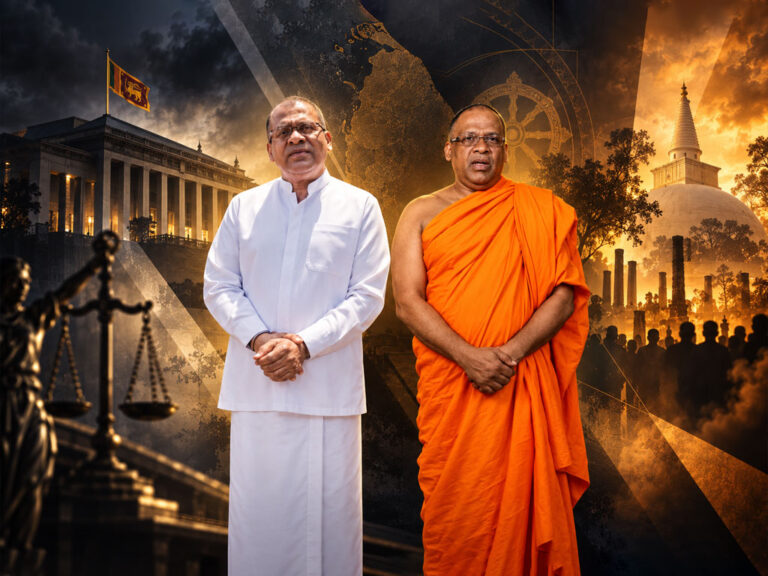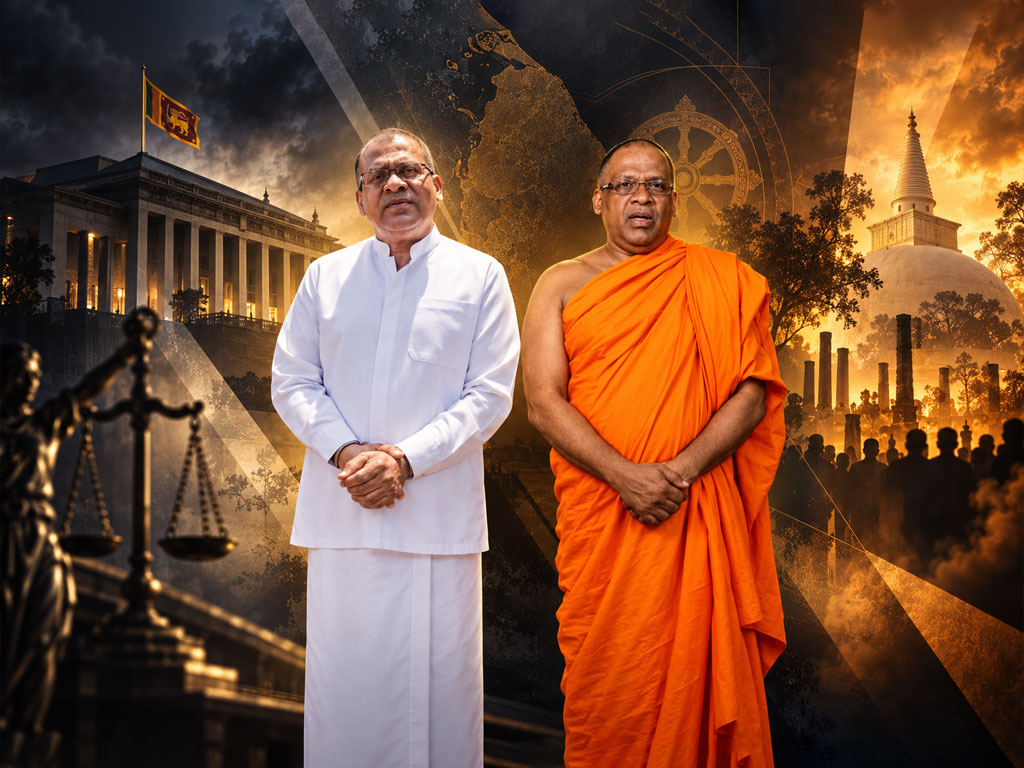
Gnanasara Thero’s imprisonment has revived debate over prison rules, Buddhist clergy, religious symbolism and the State’s treatment of Buddhism.
COLOMBO — The imprisonment of Ven. Galagoda Aththe Gnanasara Thero has prompted renewed debate among sections of Sri Lanka’s Buddhist community over how the State treats members of the clergy, religious symbols and institutions protected under the Constitution.
The argument advanced by those raising these concerns does not dispute that a monk who commits an offence must be subject to the law.
Nor does it suggest that a presidential pardon, if legally defective, should prevent a lawful sentence from being enforced.
Instead, the controversy centres on what supporters of the monk describe as the broader symbolism surrounding his imprisonment, particularly public statements about prison clothing and the removal of his robe.
The supplied commentary argues that such actions should not be viewed in isolation, but as part of what its author sees as a wider pattern involving Buddhism, political power and religious sensitivities.
Many of the claims made in that commentary remain assertions or interpretations rather than independently established facts and should therefore be treated as such.

Prison Rules and the Buddhist Robe
One of the immediate points of controversy concerns statements attributed to the Prisons Department about how Gnanasara Thero would be treated while incarcerated.
The source claims a prisons spokesman publicly stated that the monk’s robe would be removed and that he would be required to wear ordinary prison clothing.
If that is the applicable prison rule, the commentary concedes that the law should be followed.
Its criticism is directed instead at the decision to publicise the matter and the message some Buddhists may interpret from such an announcement.
The robe occupies a deeply significant place in Theravada Buddhist tradition. Any State action involving it therefore carries symbolism that extends beyond an ordinary administrative decision.
That does not mean prison regulations should automatically be suspended for ordained clergy.
It does mean officials handling such matters should recognise the sensitivity surrounding religious dress and communicate decisions with restraint.
Law Must Apply Equally
At the centre of the debate lies a basic principle.
If Gnanasara Thero has committed contempt of court or any other offence, he is subject to the law like any other citizen.
Likewise, if a previous presidential pardon was found to have been granted improperly, the resulting legal consequences must be determined through the courts.
Religious status cannot provide immunity from criminal or judicial accountability.
At the same time, equal treatment under the law does not require the State to communicate enforcement decisions in a manner that unnecessarily inflames religious sentiment.
The challenge is therefore to maintain the authority of the law while avoiding political or religious theatre.
Supporters See a Wider Pattern
The source commentary goes beyond the immediate imprisonment and presents a series of incidents that its author believes demonstrate a broader deterioration in the State’s relationship with Buddhism.
Among the examples cited is an incident in Trincomalee in which police allegedly surrounded a temple at night and removed a Buddha statue.
The commentary also refers to remarks attributed to the country’s political leadership concerning groups travelling to Jaffna to observe sil at Buddhist sites, suggesting that such visits were motivated by communal or political objectives rather than religious devotion.
These examples are presented by the source as connected episodes.
That interpretation remains contested.
Without independent evidence demonstrating coordination or a common policy behind separate incidents, it would be inappropriate to describe them as proof of an organised campaign against Buddhism.
Article 9 and the State’s Responsibility
Sri Lanka’s Constitution gives Buddhism the foremost place while also guaranteeing rights to other religions.
That constitutional arrangement gives the State a particular responsibility to protect and foster the Buddha Sasana while simultaneously preserving religious freedom and equal protection.
The source argues that recent events have caused some Buddhists to question whether the first part of that responsibility is being adequately fulfilled.
It points to political disagreements involving senior Buddhist clergy, constitutional reforms and religious institutions as evidence of growing unease.
Such concerns are legitimate subjects for public debate.
But constitutional protection of Buddhism does not place Buddhist clergy or institutions beyond the reach of ordinary law.
The central issue is whether State institutions are acting consistently, lawfully and without hostility towards any religion.
Questions Over Political Treatment of Buddhist Institutions
The commentary also criticises what it describes as the Government’s handling of representations made by senior Buddhist prelates, including correspondence attributed to the Mahanayake Theros of the Malwatte and Asgiriya Chapters concerning constitutional matters.
Its author argues that dismissing or disregarding the concerns of senior Buddhist clergy contributes to a perception that traditional religious institutions are being marginalised.
That does not mean religious leaders should determine constitutional policy.
Parliament and elected institutions ultimately carry responsibility for legislation and constitutional change.
Nevertheless, governments operating in a society where Buddhist institutions retain substantial cultural influence should expect their treatment of senior clergy to attract close scrutiny.
Claims of Religious Influence Require Evidence
The source makes a further and much more serious allegation that important State, social and economic institutions have increasingly come under the influence of what it calls “Born Again” religious groups.
No evidence establishing such institutional control is provided in the supplied material.
Assertions of this kind require particularly careful treatment because they concern identifiable religious communities and can easily contribute to communal suspicion.
Individuals belonging to any religion may hold senior positions in government, business or public institutions.
Their religious affiliation, by itself, does not establish coordinated control, improper influence or disloyalty to the State.
Any allegation that a religious network has unlawfully captured public institutions would require documentary evidence, specific decisions, identifiable conflicts of interest or other verifiable material.
Without such evidence, it should remain an allegation rather than a conclusion.
Political History and the Sangha
The commentary also invokes Sri Lanka’s history of political conflict and the role of Buddhist monks in periods of upheaval.
It argues that the relationship between political power and the Sangha has repeatedly become contentious when monks enter public or nationalist political debates.
Gnanasara Thero has long been a controversial figure whose public interventions have attracted both strong support and serious criticism.
Supporters regard him as someone willing to speak about issues they believe mainstream politicians avoid.
Critics have accused him of rhetoric that can deepen ethnic and religious divisions.
Those competing perceptions make his imprisonment particularly sensitive.
Every legal action involving him is therefore likely to be interpreted through a wider political and religious lens, even where the immediate issue is a specific court order.
Separate Legal Questions From Political Symbolism
The strongest way to assess the present controversy is to separate three different questions.
First is the legal question: was Gnanasara Thero lawfully convicted and imprisoned under the applicable law?
Second is the administrative question: are prison regulations being applied correctly and consistently?
Third is the political and symbolic question: are State officials handling a sensitive religious issue in a way that unnecessarily aggravates tensions?
Those questions should not be collapsed into one another.
A lawful prison sentence does not automatically prove hostility towards Buddhism.
Equally, the fact that a sentence is lawful does not mean every statement or administrative decision surrounding it is beyond criticism.
Buddhist Concerns Should Not Become Communal Suspicion
The supplied commentary expresses deep anxiety about what it sees as a pattern of disrespect towards Buddhist institutions.
That sentiment may be shared by some sections of society.
It should not, however, be used to cast suspicion on entire religious or ethnic communities.
Sri Lanka’s history shows the dangers of turning political disputes into collective accusations against religious groups.
Concerns about the treatment of Buddhist monks, constitutional obligations or prison procedures can be debated vigorously without portraying Christians, Muslims, Hindus or any other community as inherently hostile to Buddhism.
The same principle applies in reverse.
Criticism of an individual monk or Buddhist political movement should not be presented as hostility towards Buddhism itself.
What the Gnanasara Case Really Tests
The broader significance of Gnanasara Thero’s imprisonment lies in whether Sri Lanka can uphold the law while respecting the religious sensitivities of its majority Buddhist population.
The State should neither provide clerical immunity nor appear to use punishment as a vehicle for humiliating religious symbols.
Officials should explain the applicable prison rules clearly, apply them consistently and avoid unnecessary public spectacle.
Political leaders, meanwhile, should respond to concerns raised by the Buddhist clergy without treating every criticism as extremism.
The public also has a responsibility to distinguish between evidence and suspicion.
Separate political controversies should not automatically be woven together into a single theory without proof.
If the present debate produces anything constructive, it should be a clearer understanding that respect for Buddhism and respect for the rule of law are not competing principles.
They must coexist.