Sri Lanka vehicle imports have cost USD 3.8 billion since restrictions were lifted, reviving debate over reserves, congestion and public transport.
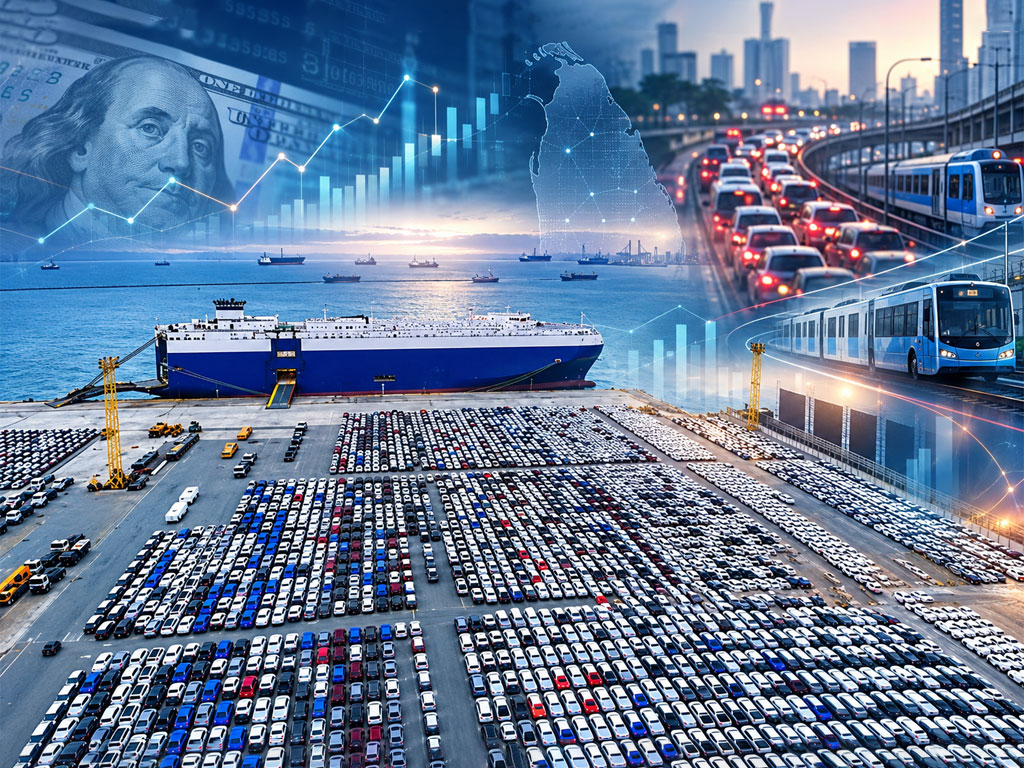
COLOMBO — Sri Lanka has imported more than 800,000 vehicles worth approximately USD 3.8 billion since restrictions were lifted, according to figures presented in Parliament by Deputy Minister of Economic Development Nishantha Jayaweera, reopening a wider debate over whether the country’s scarce foreign exchange is being directed towards the most productive areas of the economy.
Jayaweera told Parliament on October 6 that Letters of Credit worth around USD 1.9 billion had been opened for vehicle imports during 2024 and 2025, while another USD 1.69 billion in LCs had been opened during 2026.
He also sought to counter concerns over pressure on foreign reserves, saying Sri Lanka currently maintains reserves of approximately USD 6.9 billion despite the expenditure on imported vehicles. The Government expects reserves to reach USD 8 billion by the end of the year.
Those figures demonstrate that the country has regained a degree of foreign-exchange capacity after the economic crisis.
They also raise an important policy question: what kind of transport system is Sri Lanka building with that capacity?

Motorcycles and Cars Dominate 2026 Imports
The composition of imports is particularly revealing.
According to the figures presented by Jayaweera, Sri Lanka has imported more than:
- 79,000 cars
- 12,000 commercial vehicles
- 3,148 buses and vans
- 317,000 motorcycles
- 40,000 three-wheelers
during 2026.
The pattern was broadly similar in 2025, when more than 90,000 cars, 11,000 commercial vehicles, 2,185 buses and vans, 225,000 motorcycles and 22,000 three-wheelers were imported.
Motorcycles and three-wheelers cannot simply be dismissed as luxury consumption. In Sri Lanka, both categories are extensively used for commuting, delivery services, self-employment and small businesses.
Likewise, cars serve legitimate household and commercial needs.
The policy concern is therefore not that private vehicle ownership is inherently undesirable.
It is whether the scale and composition of imports are consistent with a long-term national transport strategy.
USD 3.8 Billion Is a Significant Foreign Exchange Outflow
Every imported vehicle requires foreign currency, whether payment is made immediately or through a Letter of Credit.
That does not mean the entire USD 3.8 billion should be characterised as money wasted.
Vehicle imports generate tax revenue, support dealerships and related businesses, replace ageing vehicles, facilitate mobility and contribute to commercial activity.
Yet USD 3.8 billion remains a substantial foreign-exchange commitment for an economy that only recently emerged from an acute balance-of-payments crisis.
The relevant question is therefore one of opportunity cost.
Could a greater share of the country’s available foreign exchange and investment capacity have been directed towards public transport, productive machinery, export-oriented industries, logistics infrastructure or other sectors capable of generating longer-term economic returns?
That is a legitimate debate, particularly when private vehicle numbers are increasing much faster than visible improvements in mass transit.
Public Transport Numbers Tell a Different Story
Only 3,148 buses and vans were reported among the vehicles imported so far in 2026.
That category should be interpreted cautiously because vans are not necessarily public-transport vehicles and the figures alone do not establish how many buses entered regular passenger service.
Even so, the contrast with 317,000 motorcycles, 79,000 cars and 40,000 three-wheelers is striking.
Sri Lanka’s transport problems cannot be solved simply by importing more buses either.
Effective public transport requires route planning, reliable timetables, safer vehicles, integrated ticketing, railway modernisation, bus-priority systems and better connections between different modes of transport.
A modern transport policy therefore requires more than counting vehicles.
It requires deciding whether the system encourages people to depend on private transport because public alternatives remain inadequate.
More Vehicles Could Intensify Congestion
Sri Lanka’s major urban centres already experience severe congestion during peak periods.
Adding hundreds of thousands of vehicles to the national fleet without corresponding improvements to road management and mass transit is likely to increase pressure on existing infrastructure.
More vehicles do not automatically translate into economic progress if commuters spend longer periods trapped in traffic.
Congestion has economic costs through lost working hours, increased fuel consumption, slower freight movement and greater wear on roads.
It also affects quality of life.
Colombo and its surrounding suburbs already illustrate the difficulty of accommodating steadily rising private vehicle ownership on a road network whose physical capacity cannot expand indefinitely.
The Government’s vehicle-import policy should therefore be considered together with urban planning, road development and public-transport reform rather than as an isolated trade decision.
Imported Vehicles Also Create a Second Dollar Demand
The foreign-exchange impact does not end when a vehicle enters the country.
Petrol and diesel consumption subsequently create recurring demand for imported petroleum products.
Vehicle maintenance can also require imported tyres, components, lubricants and spare parts.
Newer vehicles may be more fuel-efficient than the ageing vehicles they replace, meaning the effect is not necessarily a simple one-for-one increase in fuel demand.
Electric vehicles could also reduce direct petroleum consumption, although they create different infrastructure and energy requirements.
Nevertheless, rapid growth in the national vehicle fleet has long-term foreign-exchange implications that extend beyond the initial import bill.
Those costs should form part of any serious assessment of transport policy.
Environmental Costs Cannot Be Ignored
The expansion of private vehicle ownership also has environmental consequences.
Internal-combustion vehicles contribute to carbon emissions and urban air pollution, while congestion can increase fuel consumption through prolonged idling and inefficient stop-start driving.
Sri Lanka’s contribution to global greenhouse-gas emissions is relatively small, but that does not make local transport pollution irrelevant.
Air quality, noise, road safety and the use of urban space all form part of the environmental cost of a transport system increasingly dependent on private vehicles.
Many developed cities are responding to similar pressures by investing heavily in mass transit, cycling infrastructure, pedestrianisation and policies designed to reduce unnecessary private-car use in dense urban areas.
Sri Lanka need not copy those models mechanically.
It should, however, recognise the direction in which modern urban transport planning is moving.
Strong Reserves Do Not End the Policy Debate
Jayaweera’s reference to approximately USD 6.9 billion in reserves is important.
It demonstrates that large-scale vehicle imports have not, by themselves, produced an immediate collapse in the country’s reserve position.
The Government also expects reserves to rise to USD 8 billion by the end of 2026.
That is relevant when assessing claims that reopening vehicle imports would automatically recreate the foreign-exchange crisis.
But reserve adequacy and investment efficiency are separate questions.
A country can have enough foreign exchange to permit a particular import while still asking whether that expenditure supports its longer-term economic objectives.
The debate should therefore move beyond whether Sri Lanka can afford to import vehicles today.
The more difficult question is whether its transport policy reduces or increases the economy’s dependence on imported vehicles and imported fuel over the next decade.
Bimal Rathnayake Faces a Larger Transport Challenge
Transport Minister Bimal Rathnayake now has an opportunity to address that broader structural question.
Sri Lanka does not need to eliminate private transport, nor would such an approach be realistic.
What it does need is a credible alternative.
A commuter will not abandon a motorcycle or car merely because policymakers say public transport is preferable.
People shift to buses and trains when those services are safe, reliable, clean, predictable, affordable and faster than driving.
That requires sustained investment rather than temporary campaigns.
The Government’s challenge is therefore to ensure that renewed access to private vehicles does not become a substitute for reforming the public system.
Vehicle Imports Are Not Development by Themselves
The return of vehicle imports can be seen as one indicator of economic normalisation.
For several years, Sri Lankans faced severe restrictions imposed during an extraordinary foreign-exchange crisis. Restoring access to vehicles removes one of those emergency controls and gives consumers greater freedom.
But the number of vehicles entering the country should not itself be treated as a measure of development.
Development is better judged by whether people and goods can move efficiently, affordably and safely.
If hundreds of thousands of new vehicles enter an already congested transport network while buses, trains and urban mobility remain inadequate, economic recovery may simply produce a larger traffic problem.
The USD 3.8 billion import figure should therefore be viewed neither as proof of Government success nor as evidence of automatic economic failure.
It should be treated as a signal that Sri Lanka has reached the point where it must decide what kind of transport future it wants.
A country recovering from its worst economic crisis cannot afford to confuse purchasing power with productivity.
The real achievement will come when Sri Lankans have genuine transport choices, rather than being compelled to buy private vehicles because the public system has failed to provide them.