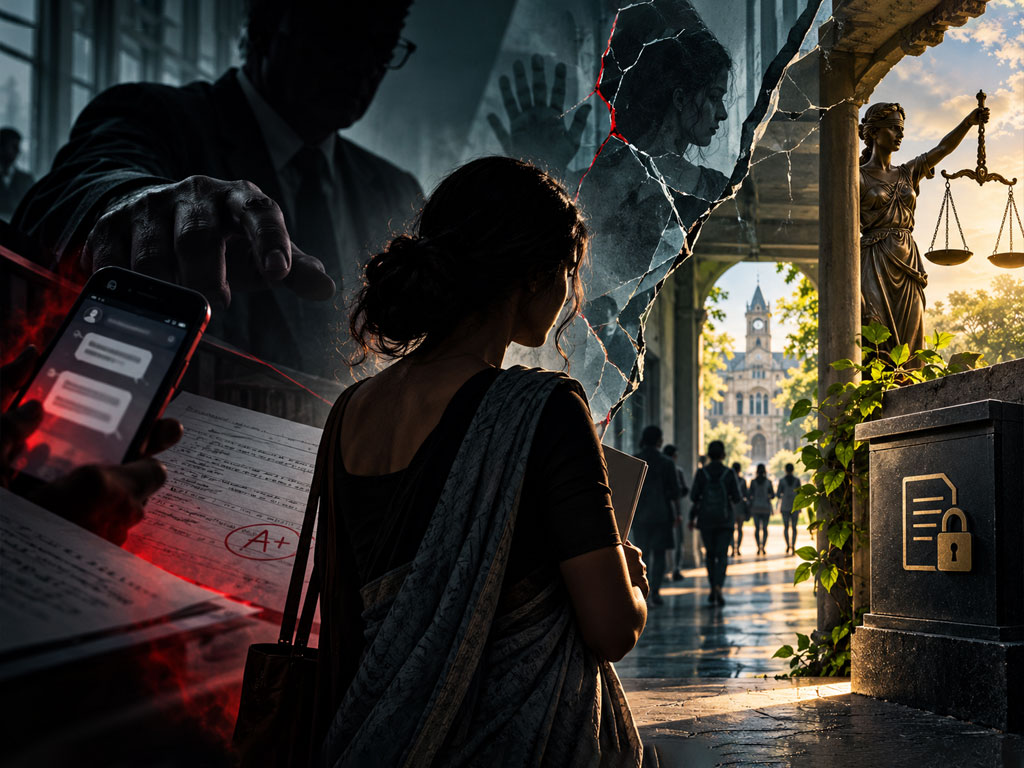
A senior female public official has revealed an alleged university sexual harassment ordeal, calling for confidential complaints and independent safeguards.
COLOMBO — A senior female public official has spoken publicly, on condition of complete anonymity, about an alleged sexual harassment ordeal she says she endured as a university student, describing years of fear and psychological distress while calling for stronger safeguards to protect students from abuse of academic power.
Her decision to speak followed recent reporting by HariDeshaya.lk on allegations of sexual harassment and the misuse of marks at the Addalachchena National College of Education.
Shortly after reading that report, she contacted the journalist responsible and requested a private meeting.
Her condition was unequivocal: her identity, position and other details that could expose her must remain confidential.
The Morning Telegraph is therefore withholding identifying information that could reasonably reveal who she is.
The allegations contained in her account have not been independently established through a court finding or formal investigation. The lecturer she refers to is not identified in the material supplied for publication.
What follows is her account of an experience she says remained unspoken for years.

“I Need to Tell My Story”
The woman said she contacted the journalist after recognising in the Addalachchena allegations the same fear and helplessness she says she experienced as a student.
“I read the article in HariDeshaya. I need to meet you. I need to tell my story, but only on one condition. Can you swear that my name, village and position will never come out?” she said.
Today, she occupies a senior position within Sri Lanka’s public administration and participates in high-level policy work.
Yet during the private meeting, she said the outward image of professional success concealed a trauma she had carried for years.
“Everyone only sees this uniform of mine, little brother, but inside this saree there is still a great fire burning. I have suffered a suffering,” she said.
A Childhood Built Around Sacrifice
Her account began not at university, but with the sacrifices she says her parents made to educate her.
She described growing up in a financially struggling rural household where her father survived through manual labour and her mother prepared food before dawn to sell to local shops.
“Father spent the whole day carrying cement for masons. All father had on his two hands were cracked calluses. Mother got up at three in the morning, made appa and indi appa, boiled them and gave them to the village shops, and that is how she bought books for me,” she recalled.
Education became, in her account, the route through which she hoped to repay those sacrifices.
She said she excelled at school, performed strongly in national examinations and eventually secured admission to a leading university in Colombo.
Financial hardship continued after entering university.
Unable to comfortably meet boarding and food expenses, she said she worked part-time and sometimes avoided travelling home during holidays to save bus fare.
“I wanted to do justice to my father’s hard work,” she said.
An Avurudu Kumari Contest Changed Her Campus Experience
Her early university years, she said, were already difficult.
She alleged that a senior student persistently pressured her and that she felt socially isolated after rejecting his advances.
She later entered an Avurudu Kumari pageant after encouragement from other students and finished as second runner-up.
At the time, she said, the result was celebrated by her peers.
Looking back, however, she believes the attention that followed changed the way one lecturer viewed her.
“Everyone said it was a pride for our batch and the campus. But God, I never even dreamed that that victory would become a curse that came to destroy my entire life,” she said.
Lecturer Allegedly Sent Pornographic Videos
The most serious allegations concern a married lecturer whom she approached for help with an academic lesson and a paper she had not understood.
According to her account, the lecturer told her that relevant notes were at his home and asked for her WhatsApp number so he could send her photographs of the material.
She said she provided the number believing the request was connected solely to her studies.
What arrived that night, she alleged, was something entirely different.
“That night at midnight, the message that came to my phone was not notes, little brother, disgusting, heartless pornographic videos,” she said.
She said she immediately deleted the material and told the lecturer not to send such content again.
According to her account, the unwanted behaviour did not stop.
No documentary evidence of those alleged messages was included in the material supplied for this article.
“If You Tell Anyone, I Will Fail You”
Her account then describes what she says became a physical confrontation on campus.
One evening after lectures, while studying alone under a tree, she alleges that the lecturer approached and sat beside her.
When she attempted to leave, she says he grabbed her hand and forced her to sit down.
“He put his hand on my body and tried to behave obscenely. When I pushed his hand away and tried to shout, he leaned into my face and threatened me,” she said.
She recalls the alleged threat in stark terms:
“Don’t shout. If you tell anyone about this, I will not give you a single mark for the exam. I will fail you and throw you out of campus. Understood?”
The account illustrates a central concern in sexual harassment allegations involving educational institutions: the possible use of academic authority, grades or progression as leverage over students.
Whether that occurred in this case has not been independently verified.
Fear of Losing Her Education Kept Her Silent
She said her immediate instinct was to report what had allegedly happened.
Instead, fear took over.
Her thoughts returned to her parents, the years of financial hardship and the possibility that speaking out could destroy the education for which they had sacrificed.
“My whole world went dark. I wanted to shout and gather the whole campus. Run to the police. But in the next second, I remembered my innocent mother and father waiting for me to return,” she said.
She also feared social stigma.
“What would happen if I shouted? The lecturer would escape. The villagers would point fingers at me, saying, ‘That girl went to campus and danced with a lecturer.’ My degree would be lost. What would happen to the money my father earned carrying cement? I would have no tomorrow.”
She said she returned to her boarding house and cried alone.
“Coming to the boarding house, I opened the tap in the bathroom and shouted and cried. Not because of that cowardice, little brother, because of this wretched system.”
Trauma Followed Her Into Professional Life
Years later, the student who says she once felt powerless has become a senior public official.
Professional achievement, she said, did not erase the experience.
She told the journalist that she had never previously disclosed the alleged incident even to some of the people closest to her.
“I have not told this truth to anyone in my life until today,” she said.
“I did not tell my mother and father then. I have not told even my beloved husband, who is like my life, today. I am ashamed. I am afraid. But the mental suffering I endured from that day until today, only I understand.”
She described continuing physical reactions when memories of the alleged encounter return.
“When I am alone at night, when that past comes to mind, even today my chest pounds. I tremble. That fear is still inside my mind.”
Her account should not be interpreted as a clinical diagnosis. It is her description of the continuing psychological impact she attributes to the experience.
Addalachchena Allegations Prompted Her to Speak
The recent allegations involving the Addalachchena National College of Education, she said, persuaded her that continued silence was no longer acceptable.
“I realised, little brother, that I cannot hide this inside my heart and live any longer alone,” she said.
She asked for the story to be published without exposing her identity.
“Please, little brother, write this story. It is okay if my name is not there, do not make me public, but write the truth inside these tears.”
Her intention, she said, was not merely to recount her own experience but to draw attention to students who may still feel unable to complain when the person they accuse exercises authority over examinations, grades or their academic future.
“I wanted to make this public because after seeing the Addalachchena incident, I felt that what happened to me was the same thing,” she said.
“That insecurity, that helplessness I suffered, is still being suffered today by my innocent little sisters in our universities and science faculties.”
Her appeal was simple: “Break this silence.”
Power Imbalance at the Heart of the Concern
The allegations described in her testimony raise a broader institutional question extending beyond any single university or lecturer.
Students can be placed in a vulnerable position when the person they accuse of harassment also has influence over marks, examinations, recommendations or academic progression.
A complaint system may exist formally, but students are unlikely to trust it if they believe their identities will become known to lecturers or administrators who can influence their future.
The same concern applies where investigations remain entirely within the institution in which the alleged misconduct occurred.
The anonymous official’s account therefore calls for safeguards that reduce the ability of academic authority to be used, or perceived to be used, as retaliation against complainants.
Appeal to Prime Minister Harini Amarasuriya
The source article directs a specific appeal to Prime Minister and Minister of Education, Higher Education and Vocational Education Dr. Harini Amarasuriya.
It calls for intervention at national level to establish stronger mechanisms for students who report sexual harassment, intimidation or the alleged misuse of academic marks.
Three proposals were specifically advanced:
- Introduce an independent national digital complaint mechanism capable of protecting the identity of students who report harassment or abuse.
- Introduce a mandatory independent second-marking mechanism where necessary to reduce the possibility of academic marks being used to intimidate or retaliate against students.
- Ensure allegations of serious misconduct are examined through an external and independent investigative mechanism rather than relying solely on relationships and structures within the institution concerned.
Each proposal would require careful legal, administrative and academic design.
Confidentiality mechanisms, for example, must protect complainants while also ensuring due process for those accused. Independent marking would require clear procedures governing when a second assessment is triggered, while external investigations would need defined powers and safeguards.
A Complaint Must Not Become a Conviction
Sexual harassment allegations require both seriousness and fairness.
Students must have credible mechanisms through which they can report abuse without fearing academic retaliation.
At the same time, allegations cannot be treated as proof of guilt before evidence is examined and the person accused is given an opportunity to respond.
That balance is precisely why independent systems matter.
A credible framework protects complainants from intimidation while protecting accused individuals from trial by rumour.
In the anonymous official’s account, the absence of such confidence was decisive. She says she remained silent because she believed reporting the lecturer could cost her education, reputation and family’s sacrifices.
Whether every element of her account can now be independently established after so many years is another question.
Its institutional message, however, is clear.
A student should never have to choose between reporting alleged sexual misconduct and protecting her academic future.
For the woman who finally decided to speak, professional success did not eliminate the memory of the fear she says she experienced as a young undergraduate.
Her request now is that the next student who confronts such a situation should have somewhere safe, independent and trusted to turn.
SOURCE:- HARI DESHAYA