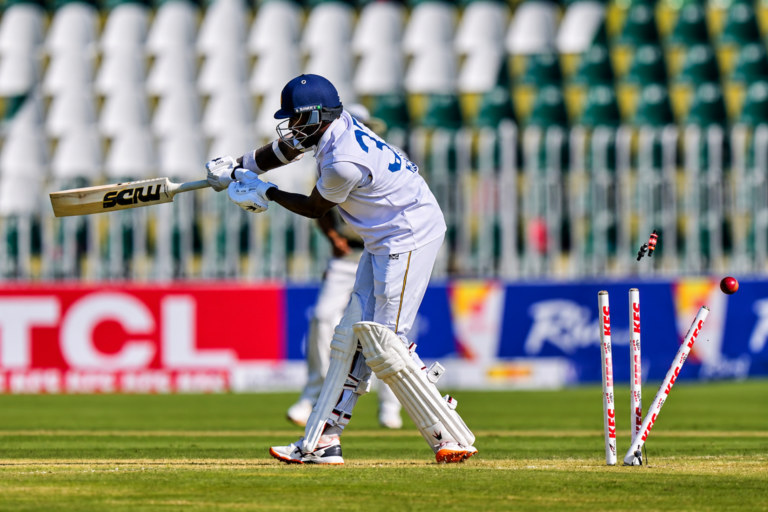
By Dwayne Ferreira
Penalty costs Sri Lanka more points than a Test victory is worth, raising serious questions about discipline and match management.
COLOMBO, November 17, 2026 — Sri Lanka’s hopes of climbing the ICC World Test Championship standings have suffered a devastating setback after the International Cricket Council deducted 15 points for maintaining an excessively slow over-rate during the opening Test against Pakistan in Rawalpindi.
The punishment, announced on Tuesday, is particularly damaging because it exceeds the 12 points awarded for winning a Test match, effectively wiping out more than the equivalent of an entire Test victory.
Pakistan were also penalised, losing five championship points for their own slow over-rate.

Sri Lanka Plunge to Eighth in Championship Standings
The consequences for Sri Lanka have been immediate and severe.
Before the penalty, Sri Lanka occupied seventh position with a points percentage of 33.33%. Following the deduction, that figure has collapsed to approximately 15.48%, pushing the island nation down to eighth in the nine-team championship.
Pakistan remain at the bottom of the standings in ninth place, with a points percentage of just 3.33%.
The development represents a substantial setback for Sri Lanka’s ambitions of qualifying for the 2027 World Test Championship final.
Under the championship’s points system, teams receive 12 points for a victory, four for a draw and none for a defeat. Championship positions are determined by the percentage of available points earned rather than simply the number of victories.
Sri Lanka’s 15-point penalty is therefore equivalent to forfeiting almost four drawn-Test results.
How Did Sri Lanka Lose 15 Points?
The ICC determined that Sri Lanka had fallen 15 overs short of the required bowling rate during the first Test, even after allowances for legitimate interruptions had been considered.
Pakistan were found to be five overs behind the required rate.
Under the World Test Championship playing conditions, teams lose one championship point for every over they fall short.
The penalties did not end there.
Sri Lankan players were fined 50% of their match fees, while Pakistani players received fines amounting to 25%.
Dean Cosker of the Emirates ICC International Panel of Match Referees imposed the sanctions following charges brought by match officials Adrian Holdstock, Rod Tucker, Allahuddien Paleker and Faisal Afridi.
Sri Lankan captain Kusal Mendis and Pakistan captain Babar Azam admitted the offences and accepted the proposed punishments, eliminating the need for formal disciplinary hearings.
Strong Batting Performance Overshadowed
The penalties have overshadowed what had been a determined Sri Lankan batting performance in the first Test, which ended in a draw on November 13.
Pakistan declared their first innings at 434 for nine before Sri Lanka responded with 446, securing a narrow first-innings advantage.
Dhananjaya de Silva produced an outstanding innings of 167, while Kusal Mendis contributed 119.
Pakistan eventually finished their second innings at 284 for eight, denying Sri Lanka another opportunity to bat and ensuring the match ended without a winner.
However, despite earning four points for the draw, Sri Lanka have now lost 15 points through disciplinary sanctions.
The contrast raises uncomfortable questions about match management and whether the team exercised sufficient control over its bowling rate throughout the five-day contest.
A Second Blow as Sri Lanka Collapse for 98
The announcement came on another difficult day for Sri Lankan Test cricket.
Playing the second and final Test against Pakistan in Rawalpindi on November 17, Sri Lanka were dismissed for just 98 runs in their first innings.
Pakistan reached 121 for three at stumps, taking a 23-run lead and placing the visitors under immediate pressure.
The batting collapse, combined with the championship points deduction, has transformed what was already a challenging tour into a deeply concerning period for Sri Lankan cricket.
Questions Over Discipline and Accountability
While slow over-rates are not uncommon in international cricket, the magnitude of Sri Lanka’s punishment demonstrates how costly failures in match management can become.
A Test team can spend five days battling to secure a victory, only to discover that its championship prospects have been severely damaged by delays in delivering the required number of overs.
Bowling changes, field placements, tactical discussions and the speed at which play resumes between deliveries all contribute to the management of over-rates.
The captain carries a central responsibility for ensuring that the match progresses efficiently, although maintaining the required rate is a collective responsibility.
For Sri Lanka, the issue now goes beyond the financial penalties imposed on players.
The larger concern is how a team attempting to rebuild its reputation in Test cricket could surrender 15 crucial championship points through an avoidable breach of playing conditions.
Sri Lanka can recover runs, wickets and even lost matches. Recovering 15 championship points surrendered without losing a Test is a far greater challenge.