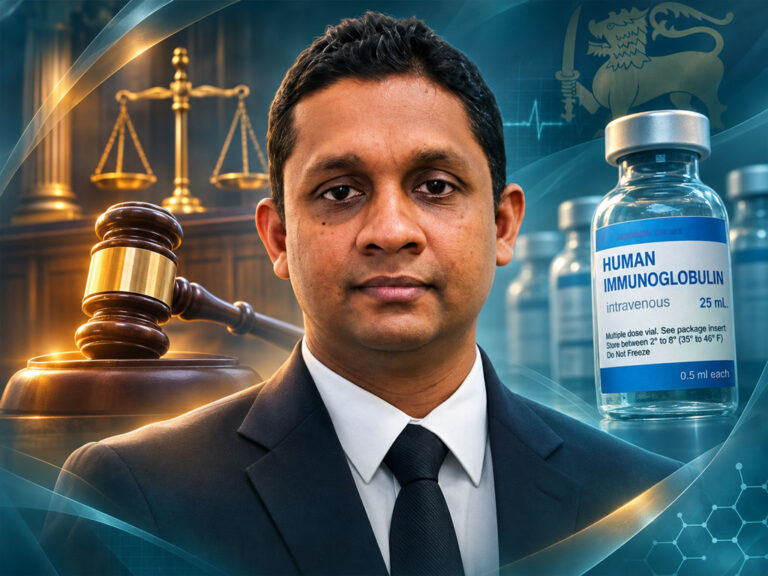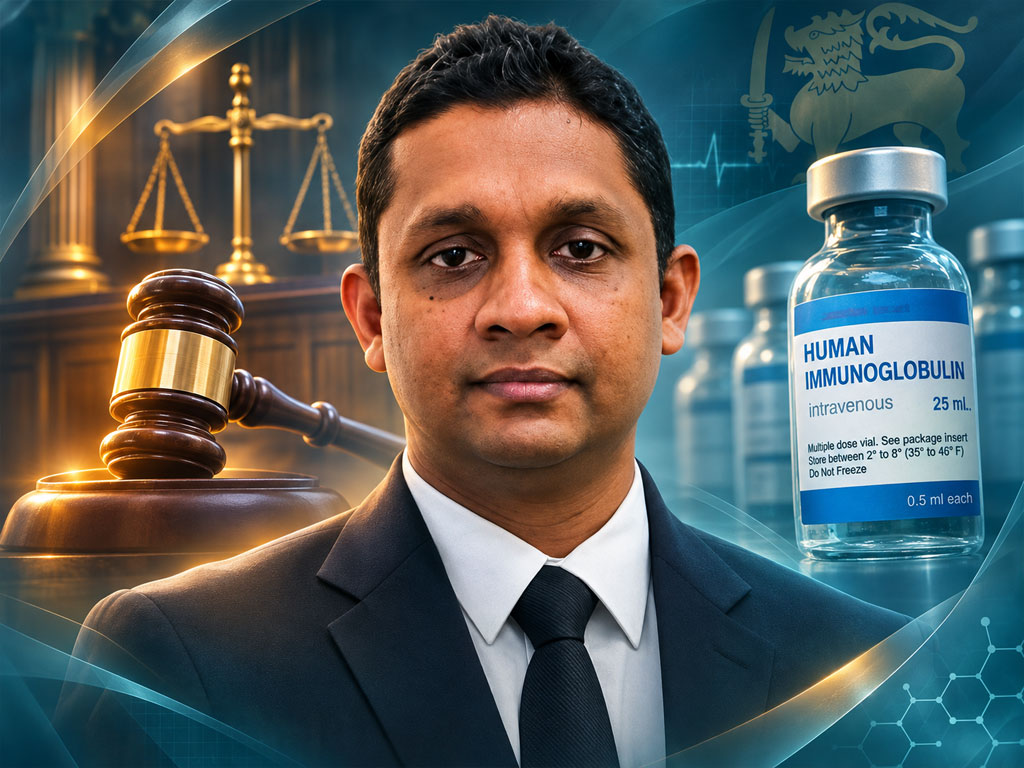
COLOMBO, November 18, 2026 — Former NMRA chief Dr. Vijith Gunasekara has defended his role in Sri Lanka’s disputed immunoglobulin procurement, telling the High Court that emergency regulatory procedures were approved institutionally and that he had no involvement in purchasing the questioned medicines.
Former National Medicines Regulatory Authority (NMRA) Chief Executive Officer Dr. Vijith Ranasinghe Gunasekara has denied involvement in the procurement of the controversial Human Immunoglobulin and Rituximab products, telling the Colombo Permanent High Court Trial-at-Bar that no applications for waivers of registration concerning those medicines were received from the supplier during his tenure.
Gunasekara, identified as the 12th accused in the prosecution concerning the alleged supply of substandard pharmaceutical products to the Ministry of Health, presented a detailed defence statement on November 3, 2026.
His account challenges the suggestion that the emergency regulatory procedures introduced during Sri Lanka’s 2022 economic crisis can, by themselves, establish his responsibility for the disputed purchases.
Appearing before the three-judge bench comprising High Court Judges Priyantha Liyanage, Viraj Weerasuriya and Thilakarathna Bandara, Gunasekara maintained that the NMRA’s function was to regulate pharmaceutical products rather than procure them.
He said the procedures used to accelerate regulatory consideration during the national medicine shortage were developed through official channels and presented to the authority’s governing board.
According to his statement, the board subsequently received regular reports of approvals issued under the temporary arrangements without instructing him to suspend or withdraw the procedure.
His defence also addresses the NMRA’s internal administrative weaknesses, emergency imports, the role of the Ministry of Health, an alleged telephone conversation with a supplier and the procedures followed when adverse reactions to medicines are reported.
The testimony forms part of the defence in a case involving allegations that 6,195 vials supplied as Human Immunoglobulin and Rituximab did not contain the medicines they were purported to contain.
The Attorney General has brought 13 charges against 12 accused, including former Health Minister Keheliya Rambukwella, in connection with the alleged misappropriation of approximately Rs. 144.4 million.
The prosecution’s allegations remain subject to judicial determination.
Gunasekara has denied wrongdoing and requested acquittal.

From Military Hospital Service to Medical Administration
Gunasekara began his statement by outlining a medical and administrative career spanning nearly three decades.
Born in Galle, he attended Richmond College from Grade 1 to Grade 12 before entering the Faculty of Medicine at the University of Sri Jayewardenepura.
During the disruption to university admissions in 1993 and 1994, he briefly worked as a non-executive employee at Sampath Bank.
Following his medical graduation in 1998, he undertook voluntary work at a military hospital while awaiting internship training.
He subsequently chose to complete his internship at Anuradhapura Hospital before receiving his first medical appointment at Kuruluwewa Hospital in the Galenbindunuwewa area.
In his statement, he described the difficulties associated with providing medical services in rural communities and recalled working in military surgical wards during the civil war.
His subsequent service included appointments at Anuradhapura and Ragama hospitals.
After passing the medical administration examination in late 2004, he underwent postgraduate training and began his administrative career in 2007 as Deputy Director of Matara Hospital.
Further appointments followed at Lady Ridgeway Hospital for Children in Colombo, the Galle District health administration and the former Cosmetics, Devices and Drugs Authority, which preceded the establishment of the NMRA.
He also served as Director of the National Blood Transfusion Service and Director of Laboratory Services at the Ministry of Health.
In 2015, he entered the senior medical administrative service and served as Kegalle District Director of Health Services.
During the 2016 Aranayake landslide disaster at Samasara Kanda, Gunasekara said he was involved in coordinating the health-sector response.
He subsequently undertook additional responsibilities relating to the National Blood Transfusion Service.
Between 2019 and 2020, he pursued postgraduate training at the University of Warwick in the United Kingdom, focusing on health economics and regulatory science.
These details formed part of his account of his professional experience and the circumstances leading to his appointment as NMRA chief executive.
They do not, independently, determine the allegations being considered by the court.
Returning to Sri Lanka During the COVID-19 Crisis
A significant part of Gunasekara’s statement concerned his decision to return to Sri Lanka during the COVID-19 pandemic.
According to his account, he had been entitled to remain overseas on approved leave but decided to return early because laboratory services were assuming an increasingly important role in the national response.
He said he travelled on a repatriation flight and resumed his responsibilities as Director of Laboratory Services.
In 2021, following the death of the then director of Apeksha Hospital in Maharagama, the Ministry of Health asked him to assume responsibility for that institution as well.
Gunasekara accepted the additional assignment and temporarily managed responsibilities involving both Apeksha Hospital and laboratory services.
He subsequently applied for the NMRA chief executive position and attended an interview in 2021 but was not appointed at that time.
After serving at the Medical Research Institute in Borella, he was invited to assume the NMRA position in 2022.
He told the court that he was appointed by the authority’s board on July 18, 2022, following the earlier formal selection process.
The appointment coincided with one of the most difficult periods in Sri Lanka’s economic history.
Hospitals were experiencing acute shortages of medicines and medical supplies, while the country’s financial crisis had severely disrupted procurement and import arrangements.
NMRA Faced Years of Administrative Weaknesses, Court Told
Gunasekara described serious administrative shortcomings within the NMRA when he assumed office in July 2022.
The authority had been established under legislation enacted in 2015, but he maintained that important institutional arrangements remained incomplete seven years later.
According to his statement, staff recruitment and the absorption of personnel from the Ministry of Health had not been fully regularised.
He also alleged that essential financial and administrative reporting had fallen significantly behind schedule.
Annual accounts required for parliamentary oversight had reportedly not been submitted for five years.
The institution’s corporate plan remained incomplete, while annual reporting obligations had also been neglected.
Gunasekara argued that these deficiencies affected the authority’s ability to perform its day-to-day responsibilities.
The NMRA was responsible for regulating medicines, medical devices, pharmacies and pharmaceutical manufacturing, all of which required specialised technical and administrative oversight.
According to his account, the governing board generally met once a month, leaving the chief executive responsible for coordinating operational matters and representing the authority at Ministry of Health meetings.
The former CEO said the situation became particularly difficult because regulators were being questioned about shortages arising within a procurement system they did not directly control.
His account distinguishes the NMRA’s statutory responsibilities from those of institutions responsible for purchasing, distributing and maintaining stocks of medicines.
That distinction is relevant to the trial, although the prosecution’s allegations against individual officials must be assessed against the specific duties and conduct attributed to them.
Hospitals Struggled to Obtain Basic Medicines and Supplies
Gunasekara recalled the severity of the shortages affecting Sri Lanka’s hospitals during the 2022 financial crisis.
He told the court that even ordinary paracetamol tablets could sometimes be difficult to obtain from private pharmacies.
Medical institutions also faced shortages of basic items, including gauze and bandages needed for wound care.
The situation placed considerable pressure on public health administrators, regulatory authorities and institutions responsible for supplying medicines.
According to his statement, officials attending Ministry of Health meetings frequently questioned the NMRA about the availability of urgently required products.
Gunasekara emphasised that the authority was not responsible for purchasing medicines.
Its role concerned the registration, quality regulation and authorisation of pharmaceutical products entering the market.
He said procurement agencies, including the State Pharmaceuticals Corporation, repeatedly attributed import delays to regulatory procedures and the time required to issue waivers of registration.
The shortages, he argued, placed pressure on the authority to consider ways of processing legitimate requests more quickly without abandoning essential regulatory requirements.
This was the context in which the NMRA introduced a temporary procedure intended to facilitate the importation of urgently needed products.
September 2022 Proposal for Emergency Regulatory Approvals
On September 2, 2022, Gunasekara sent an official letter to the Secretary of the Ministry of Health proposing a special regulatory arrangement.
According to his statement, the proposed procedure was intended to operate for six months and assist approved organisations involved in supplying urgently required medicines to Sri Lanka.
International donors, foreign governments and multilateral institutions were supporting the country’s health system during the crisis.
Those institutions included the World Health Organization, World Bank and Asian Development Bank, together with other organisations providing financial assistance or pharmaceutical donations.
Gunasekara explained that delays in regulatory processing could prevent donated medicines from being cleared and distributed when hospitals urgently required them.
His proposal contained two principal measures.
First, he sought approval for a special process through which waivers of registration could be considered, where necessary, for essential medicines that were not already registered in Sri Lanka.
Second, he proposed providing approved donor organisations with updated information about registered suppliers.
The objective of the second measure, he said, was to encourage procurement from suppliers and products already recognised by the NMRA wherever possible.
According to his explanation, the authority was attempting to reduce supply disruptions while retaining regulatory oversight of products entering the country.
The existence of such a proposal does not establish that every subsequent medicine import was properly authorised.
Each application, recommendation, assessment and approval would still need to be examined against the governing legal requirements.
Ministry Recommendation Required for Registration Waivers
Gunasekara also explained the distinction between a waiver of registration and a conventional medicine registration.
A waiver of registration, commonly referred to as a WOR, permits the importation of a specified product or consignment under defined circumstances without completing the ordinary registration process.
According to his testimony, the special procedure did not remove the requirement for a formal request and supporting documentation.
He maintained that the NMRA required an application accompanied by a recommendation from the Secretary of the Ministry of Health or an authorised Additional Secretary.
The application and associated documents would then be processed within the authority.
Gunasekara said suppliers did not control the internal pathway through which their submissions were evaluated.
He also explained that a waiver was not a reusable licence allowing unrestricted imports.
The relevant authorisation concerned a particular consignment and formed part of the process leading to an import licence issued by the Controller General of Imports and Exports.
Customs clearance depended on the necessary import documentation.
Within the NMRA, applications were examined by officers attached to the medicine regulatory division.
Where deficiencies were identified, officials were required to record observations before forwarding the documents for further consideration.
Gunasekara said applications were subject to internal review before reaching the chief executive for signature and that relevant decisions were also reported to the appropriate committees and governing board.
These were the procedures he described to the court.
Whether they were followed in every relevant instance remains a question for the evidence and the court’s assessment.
Former CEO Says NMRA Board Approved Six-Month Procedure
One of the central arguments in Gunasekara’s defence concerns the governing board’s involvement in the temporary regulatory arrangement.
He told the court that the procedure was introduced following correspondence with the Ministry of Health and consultation with the NMRA chairman.
According to his recollection, the arrangement was presented at the board meeting held on September 16, 2022.
He said the chairman, rather than the chief executive, explained the proposed procedure to board members.
The arrangement was subsequently implemented for an initial period of six months.
Gunasekara maintained that lists of approvals issued through the procedure were regularly presented to the governing board.
He said the documents were returned with endorsements indicating that they had been approved or noted.
During this period, according to his testimony, he received no instruction from the board to discontinue the arrangement, cancel approvals or recall previously issued authorisations.
His defence therefore raises the question of how responsibility should be assessed where a regulatory procedure was introduced through an institutional decision-making process.
Board awareness or approval may be relevant to determining whether the chief executive acted within the scope of his responsibilities.
It would not necessarily resolve questions concerning individual applications, the authenticity of documents or compliance with statutory obligations.
Those matters remain subject to the evidence presented in court.
Emergency Procurement and the EOI Process
Gunasekara’s statement also examined the emergency procurement arrangements adopted by the Ministry of Health as the medicine shortage intensified.
He recalled receiving a telephone call from an anaesthesiologist who described the serious difficulties hospitals were experiencing in obtaining medicines needed for surgical procedures.
According to his account, the doctor explained that certain medicines required during anaesthesia were available while others needed for patient recovery were in short supply.
The episode was presented as an illustration of the pressure facing medical personnel during the crisis.
Gunasekara said the Ministry of Health subsequently pursued an emergency procurement programme using an Expression of Interest (EOI) procedure.
According to the figures he presented, more than 200 pharmaceutical products were considered under that arrangement.
Approximately 170 received procurement committee approval, while the Medical Supplies Division eventually issued purchase orders for around 158.
Copies of relevant letters of acceptance were subsequently forwarded to the NMRA.
Gunasekara maintained that receipt of those documents did not give the authority responsibility for the original procurement decisions.
He further stated that only a comparatively small proportion of the suppliers involved required waivers of registration, as some products were already registered and other suppliers withdrew because of financial or operational difficulties.
His evidence sought to separate the decision to purchase medicines from the regulatory procedures through which particular products might be authorised for importation.
That distinction is central to his defence, but it does not remove the need to examine whether regulatory officials fulfilled their statutory obligations where documentation was presented or irregularities became apparent.
No Waivers Issued for Disputed Medicines, Gunasekara Claims
A particularly important part of Gunasekara’s testimony concerned the two medicines at the centre of the criminal proceedings.
He told the High Court that the NMRA had not received applications from the relevant supplier seeking waivers of registration for either Human Immunoglobulin or Rituximab.
According to his account, after learning of complications involving the disputed Human Immunoglobulin product, he made inquiries through an NMRA officer identified as Nishani Lanka.
He maintained that those checks established that no waiver of registration had been issued by the authority for the product.
He further stated that the supplier had not submitted the formal applications, supporting documents or Ministry recommendations that would ordinarily have been required.
Gunasekara said he had no knowledge of where the disputed waiver documents were produced.
This assertion is one of the most consequential elements of his defence because the investigation involves documents purportedly associated with regulatory authorisation.
Earlier reporting on the procurement controversy identified waiver documents issued in Gunasekara’s name among the records relied upon in the purchasing process.
His denial therefore creates a factual dispute that must be resolved through the original documentation, official registers, witness testimony and other admissible evidence.
If documents bearing an official’s name were created or used without authorisation, their authenticity and origin would be central to the investigation.
Conversely, an absence of a record in one system would need to be evaluated alongside the wider documentary evidence before a definitive conclusion could be reached.
The High Court has not yet delivered its final determination on Gunasekara’s criminal responsibility.
Former CEO Explains 98-Second Supplier Call
Gunasekara also addressed evidence concerning a telephone conversation with the relevant pharmaceutical supplier.
The call reportedly took place at 10:38 a.m. on December 2, 2022, and lasted 98 seconds.
Its existence had been raised during the proceedings.
According to Gunasekara, the supplier initiated the call, rather than the other way around.
He said the purpose was to inquire about the progress of approval relating to a factory.
The former CEO disputed any suggestion that the conversation established his involvement in the procurement of the two questioned medicines.
The call’s date, duration and circumstances are relevant to the factual record, but they cannot independently establish the substance of the conversation or its legal significance.
That assessment depends on the telecommunications evidence, the testimony of those involved and any supporting communications.
Gunasekara’s explanation forms part of his defence and must be considered against the prosecution’s evidence.
September 2023 Adverse Reactions and Regulatory Decisions
Another major section of Gunasekara’s statement concerned the handling of suspected adverse reactions to pharmaceutical products.
He recalled becoming aware on September 20, 2023, of complications reported among patients at hospitals in Matale and Kandy.
According to his testimony, the information reached him through a professional clinical network involving the Medical Research Institute’s Chief Immunologist, Dr. Rajiv de Silva.
Gunasekara discussed how the NMRA assesses suspected adverse drug reactions and determines whether regulatory action is necessary.
He explained that adverse reactions can occur even when a medicine has previously been administered without complications.
As an example, he referred to a patient who might develop an allergic reaction to penicillin despite having received the medicine safely over many years.
His broader argument was that regulators must examine clinical evidence carefully before deciding whether a product should be withdrawn.
The NMRA’s pharmacovigilance system and the Safety and Risk Evaluation Subcommittee, known as SAFRESC, are relevant to that process.
Gunasekara maintained that suspending a medicine without adequate scientific evaluation could create shortages if no suitable alternative was immediately available.
He argued that such decisions could affect large numbers of patients who depended on the product.
There is, however, an important distinction between an unexpected adverse reaction to an authentic medicine and a product suspected of being counterfeit, contaminated or otherwise substandard.
The fact that some legitimate medicines can cause unpredictable reactions does not establish that a questioned product is safe.
Nor does the need to preserve medicine supplies justify continued distribution where evidence establishes an unacceptable risk to patients.
The appropriate regulatory response depends on the available safety information, the seriousness of reported incidents, the product’s authenticity and the potential consequences of continued use.
Gunasekara’s evidence provides an explanation of his claimed decision-making approach. The court must determine whether the actions relevant to the indictment were lawful and appropriate in the circumstances.
Gunasekara Says Proceedings Cost Him His Career
The concluding section of Gunasekara’s defence addressed the personal consequences of the investigation and prosecution.
He told the court that the case had disrupted his professional life and caused substantial damage to his reputation.
According to his statement, he lost his employment and faced widespread public criticism.
Gunasekara argued that much of the discussion surrounding the controversy failed to distinguish pharmaceutical procurement from regulation.
He maintained that the NMRA did not purchase the disputed medicines and that he had no involvement in supplier selection, procurement evaluation or the issuing of purchase orders.
His account also challenged the suggestion that the emergency regulatory pathway could be treated as evidence that he had approved the questioned products.
Gunasekara maintained that neither he nor his staff knowingly issued waivers of registration for the disputed Human Immunoglobulin and Rituximab consignments.
He asked the court to consider the evidence in its proper administrative and legal context and acquit him of the charges he faces.
The personal consequences he described do not establish his innocence, just as the existence of criminal proceedings does not establish guilt.
Both the prosecution and defence are entitled to have their evidence assessed according to law.
Court Must Determine Responsibility for Procurement Decisions
Gunasekara’s statement places the division of responsibility within Sri Lanka’s pharmaceutical regulatory and procurement system at the centre of the proceedings.
His defence rests on several interconnected assertions: that the NMRA did not purchase the disputed medicines, that emergency regulatory arrangements were introduced through official institutional procedures, that the governing board was informed of their operation, and that no valid waiver applications were received from the relevant supplier for the two products involved.
The prosecution, meanwhile, alleges that public funds were dishonestly misappropriated through the supply of thousands of vials that were not the pharmaceutical products they purported to be.
Those competing positions require careful examination of the original documents, regulatory records, the approval process and the conduct attributed to each accused person.
Broader questions about failures in Sri Lanka’s healthcare administration also remain relevant.
The 2022 economic crisis exposed serious weaknesses in pharmaceutical supply chains, procurement planning and institutional coordination.
Yet evidence of systemic shortcomings cannot automatically establish that an individual official committed a criminal offence.
Equally, the existence of wider administrative failures does not necessarily excuse personal misconduct where it is proven.
The defence statement raises important questions about the authenticity of the disputed waiver documents, the scope of NMRA authority and the extent of the governing board’s involvement in emergency regulatory procedures.
It does not establish that the prosecution was politically motivated or that another unidentified individual deliberately manipulated the entire procurement process. Those suggestions would require evidence of their own.
With the defendants’ oral statements concluded on November 3 and the trial moving into its final submissions stage, the court must now assess the allegations against each accused on the evidence presented.
Written submissions are scheduled for November 25, followed by oral submissions on November 30.
The eventual judgment will determine whether the prosecution has proved the charges, while also clarifying how the law applies to the officials involved in the contested procurement and regulatory decisions.
Legal note: This report is based principally on the supplied account of Dr. Gunasekara’s defence statement dated November 3, 2026, in case HC(PTB) 02/01/2025, together with published reporting on the proceedings. The translated testimony has been paraphrased rather than reproduced as independently authenticated verbatim quotations. All findings of criminal responsibility remain for the court.