By Roy Denish.
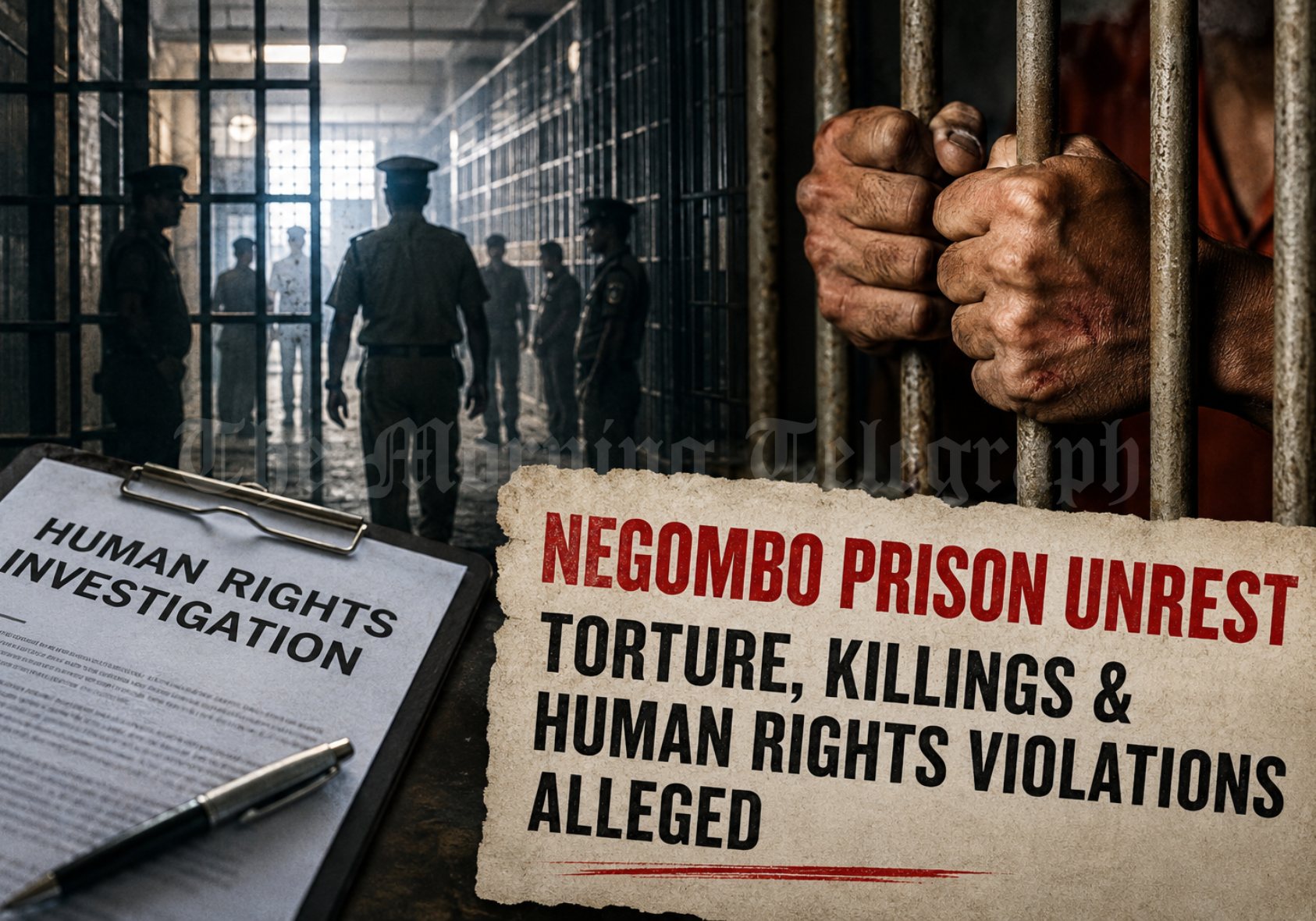
Negombo Prison unrest allegations include torture, extrajudicial killings and administrative failures across Sri Lanka’s prison system.
COLOMBO, Sri Lanka: The Negombo Prison unrest has triggered serious allegations of systematic torture, extrajudicial killings and severe administrative failures across Sri Lanka’s prison system. A prominent prisoners’ rights advocate has challenged the government’s official account and accused authorities of an inhumane and biased campaign of suppression.
Sudesh Nandimal Silva, chief convener of the Committee for Protecting the Rights of Prisoners, has raised allegations about the treatment of inmates during and after the unrest. His claims include severe beatings, suspicious deaths and alleged retaliation against prisoners transferred from Negombo to other facilities.

The initial disturbance began on the evening of the fifth of the month. Silva and a delegation from the rights committee visited the facility at around 8 p.m. By then, a large crowd of anxious relatives, journalists and police officers had gathered outside the prison.
Families remained distressed because prison management had provided no official updates. Senior police officers at the scene told the public that a clash inside the prison had left two inmates dead. However, they insisted that officers had brought the situation fully under control.
Police then directed relatives to a police post, where they could check a list of inmates admitted to hospitals. Silva said he repeatedly tried to contact the commissioner general of prisons and the private secretary to the justice minister.
However, no prison authority came forward to address the waiting families. Police eventually dispersed the crowd.
Negombo Prison Unrest Narrative Challenged
The subject minister and prison officials told Parliament that the initial riot began because of either a dispute over food or a turf war involving rival drug factions. However, Silva cited internal briefings that, he said, revealed a fundamentally different sequence of events the following morning.
Water facilities inside the prison had failed on the morning of the sixth. However, Silva said the true catalyst for the subsequent violence was the arrival of outside prison officers from facilities in Colombo and Wariyapola.
According to Silva, these officers entered the prison wearing civilian sportswear instead of official uniforms. He alleged that they deliberately identified inmates who had caused disruption the previous day and singled them out for punishment.
Internal reports cited by Silva claim that the outside officers forced selected inmates onto their knees and demanded apologies to prison staff. The officers then allegedly attempted to assault them.
Silva said the inmates retaliated only in response to this unauthorized and inhumane treatment. He argued that the absence of casualties among local Negombo Prison staff showed that the inmates directed their retaliation specifically at the outside officers who allegedly initiated the confrontation.
Silva also rejected claims that authorities prevented a catastrophic jailbreak because one officer heroically fired a gun through a window to control 1,500 inmates who were breaking through doors.
Instead, he described the episode as an administrative failure that had placed an international black mark on Sri Lanka.
Drawing on his own experience as an inmate during the 2012 Welikada Prison crisis, Silva recalled how a chief jailor and fewer than 10 experienced officers managed more than 3,000 inmates. He said they brought that situation under control without a single staff injury because they relied on professional prison protocols.
Rights Group Questions Prison Management Response
Silva said the events in Negombo exposed an impulsive and uncoordinated response by personnel who lacked the required training.
He argued that proper intelligence gathering could have helped the prison administration identify and transfer high-risk inmates before the confrontation escalated. Authorities could also have requested early assistance from the police and the Special Task Force, he said.
Police reports, according to Silva, show that prison authorities did not request law enforcement assistance until Monday. That request came a full day after the initial clash began.
Silva described the delay as evidence that the prison administration was operating in the dark. He also accused the minister of avoiding responsibility by simply issuing instructions over the telephone.
The rights group has also disputed allegations that inmates escalated the violence after looting the prison pharmacy and consuming high doses of medicine.
Silva said authorities had used the same narrative during earlier crises at Mahara and Welikada prisons to divert responsibility. He also pointed to chronic shortages of medicine inside state correctional facilities.
According to Silva, even female inmates frequently protest because prison medical services often provide only basic analgesics such as Panadol when they become ill.
He maintained that the escalation at Negombo began after the ununiformed outside officers allegedly launched an assault on Monday morning.
Transfers Followed by Allegations of Brutal Retaliation
After authorities suppressed the Negombo Prison unrest, they transferred a large group of inmates to high-security prisons across the island. These facilities included Welikada, Boossa and Angunakolapelessa.
Silva said he had received detailed information indicating that prison personnel subjected transferred inmates to systematic and brutal retaliation.
Among those inmates was Avishka Dayan, a young prisoner who had been responsible for the rooms in Ward 9 at Negombo Prison.
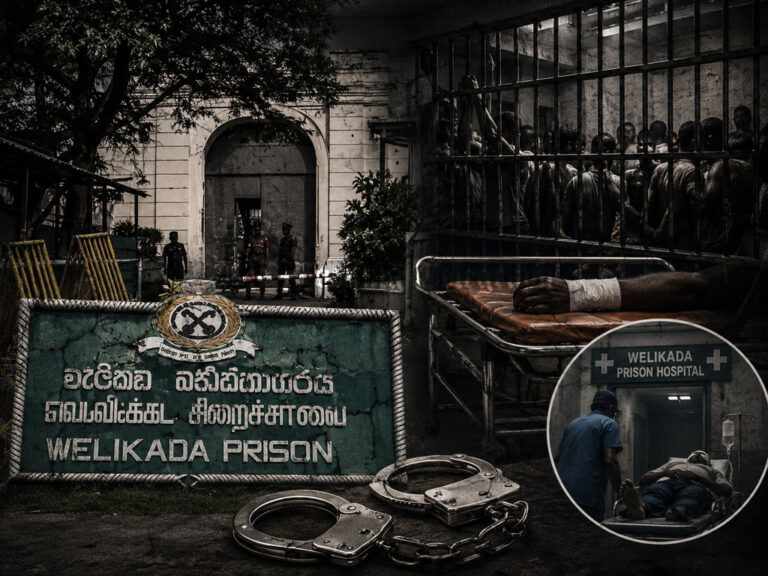
Following his transfer to Welikada Prison, Dayan suffered severe injuries and died. Prison officials claimed that he committed suicide by hanging himself with a belt. However, the rights committee alleges that an assault caused his death and has described the case as murder.
The death has also raised concerns about the obstruction of statutory oversight.
On the seventh of the month, officials from the Human Rights Commission of Sri Lanka attempted to enter Welikada Prison to investigate Dayan’s death. Silva said prison guards forcibly prevented the officials from entering.
The commission gained access only the following day.
Dayan’s wife has described the death as highly suspicious because of extensive external injuries on his body. A judicial medical officer has also ordered a comprehensive post-mortem examination.
Reports of severe abuse have also emerged from other prisons holding inmates transferred from Negombo.
An inmate named Suresh, whom authorities accused of initiating the Negombo clash, was transferred to Boossa Prison. Silva alleged that guards beat him so severely that his spine fractured, leaving him unable to walk.
Meanwhile, authorities transferred approximately 150 inmates to Angunakolapelessa Prison. According to Silva, those prisoners faced exceptionally cruel treatment.
He alleged that officers cut 100-foot-long water hoses into smaller sections and used them to beat every transferred inmate. The assaults allegedly left prisoners with deep lacerations across their backs.
Death and Critical Injuries Alleged at Angunakolapelessa
Silva said the alleged abuse at Angunakolapelessa resulted in one confirmed inmate death. Another prisoner remains in critical condition in an intensive care unit, while many others require hospital treatment.
He said he personally telephoned the prison superintendent while the assault was taking place and urged him to intervene. However, Silva alleged that the official avoided the call.
According to his account, the beating continued uninterrupted from midnight until 1 a.m.
Silva claimed that blood completely covered the courtyard in front of the prison office after the assault. He further alleged that administrative staff washed the area the following morning.
Silva stressed that remand prisoners remain under the legal custody and protection of the Magistrate’s Court. Therefore, he said, any extrajudicial assault or killing of a remand prisoner would constitute a grave criminal offence.
The rights group has warned that continued impulsive and violent crackdowns could create conditions for similar disturbances across the wider prison network.
Silva identified Galle Prison as the facility currently facing the greatest risk of similar unrest. He said he had warned senior officials about serious operational pressures at the prison even before the Negombo crisis.
Those concerns followed previous escape attempts and clashes between groups of inmates.
While the government reportedly plans to relocate Galle Prison, Silva argued that the state still lacks a cohesive strategy for the correctional system as a whole.
He also accused the minister of using parliamentary statements about inmates initially throwing bricks and clubs to indirectly justify the subsequent deaths of prisoners.
Wider Prison System Faces Growing Pressure
The delay in requesting outside law enforcement assistance, even as police and specialized units remained ready outside the prison gates, points to a serious weakness in prison management, according to Silva.
He also raised allegations of abuse involving female inmates.
Silva said authorities transferred female prisoners to Dumbara Prison, where they were brutally beaten. He alleged that male guards, rather than female correctional officers, carried out the assaults, violating standard gender protocols.
Silva clarified that the Committee for Protecting the Rights of Prisoners does not condone narcotics trafficking inside correctional facilities.
However, he rejected suggestions that prison contraband simply crosses perimeter walls by chance. He said drugs enter facilities through sophisticated internal networks, which corrupt prison staff often help operate.
Several allegedly complicit officers have recently faced suspension and dismissal. Nevertheless, Silva maintained that ultimate accountability rests with the senior prison administration.
The alleged systematic dispersal and subsequent torture of inmates, according to the rights group, suggests a coordinated campaign of state-sponsored suppression rather than isolated disciplinary incidents.
Sri Lanka’s prison system also faces a severe operational imbalance. Around 13,000 officers must manage an overcrowded inmate population of approximately 42,000 people.
Against that background, the committee warns that further instability will become increasingly difficult to prevent unless authorities address overcrowding, administrative weaknesses, alleged abuses and failures in accountability.
The Committee for Protecting the Rights of Prisoners has called for the immediate removal or resignation of the subject minister. It accuses the minister of gross negligence, bias and a complete failure to uphold human rights standards.
As allegations surrounding the Negombo Prison unrest spread beyond the original facility, the controversy now reaches several of Sri Lanka’s major prisons. The rights group’s accusations raise urgent questions about deaths in custody, the treatment of transferred inmates, statutory oversight and whether the country’s correctional administration can prevent further violence.