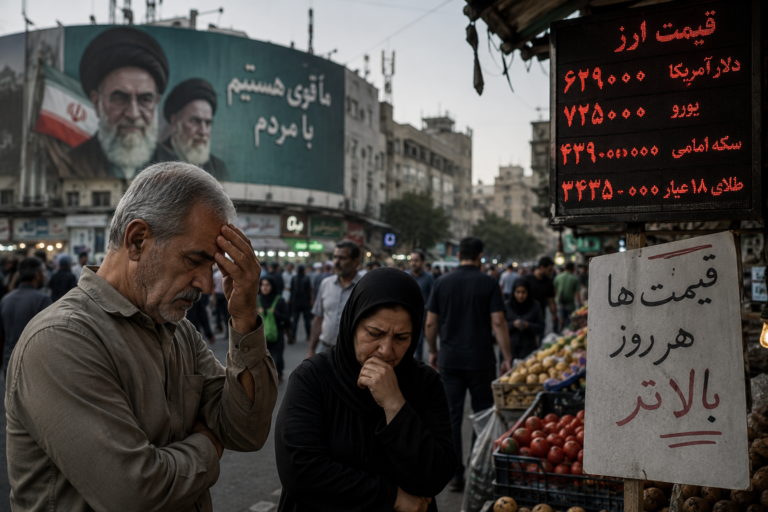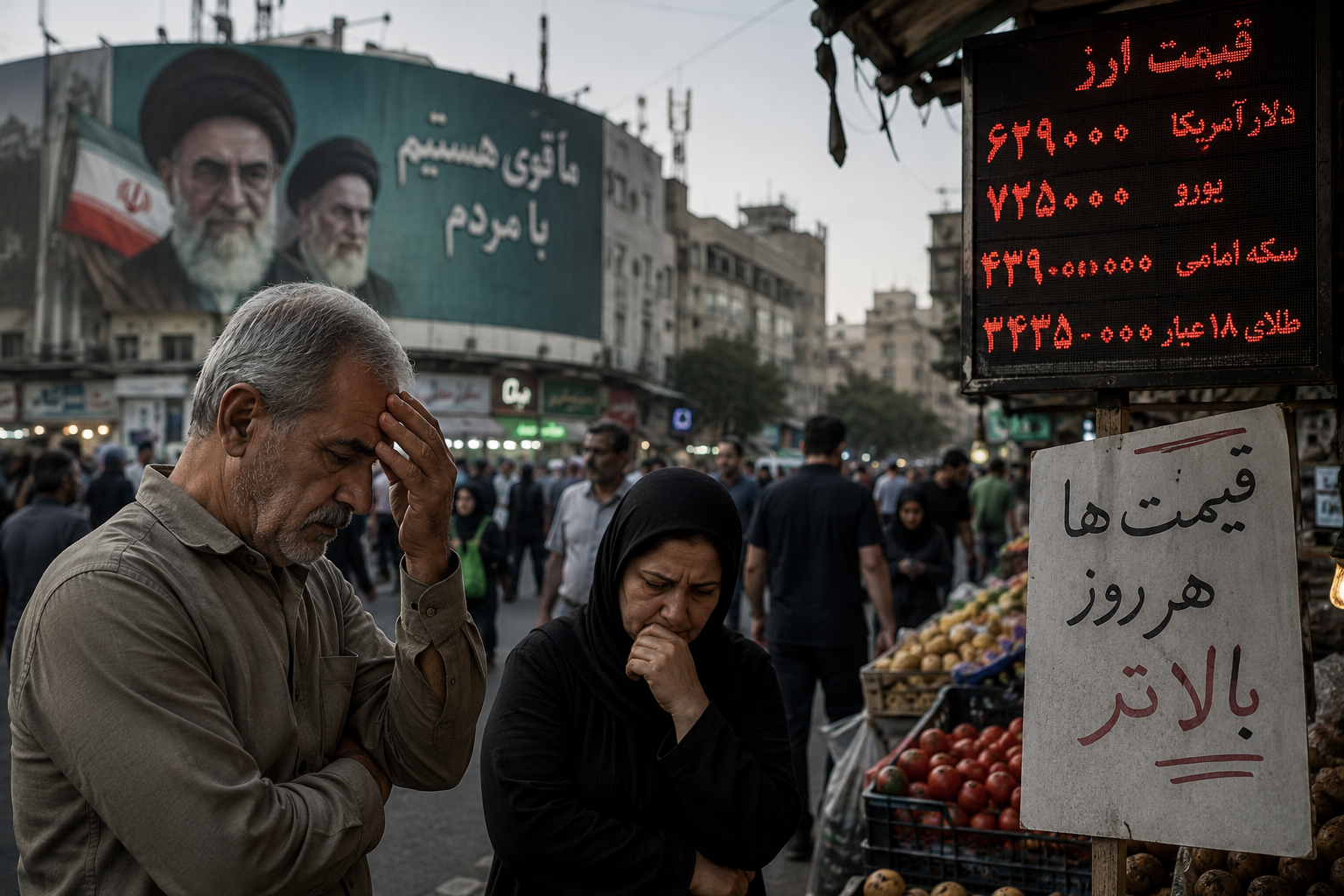
Iran economic crisis leaves government supporters and opponents struggling with soaring food prices, shrinking wages, blackouts and war fears.
Iran’s economic crisis is crushing daily life for government supporters and opponents alike, as food prices soar, wages shrink and war fears deepen.
Iranian society remains sharply divided over the Islamic Republic, its confrontation with the United States and Israel, and the country’s political future. Yet inside homes, supermarkets, factories and offices, those divisions matter less than the struggle to afford basic necessities.

Government loyalists may attend rallies, join Friday prayers and support calls for resistance. Government critics may blame the Islamic Republic, economic mismanagement and years of international isolation. However, both groups buy food with the same weakened currency. They also endure the same blackouts and watch their incomes lose value.
The result is a national emergency in which ordinary people pay the highest price, regardless of their political loyalties.
Iran’s Economic Crisis Leaves Wages Worth Less
For many Iranian workers, one month’s salary reportedly no longer covers much beyond the minimum cost of food.
An economic analysis cited by Iran International estimated that an individual needed about 78 million rials in June to meet basic nutritional requirements. For a married minimum-wage employee with one child, food alone could consume almost the entire monthly income.
That leaves little or nothing for rent, electricity, transport, medical treatment, clothing or education. Families may have jobs and regular pay, yet still find themselves unable to meet essential expenses.
Housing adds another severe burden. Many households reportedly spend between 50% and 70% of their income on accommodation. Therefore, even employed families may cut food purchases, delay medical care or borrow money simply to survive.
Essential goods have also risen faster than average inflation. Food and beverage inflation reportedly exceeded 130%. Meanwhile, market reports suggested that red meat and poultry prices had climbed by nearly 180% from the previous year.
For lower-income families, meat is becoming a luxury. Dairy products, eggs, rice, fruit, vegetables and cooking oil are also moving beyond the reach of households whose wages cannot keep pace.
War Makes an Existing Crisis Worse
The conflict has deepened problems that existed long before the latest military escalation.
The International Monetary Fund forecast inflation of 68.9% for Iran in 2026. Its April outlook projected a 6.1% economic contraction, although the IMF’s Iran country page now displays a slightly smaller contraction of 5.4%.
Either figure would represent a severe recession.
Economic contraction means businesses produce and sell less, investment falls and employment opportunities shrink. High inflation means the income people continue to earn loses value at extraordinary speed.
Together, those forces attack households from both directions: fewer opportunities to make money and dramatically reduced purchasing power after they are paid.
Damage to energy and transportation infrastructure, disrupted exports and uncertainty surrounding the Strait of Hormuz have added to the pressure.
Even if the fighting were to end, economists warn that Iran would not recover immediately. Restoring trade, rebuilding infrastructure, controlling inflation and attracting investment could take years.
Government Opponents See Their Future Disappearing
For critics of the Islamic Republic, the crisis carries an additional sense of frustration.
Many believe the suffering was avoidable and that years of confrontation, international isolation, policy failures and restrictions on economic activity have destroyed opportunities for an entire generation.
Young Iranians face fewer secure jobs, expensive housing and declining prospects of building independent lives. Middle-class families that once had savings and financial security are being pushed closer to poverty.
Business owners face unpredictable exchange rates, power shortages, trade restrictions and weak consumer demand. Professionals may continue receiving salaries, but the real value of those salaries falls each month.
For these Iranians, economic hardship is not only about hunger or unpaid bills. It represents the gradual disappearance of hope.
Government Supporters Face Their Own Burden
Some may remain committed to the government because of religious conviction, nationalism, anger over foreign attacks or fear that the collapse of the state would produce greater chaos.
They may believe that resistance is necessary to protect Iran’s sovereignty. Yet supporting the government does not make groceries cheaper or shield a family from unemployment.
Hardline newspapers have largely blamed the United States, Israel, sanctions, currency speculators, hoarders and so-called economic saboteurs. Their proposed response includes stricter market controls, expanded rationing and a stronger “resistance economy.”
But even media organizations close to the political establishment have acknowledged the widening gap between wages and the amount required for basic survival. One estimate placed the minimum wage at less than 40% of the cost of an average family’s basic subsistence basket.
This means even citizens who believe in the political system may privately be exhausted by the sacrifices demanded of them.
One Country Divided by Politics, United by Suffering
The government continues to provide cash subsidies and electronic food vouchers to large parts of the population. However, rising prices constantly reduce the real value of that support.
Ordinary citizens still stand in supermarket queues, calculate which bills they can delay and decide which necessities their families must abandon.
Iran’s tragedy is that the people least responsible for its political and military decisions now carry their heaviest consequences.
Supporters and opponents may disagree over Iran’s past and future. Today, however, millions share the same reality: wages that barely cover food, savings that rapidly lose value, infrastructure that repeatedly fails and the constant fear that another escalation could make an unbearable life even worse.