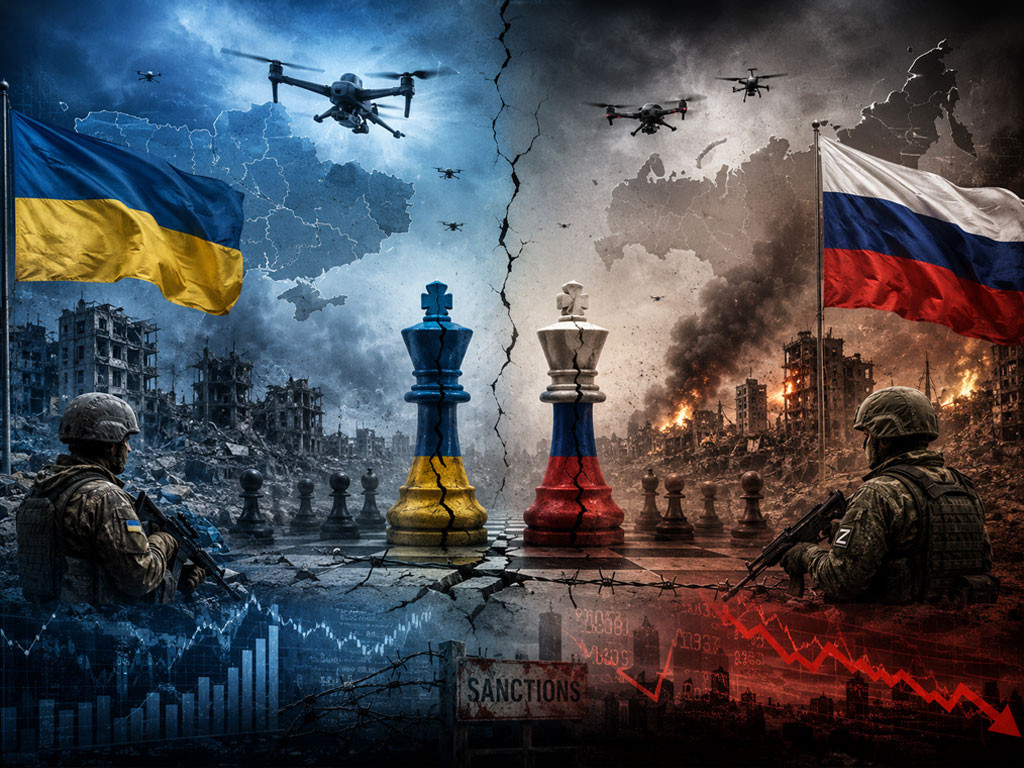
The Russia Ukraine war outlook shows Moscow struggling for gains while Kyiv preserves sovereignty but faces manpower and demographic crises.
The Russia Ukraine war outlook in 2026 suggests that Moscow has failed to secure a decisive strategic victory, while Kyiv has achieved only a partial success.
Ukraine has preserved its sovereignty and prevented Russia from achieving its original war aims. However, it has not recovered all occupied territory and now faces severe military, political and demographic pressures.
Russia, meanwhile, appears reluctant to accept a settlement that would freeze the current front line. Defence analyst Nico Lange has argued that continued political, economic and military pressure will remain necessary to push Moscow towards serious negotiations.

Hopes for a Quick Diplomatic End Failed
Some observers previously expected the war to end in 2025. That assumption rested partly on the belief that China and the United States could jointly pressure Russia.
In September 2024, Polish Foreign Minister Radosław Sikorski argued that Beijing held exceptional leverage because Russia had become heavily dependent on China.
There was also an expectation that Donald Trump could use trade negotiations with Chinese President Xi Jinping to restrain Vladimir Putin after entering office in 2025.
However, that calculation underestimated Beijing’s strategic interests.
During discussions in July 2025 between Chinese Foreign Minister Wang Yi and European Union foreign policy chief Kaja Kallas, Wang reportedly said China did not want Russia to lose. Beijing feared that a Russian defeat would allow Washington to shift more military and political attention towards China, Taiwan and the Pacific.
That position suggests China sees continued conflict as strategically useful, even if it publicly calls for peace.
Russia’s Advance Has Slowed Sharply
The battlefield picture in 2026 does not support claims of an imminent Russian victory.
Russia still controls roughly 19% of Ukraine, including Crimea and occupied parts of the Donbas. However, its advances have slowed sharply, and Ukraine has regained ground on some fronts. Recent assessments show that Russia’s territorial gains during 2026 have remained small compared with previous years.
Russia occupied far more territory during the opening months of the full-scale invasion in 2022. Since then, Ukrainian resistance has denied Moscow control over most of the country.
The widespread use of drones has made large breakthroughs difficult for both sides. Ukraine has also expanded its domestic drone industry and now regularly strikes Russian logistics, fuel infrastructure and supply lines hundreds of kilometres from the front.
Recent Ukrainian operations have targeted oil facilities and transport networks inside Russia, adding pressure to Moscow’s war economy.
Putin still seeks full control of the Donbas. However, the remaining Ukrainian-held areas of Donetsk include heavily fortified cities. At the current pace, capturing the entire region could take years rather than months.
Russia Has Also Lost Geopolitically
Even without a formal military defeat, Russia has suffered major strategic losses.
Its relations with Europe, particularly Germany, have deteriorated sharply. Moscow has also become more economically and politically dependent on Beijing.
The war has strengthened anti-Russian sentiment across Ukrainian society. It has also pushed Ukraine further towards Europe while destroying much of Russia’s former cultural and political influence.
However, these losses do not mean Ukraine is close to an outright victory.
Ukraine Faces a Serious Manpower Crisis
The Russia Ukraine war outlook also remains shaped by Ukraine’s internal military problems.
Many Ukrainian men have attempted to avoid mobilisation or leave the country. In January 2026, Defence Minister Mykhailo Fedorov said around 200,000 soldiers had deserted without authorisation, while approximately two million people were wanted for evading mobilisation.
The article’s claim that 39% of recruits leave within their first two months would require further official confirmation. Nevertheless, available reporting shows that desertion, mobilisation fatigue and falling morale have become serious problems.
These weaknesses limit Ukraine’s ability to launch large-scale offensives, even as Russian forces struggle to advance.
Ukraine Has Still Preserved Its Statehood
Despite those setbacks, Ukraine has achieved something strategically important.
It remains a sovereign and internationally recognised state nearly five years after Russia launched its full-scale invasion.
Ukraine has built one of Europe’s most battle-tested militaries. It has also developed cruise missiles, long-range drones and advanced battlefield technologies without becoming a NATO member.
The country’s ability to resist a much larger neighbour represents a significant achievement.
Future European Union membership could further separate Ukraine from Russian political influence. However, a prolonged conflict may slow accession, reduce investment and complicate reconstruction.
Demographic Decline May Be Ukraine’s Deepest Wound
Ukraine’s most damaging long-term crisis may not be territorial. It may be demographic.
The article estimates that the population has fallen from 41 million in 2021 to about 29 million. It says around 10 million people have left, while another two million remain in Russian-controlled areas.
Exact population figures remain difficult to verify during wartime because millions of people have moved repeatedly across borders and occupied regions.
However, the broader trend is clear. Ukraine has lost a large share of its working-age population, including many highly educated citizens.
Earlier expectations suggested that about half of those who fled might return after the war. Current estimates are reportedly closer to 30%.
That decline could weaken reconstruction, tax revenues, labour supply and long-term economic growth.
A continuing low-intensity conflict involving drones, sabotage and psychological warfare would make the challenge worse. It could discourage foreign investment even if major front-line fighting declines.
Political Stability Remains Another Test
Western governments also remain concerned about Ukraine’s post-war political development.
Some analysts fear that nationalism and far-right politics could gain influence, as happened in parts of Central and Eastern Europe after communist rule.
Ukraine has also faced repeated criticism over corruption and the concentration of political authority during wartime.
In July 2025, thousands of protesters gathered in Kyiv after legislation threatened the independence of major anti-corruption institutions. Zelensky later reversed course and introduced new legislation following public pressure.
The protests showed that Ukrainian civil society remained active despite martial law and wartime pressures.
Front-line soldiers, activists and minority groups have also continued supporting the state while demanding political reform.
Many believe that Ukraine’s flaws remain preferable to living under Russian rule.
Neither Side Can Yet Claim Victory
The Russia Ukraine war outlook therefore presents a complex picture.
Russia has failed to conquer Ukraine, remove its government or break its national identity. Its territorial gains have slowed, while the war has deepened its dependence on China.
Ukraine has survived, strengthened its sovereignty and built a powerful military. Yet it remains unable to recover all occupied territory and faces severe manpower, population and economic challenges.
Russia may be losing strategically, but Ukraine has not secured a complete victory.
The most likely outcome may be a prolonged struggle in which neither side achieves all its aims. Political pressure, sanctions and military resistance may eventually force negotiations, but the path towards a stable settlement remains uncertain.