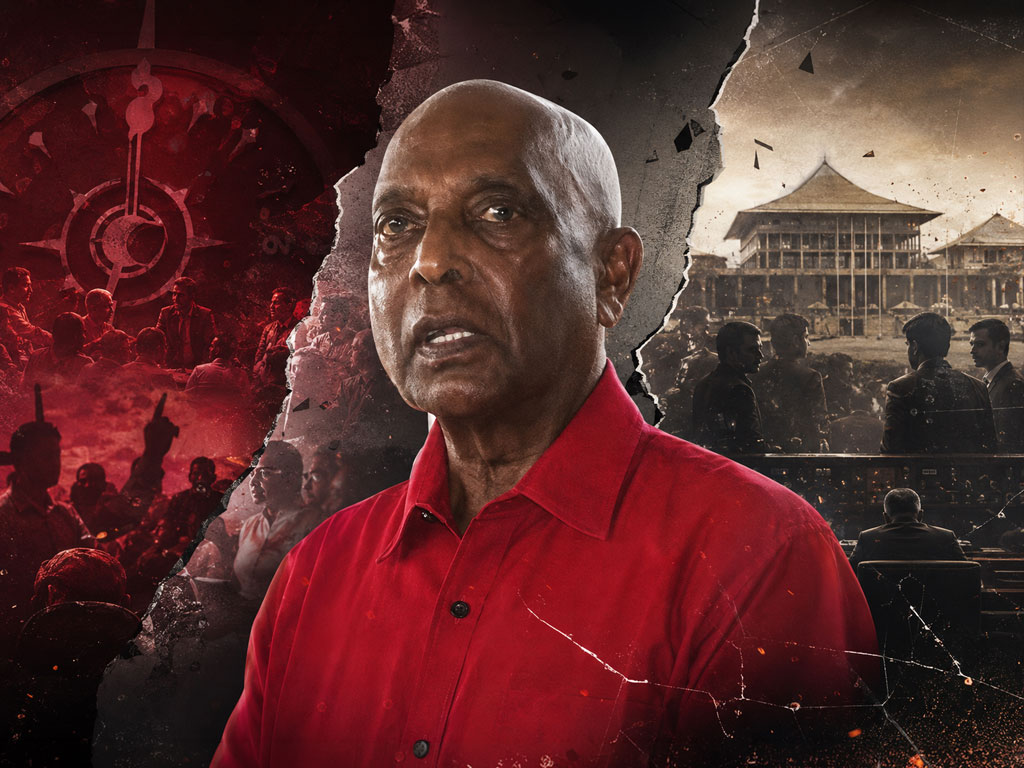
The Lal Wijenayake NPP exit challenges the government’s image of unity after the veteran lawyer openly confronted the movement he helped build.
The Lal Wijenayake NPP exit marks the first major public break by a prominent figure from the National People’s Power government.
He has not walked away from an ordinary administration. He has challenged a government that commands a two-thirds majority in Parliament.
The NPP is also known for enforcing strict discipline among its members.
Discussions inside the party, the wider alliance and the Cabinet remain closely guarded. Members are expected not to disclose internal information to outsiders or the media.
The government also prides itself on protecting confidential state information through absolute internal discipline.
Against that background, Lal Wijenayake’s decision carries greater political significance.
So, who is the man prepared to challenge a movement known for controlling dissent?
Get
Breaking News
First
on WhatsApp
Follow The Morning Telegraph for instant alerts, top stories and exclusive updates delivered straight to your phone.

From Kandy Student Leader to Courtroom Advocate
Lal Wijenayake was born in Kandy in 1941.
He studied at Dharmaraja College before entering the University of Peradeniya.
As president of the university’s student union, he became a prominent figure in the student movement. He also negotiated directly with the university’s then vice-chancellor, Sir Nicholas Attygalle.
Wijenayake qualified as an attorney in 1967.
His first major court appearance came in 1971, when he defended an accused participant in the JVP insurrection before the Criminal Justice Commission.
At the time, he worked as a junior to the distinguished lawyer Nadesan.
He later represented many people prosecuted in connection with the 1971 uprising.
His work soon extended beyond politically charged criminal cases.
When the UNP government attempted to impose a water tax on farmers following World Bank advice, Wijenayake supported the farming community.
He successfully secured a court order striking down the tax.
He also represented poor families who had received land through the Land Reform Commission.
After the UNP returned to office in 1977, the government sought to remove those families from the land. Wijenayake defended their right to remain.
A Long Career in the Old Left
Wijenayake began his political life in the Lanka Sama Samaja Party in 1963.
He later joined the LSSP Central Committee and Political Bureau. Eventually, he became the party’s treasurer.
He first contested an election during the 1988 Provincial Council polls.
Later, he became Leader of the Opposition in the Central Provincial Council.
Wijenayake served as a provincial councillor for 15 years.
Before the 1993 Provincial Council elections and the 1994 General Election, he strongly supported an alliance between the LSSP and the Sri Lanka Freedom Party.
His objective was to defeat the UNP government.
During the 1994 campaign that ended 17 years of UNP rule, Wijenayake emerged as one of the alliance’s leading campaigners.
Like many progressive activists, he placed enormous hope in Chandrika Kumaratunga after her election victory.
He believed she would abolish the Executive Presidency and establish a genuinely democratic system.
Instead, he watched those expectations collapse.
Wijenayake believed Kumaratunga became more concerned with retaining political power than using it to deepen democracy.
During heated discussions within the LSSP Political Bureau, he repeatedly argued that the party should leave her administration.
However, senior figures including Bernard Soysa and Athauda Seneviratne were unwilling to surrender their ministerial positions.
When private discussions failed, Wijenayake began voicing his criticism publicly.
Confronting Chandrika Kumaratunga Over the Judiciary
His confrontation with the Kumaratunga government peaked over the proposed appointment of Attorney General Sarath N. Silva as Chief Justice.
Wijenayake believed the appointment aimed to place the judiciary under political control.
Even as the Bar Association remained largely silent, he joined Ravaya editor Victor Ivan in opposing the move.
Victor Ivan became the most prominent public voice in that campaign.
Despite the opposition, Kumaratunga proceeded with the appointment.
Wijenayake’s disappointment with the LSSP deepened during the Mahinda Rajapaksa administration.
Journalist Lasantha Wickrematunge was assassinated in 2009.
At that time, the LSSP remained a partner in Rajapaksa’s government. Party leader Tissa Vitharana also served as a Cabinet minister.
Wijenayake could no longer accept what he regarded as the LSSP’s silence.
That year, activists established the Platform for Freedom to oppose attacks on journalists and growing political repression.
Representatives of civil society, trade unions and media organisations urged Wijenayake to join.
“You must be part of this movement,” they told him.
He initially hesitated because the UNP, his lifelong political opponent, also supported the platform.
“But the UNP, my lifelong political opponent, is also supporting this platform. How can I stand on the same stage?” he asked.
The activists told him the issue had moved beyond party politics.
“This is no longer about party colours. We must unite against repression. Otherwise, the country is heading towards one-party authoritarian rule,” they said.
“Very well. I’ll join,” Wijenayake decided.
He then became part of the Platform for Freedom.
Expelled From the LSSP but Not Silenced
The Rajapaksa administration reportedly reacted with anger.
Senior LSSP leaders serving in government were summoned and reprimanded.
Fearing the loss of ministerial positions, they quickly moved to expel Wijenayake from the party.
He did not retreat.
On the same day, he helped establish Lawyers for Democracy.
The organisation committed itself to protecting democratic principles.
In 2012, the Rajapaksa government moved to impeach Chief Justice Shirani Bandaranayake.
Wijenayake became one of the lawyers most openly opposed to the impeachment.
He also emerged as a leading figure in the campaign against it.
His activism continued during the movement that helped defeat Mahinda Rajapaksa in the 2015 presidential election.
That campaign brought Maithripala Sirisena to power.
However, Wijenayake later criticised Sirisena and Prime Minister Ranil Wickremesinghe when they departed from the mandate they had received.
His political loyalties did not prevent him from challenging governments he had helped bring to office.
That pattern would later define his relationship with the NPP.
The Honour Lal Wijenayake Refused
Wijenayake served on the Political Bureau of a party that supported both Chandrika Kumaratunga and Mahinda Rajapaksa.
During those administrations, several lawyers linked to left-wing parties accepted appointments as President’s Counsel.
Wijenayake refused the honour.
When the LSSP proposed his name, he rejected the title.
“No President’s Counsel title can silence my voice,” he said.
Only a small number of Sri Lankan lawyers have declined the prestigious appointment.
They include S.L. Gunasekara, R.K.W. Gunasekara and Gomin Dayasiri.
Wijenayake belongs to that rare group.
His refusal reinforced the image of a lawyer unwilling to exchange independence for official recognition.
That reputation later made him valuable to the NPP.
Why the JVP Brought Him Into the NPP
The JVP has traditionally remained cautious about embracing veteran figures from Sri Lanka’s old Left.
However, Wijenayake’s long record of legal and political activism made him difficult to ignore.
The JVP appointed him to the Executive Committee and Leadership Council of the National People’s Power.
He joined the NPP to fulfil a political goal he had pursued since 1978.
That objective was the abolition of the Executive Presidency and the dismantling of the constitutional system introduced by J.R. Jayewardene.
Chandrika Kumaratunga had failed to achieve it.
Mahinda Rajapaksa had also failed.
Maithripala Sirisena did not deliver it either.
Wijenayake believed a left-wing government finally had the opportunity to make that transformation possible.
For the first time, he believed the country had elected an administration capable of ending the presidential system.
Instead, that hope has now collapsed.
Lal Wijenayake NPP Exit Breaks the Image of Unity
The Lal Wijenayake NPP exit is therefore not simply the departure of another dissatisfied political figure.
It represents the collapse of a dream he carried for nearly five decades.
Wijenayake helped build the NPP and served on its Leadership Council.
He has now become the first member of that body to openly confront the movement from within.
His challenge strikes at the NPP’s carefully protected image of discipline, secrecy and internal unity.
The government may retain its two-thirds parliamentary majority.
It may also continue enforcing strict control over internal dissent.
However, Wijenayake’s departure shows that political discipline cannot permanently suppress ideological disappointment.
His record suggests that he has repeatedly opposed governments and parties when he believed they had abandoned democratic promises.
He challenged Chandrika Kumaratunga.
He broke with the LSSP under Mahinda Rajapaksa.
He opposed the impeachment of Shirani Bandaranayake.
He criticised Maithripala Sirisena and Ranil Wickremesinghe after helping bring them to power.
Now he has challenged the NPP.
The departure of Lal Wijenayake has therefore torn through the appearance of perfect unity that the National People’s Power worked hard to maintain.
For the NPP, the immediate issue is not simply that one veteran has rebelled.
The deeper question is whether his decision signals a wider crisis among those who joined the movement expecting constitutional and democratic transformation.