By Roy Denish
More than a dozen lawsuits filed this July highlight the urgent need for legal reform as AI-generated deepfakes and fabricated narratives exploit outdated digital laws.
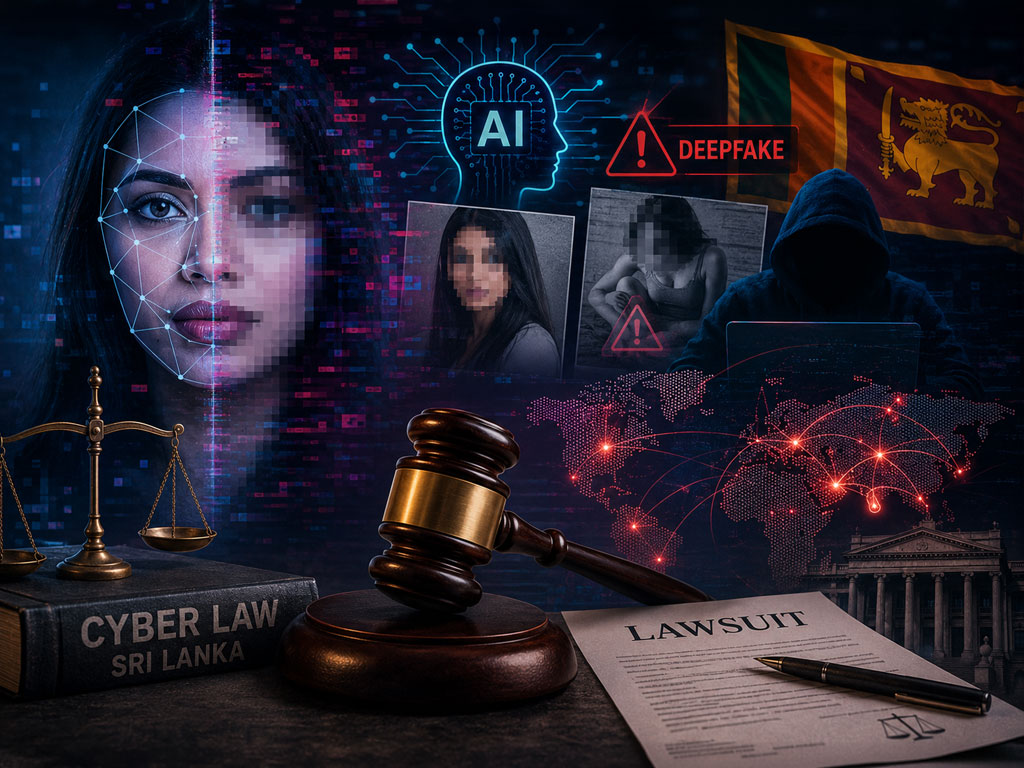
More than a dozen lawsuits filed across Sri Lankan courts this July have suddenly forced a quiet digital crisis into the public eye. The legal filings, directed against individuals who used generative artificial intelligence to superimpose faces onto non-consensual explicit and compromising images, mark a grim milestone for the nation. For years, Sri Lanka has treated cyber law as a secondary concern, relying on outdated statutes and highly politicized safety acts. Now, as technology democratizes the creation of deepfakes and fictional online narratives, the chasm between technological reality and legal recourse has widened into a crisis. Sri Lanka urgently needs to rewrite its digital laws, not to police political opinions, but to protect its citizens from a weaponized reality.
The toxic potential of unregulated digital media was vividly demonstrated on Monday, July 13, 2026, when local fact-checkers exposed a highly viral social media story as an absolute fabrication. The viral narrative centered on the recent tragedy at the Negombo Prison on July 5 and 6, where a violent clash between rival inmate groups resulted in the deaths of 29 prisoners and left over a hundred injured. During the height of the tension, as female inmates climbed onto the prison roof to protest for their rights, photographs of the scene were captured and widely shared.

Almost immediately, a heartbreaking story emerged on Facebook detailing the background of a female prisoner dubbed “Chanduni.” The post claimed that she was a brilliant student from a prominent school in Badulla who later moved to a leading women’s college in Colombo and excelled in netball. According to the viral narrative, she was unknowingly framed for drug trafficking under Section 54(2) via a parcel sent by her boyfriend through a WhatsApp group. The emotional climax of the post asserted that her newly released Advanced Level examination results revealed she had been selected for a university Faculty of Medicine while behind bars.
The story provoked immense public sympathy, yet a detailed investigation by a prominent fact-finding organization revealed that every line of the narrative was completely untrue. The Facebook user who originally generated the post, identified as Nalinda Dhanaranjan, admitted to investigators that the story was entirely fictional, created purely for personal entertainment and to drive community engagement on social media pages. Furthermore, investigations revealed that the creator, who had falsely identified herself as an investigative journalist on her social media profiles, is actually a photographer. Prison authorities later declined to comment on individual cases, citing inmate privacy regulations, confirming that the “medical student” narrative was a total fabrication designed to exploit a national tragedy for digital clout.
This incident exposes how easily the current legal framework is outpaced by modern synthetic and manipulated media. The Computer Crimes Act of 2007 was written when smartphones were a luxury and generative AI was science fiction. While the controversial Online Safety Act of 2024 attempted to address modern online harms, it remains broad where it should be precise, and entirely blind to the distinct mechanics of AI and algorithmic deception. The current act targets the distribution of false statements, but deepfakes and targeted viral fabrications introduce a much more insidious threat: the malicious act of creation. Under current frameworks, if someone uses an AI model to swap a classmate’s face onto an explicit photo or crafts a highly specific, damaging lie utilizing real news photographs, proving defamation or distribution remains a bureaucratic nightmare. The law must evolve to criminalize the unauthorized generation of a person’s biometric likeness itself.
Furthermore, this is not a gender-neutral crisis. Globally, and acutely within Sri Lanka’s conservative social fabric, the vast majority of non-consensual deepfakes and target-fabricated narratives aim directly at women. For a Sri Lankan woman, an AI-altered explicit photo or a fabricated criminal backstory circulating online is not just a digital nuisance; it is a catastrophic event that can destroy her employment prospects, alienate her family, and invite severe societal shaming. Treating this under archaic obscenity laws minimizes the trauma of image-based abuse.
Beyond personal ruin, the systemic threats are staggering. Sri Lanka’s history proves that manipulated media can ignite communal violence within hours. A deepfake video of a religious leader making inflammatory remarks, or a politician admitting to a fake corruption scandal days before an election, can go viral and cause real-world harm before fact-checkers can even intervene. Moreover, the lack of robust AI legislation invites the “liar’s dividend,” allowing public figures caught in genuine acts of corruption to simply claim the authentic footage is an AI-generated deepfake. Without clear, legally binding standards for digital forensic evidence in courts, separating truth from simulation will become nearly impossible.
Critics will rightly worry that rewriting digital laws could give the government more tools to censor dissent. The intense public pushback to the Online Safety Act proved that Sri Lankans are deeply suspicious of state-mandated truth. This is exactly why a total rewrite is necessary. The solution is not broad, vague bans on falsehoods. Sri Lanka needs narrowly tailored, tech-specific legislation. The law should precisely define synthetic media, mandate digital watermarking for AI tools operating domestically, and establish fast-track civil remedies that force platforms to take down non-consensual deepfakes within hours, not weeks. Lawmakers must look past the political theater of online censorship and build a modern legal fortress that protects its people from the dark side of the digital age.