The Kyiv ballistic missile attack involved 41 missiles, killing one person as Ukraine warned that Patriot interceptors were running low.
The Kyiv ballistic missile attack exposed Ukraine’s deepening air-defence shortage after Russia launched 41 missiles and 125 drones during a major overnight assault.
Ukrainian President Volodymyr Zelenskyy said at least one person died and 16 others suffered injuries in Kyiv. Three of the wounded remained in serious condition.
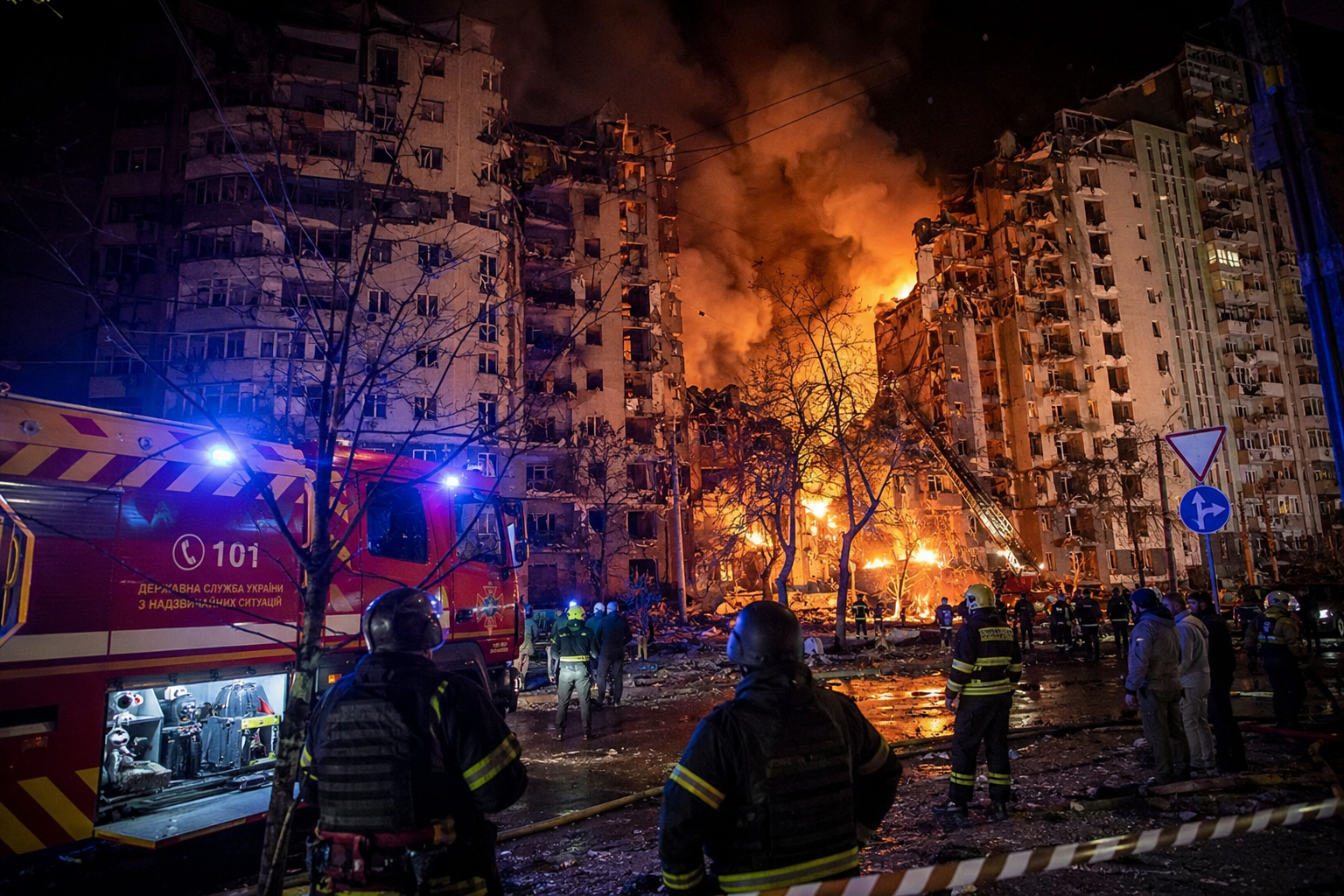
Powerful explosions echoed across the capital as ballistic and hypersonic weapons struck several districts. Fires erupted at residential buildings, warehouses, offices and other commercial locations.

Kyiv Mayor Vitali Klitschko said the attack damaged apartment buildings, a supermarket and a dormitory. Emergency teams searched shattered structures while firefighters battled flames across the city.
Russia carried out the assault overnight into Sunday, July 19. Reuters described it as one of the largest ballistic missile barrages directed at Kyiv since Russia launched its full-scale invasion.
Ukraine’s Air Force said Russia deployed 41 air-launched and ground-launched missiles alongside 125 attack drones and decoys.
The weapons included 25 Iskander-M or S-400 ballistic missiles and 10 Zircon hypersonic missiles. Russia also launched three Onyx missiles and three Kh-59 or Kh-69 guided missiles.
Kyiv Ballistic Missile Attack Overwhelms Defences
Ukraine said its forces intercepted or suppressed 18 missiles and 108 of the 125 drones.
However, preliminary military figures suggested that 23 missiles and 10 drones reached 20 locations. Debris from intercepted drones reportedly fell at another 18 sites.
The figures showed the pressure facing Ukraine’s air-defence network. While Ukrainian forces stopped most of the drones, more than half of the missiles reportedly penetrated the defensive shield.
Russia has increased its use of ballistic missiles against Kyiv and other Ukrainian cities. Ukrainian officials say the attacks are exploiting a critical shortage of advanced Western-made interceptors.
In Kyiv, explosions and falling debris affected the Desnianskyi, Dniprovskyi, Shevchenkivskyi, Sviatoshynskyi and Solomyanskyi districts.
A missile also struck an underground pedestrian passage near the Lukyanivska metro station. The attack damaged the station’s above-ground entrance and forced authorities to close the facility.
Emergency workers searched smouldering apartment buildings in western Kyiv. Near the city centre, crews removed rubble from the damaged station and a collapsed pedestrian underpass.
One resident, identified by Reuters as Vlad, said an explosion tore away his balcony door and struck him on the head.
“My grandmother lives with me, and she can’t walk. How could I run away and leave her behind?” he said.
Why Ballistic Missiles Are Harder to Stop
Ballistic missiles create a far more difficult interception challenge than conventional attack drones.
Drones generally travel more slowly and may remain in the air for an extended period. That gives radar operators and mobile air-defence teams more time to detect, track and engage them.
Cruise missiles usually fly at lower altitudes and follow a flatter path. Although they can manoeuvre and avoid radar, their lower speed can provide defenders with additional opportunities to respond.
Ballistic missiles follow a much steeper trajectory. They rise rapidly before descending towards their targets at extremely high speeds.
This reduces the time available to identify the target, calculate its flight path and launch an interceptor. Hypersonic weapons make the problem even more severe because they travel at several times the speed of sound.
Only advanced systems can reliably engage such threats during the final stages of flight. Ukraine relies heavily on the American-designed Patriot system for protection against ballistic missiles.
However, every interception requires specialised missiles. Russia can also launch several weapons almost simultaneously to overwhelm defensive batteries or force Ukraine to expend limited interceptor stocks.
Sunday’s Kyiv ballistic missile attack demonstrated that imbalance. Ukraine intercepted most of the drones but struggled to stop the larger missile barrage.
Zelenskyy Demands More Patriot Interceptors
Zelenskyy renewed his appeal for allies to accelerate deliveries of Patriot interceptors and other anti-ballistic weapons.
“Protection against ballistic missiles is our constant and top priority right now,” he wrote on social media. “Interceptors are needed every day.”
Zelenskyy previously said Ukraine and the United States had reached a political agreement covering licences to produce Patriot interceptor missiles locally.
He expressed hope that production could begin before the end of 2026. However, Ukraine still needs immediate deliveries because domestic manufacturing cannot quickly replace depleted stocks.
The attack was not limited to Kyiv.
A Russian strike on a postal depot outside Kharkiv reportedly killed four people and wounded 19 others. Bombs also struck residential buildings in Zaporizhzhia, killing at least two people and injuring 14.
Across Kyiv, residents and workers began clearing debris soon after the assault. Fruit vendors reopened stalls near damaged buildings while excavators removed concrete and twisted metal.
“Kyiv will flourish,” resident Iryna Lomeyko, 68, told Reuters.
“Those idiots destroy everything, but we’ll repair it and build anew. Everything will be alright.”
Her words reflected the determination visible across the capital. However, rebuilding damaged homes cannot resolve the wider military problem.
The Kyiv ballistic missile attack showed that Russia can still place enormous pressure on Ukraine by combining drones, ballistic missiles and hypersonic weapons in a single operation.
Unless Ukraine receives a steady supply of Patriot interceptors and other advanced defences, future barrages could continue to penetrate the protective shield surrounding its cities.