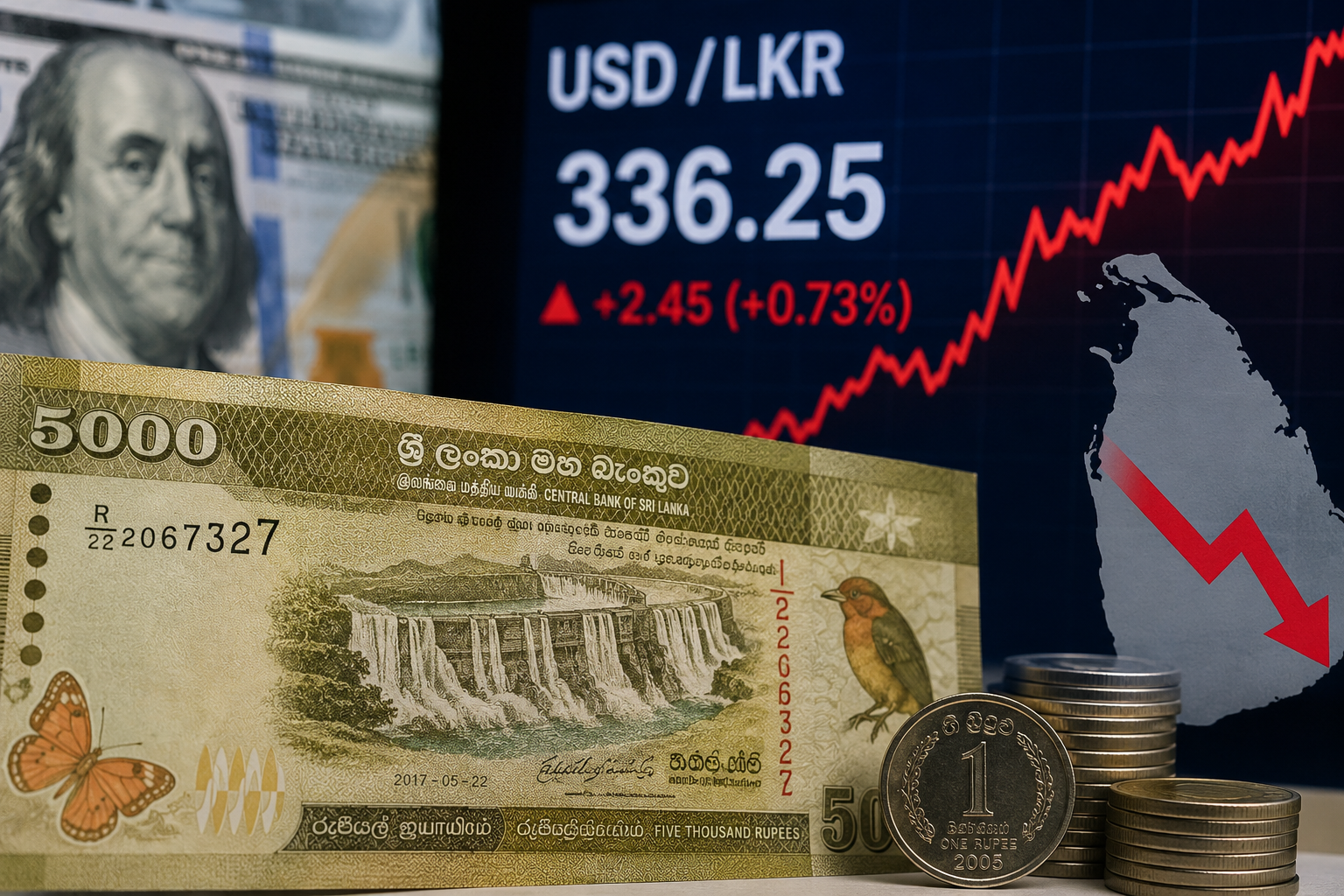
Sri Lankan rupee depreciation continues despite rising remittances as fuel imports, debt payments and business demand drain dollars.
The Sri Lankan rupee depreciation has become one of the economy’s most puzzling developments, despite billions of dollars arriving through worker remittances and improving merchandise exports.
The rupee traded at around Rs. 336.15 to Rs. 336.25 against the US dollar by July 19. It had already weakened by 7.9% during the first six months of 2026, according to the Central Bank of Sri Lanka.

At first glance, the decline appears difficult to explain. Sri Lanka received US$847 million in worker remittances during May alone. Total remittances reached US$3.9 billion between January and May, rising 26% from the same period in 2025.
Exports have also continued to bring foreign currency into the country. However, these inflows tell only one side of the story. The pressure comes from what Sri Lanka must pay overseas and how quickly its demand for dollars has increased.
Imports Are Consuming Sri Lanka’s Dollar Inflows
The clearest explanation lies in the widening merchandise trade deficit.
Sri Lanka’s imports increased much faster than its exports during the first five months of 2026. As a result, the cumulative trade deficit widened to US$4.7 billion, compared with US$2.7 billion during the same period in 2025.
Therefore, even record or near-record remittance inflows could not fully cover the country’s growing import bill.
Fuel has become one of the largest sources of pressure. Sri Lanka spent US$886 million on fuel imports in April, an increase of 149.9% from a year earlier. Although monthly fuel expenditure fell to US$536 million in May, it remained 112% higher than in May 2025.
Higher international petroleum prices and greater import volumes drove the increase. The escalation of conflict in the Middle East also pushed up global energy costs.
Vehicle imports created another significant demand for dollars. Sri Lanka spent US$1.07 billion on vehicle imports during the first five months of 2026. Expenditure reached US$250 million in May, following US$208 million in April.
Businesses importing machinery, fuel, vehicles, medicines, food and raw materials must purchase dollars to settle their bills. When that demand rises faster than the supply of foreign currency, the rupee weakens.
The Central Bank has also identified credit-driven imports as a growing concern. Stronger private-sector credit allows companies and consumers to finance more purchases, including imported goods. That creates additional demand in the foreign-exchange market.
Why Remittances Have Not Stopped Sri Lankan Rupee Depreciation
Worker remittances remain one of Sri Lanka’s strongest sources of foreign currency.
The country received US$751 million in January, US$815 million in March, US$768 million in April and US$847 million in May. Remittances totalled US$3.9 billion during the first five months of the year.
However, remittances do not automatically translate into an equal increase in the foreign currency available to defend the exchange rate.
Banks convert part of those inflows into rupees for recipients. Meanwhile, importers, investors, travellers and companies continue buying dollars. The overall exchange rate depends on the balance between all foreign-currency inflows and outflows, not remittances alone.
Sri Lanka’s services account has also provided less support than expected. The services surplus fell 36.8% year-on-year to US$143 million in May. The cumulative services surplus declined 20.8% during the first five months.
Although tourist arrivals increased in May, estimated tourism earnings fell 5.1% to US$156 million. Cumulative tourism earnings declined 11.9% to US$1.36 billion between January and May.
Foreign investors also removed money from government securities and the Colombo Stock Exchange. Government securities recorded a net outflow of US$60 million in May. The stock market recorded a further US$23 million net outflow.
Each outflow adds to the demand for foreign currency or reduces the amount entering Sri Lanka.
Debt Payments and Central Bank Intervention Add Pressure
Sri Lanka must also use foreign currency to service external debt.
The Central Bank reported gross official reserves of US$6.9 billion at the end of May. However, that figure included a swap facility with the People’s Bank of China, while the country continued making sizeable external debt-service payments.
Foreign-debt repayments remove dollars from the available pool even when reserves appear stable. Multilateral loan disbursements can replenish reserves, but those inflows may arrive at different times from debt repayments and import settlements.
The Central Bank has also sold foreign exchange into the domestic market. Such intervention can prevent abrupt or disorderly currency movements by supplying dollars when market demand becomes excessive.
However, intervention also has limits. Selling too many dollars could weaken reserves and undermine confidence. The authorities must therefore balance exchange-rate stability against the need to preserve a sufficient reserve buffer.
The Central Bank was a net purchaser of foreign currency in January, when the rupee had appreciated slightly. By April and May, however, it reported net foreign-exchange sales as external pressures intensified.
This change suggests the market moved from having surplus dollar liquidity to requiring Central Bank support.
Is the Rupee Being Allowed to Move More Freely?
The depreciation may also indicate that authorities are allowing the exchange rate to respond more freely to supply and demand.
Sri Lanka’s post-crisis economic framework requires the country to avoid maintaining an artificially strong currency through excessive reserve sales. A more flexible rate can absorb external shocks and discourage unnecessary imports.
That does not mean the Central Bank has stopped intervening. Its official indicative spot rate includes transactions conducted through Central Bank foreign-exchange interventions.
However, intervention may now aim to smooth sudden volatility rather than defend a fixed rupee value.
A controlled depreciation can make exports more competitive and increase the rupee value of remittances. Yet it also raises the local cost of fuel, medicine, machinery and other imports. Those costs may eventually reach consumers through higher transport, electricity and food prices.
The Central Bank raised its Overnight Policy Rate by 100 basis points to 8.75% in May. It cited inflation, credit expansion, import demand and pressure on the external sector among the reasons for tightening monetary policy.
Higher interest rates can reduce credit growth and import demand. However, their effect usually takes time to move through the economy.
The Real Test Is Sri Lanka’s Total Dollar Balance
The weakening rupee does not mean remittances or exports have failed. Those inflows have prevented far greater pressure on the currency.
Instead, the decline shows that Sri Lanka’s total demand for foreign exchange has risen even faster. Fuel costs, vehicle imports, business payments, investment outflows, tourism weakness and debt servicing have collectively consumed much of the incoming currency.
The Central Bank said pressures also reflected the Middle East conflict and followed depreciation across several regional currencies. However, domestic import demand remains a critical part of the equation.
The future direction of the rupee will depend on whether fuel prices ease, exports and tourism strengthen, remittances remain high and import growth slows.
For now, Sri Lanka is earning more dollars through its workers and exporters. But it is also spending those dollars at a much faster rate. That imbalance provides the clearest explanation for why the currency continues to fall.