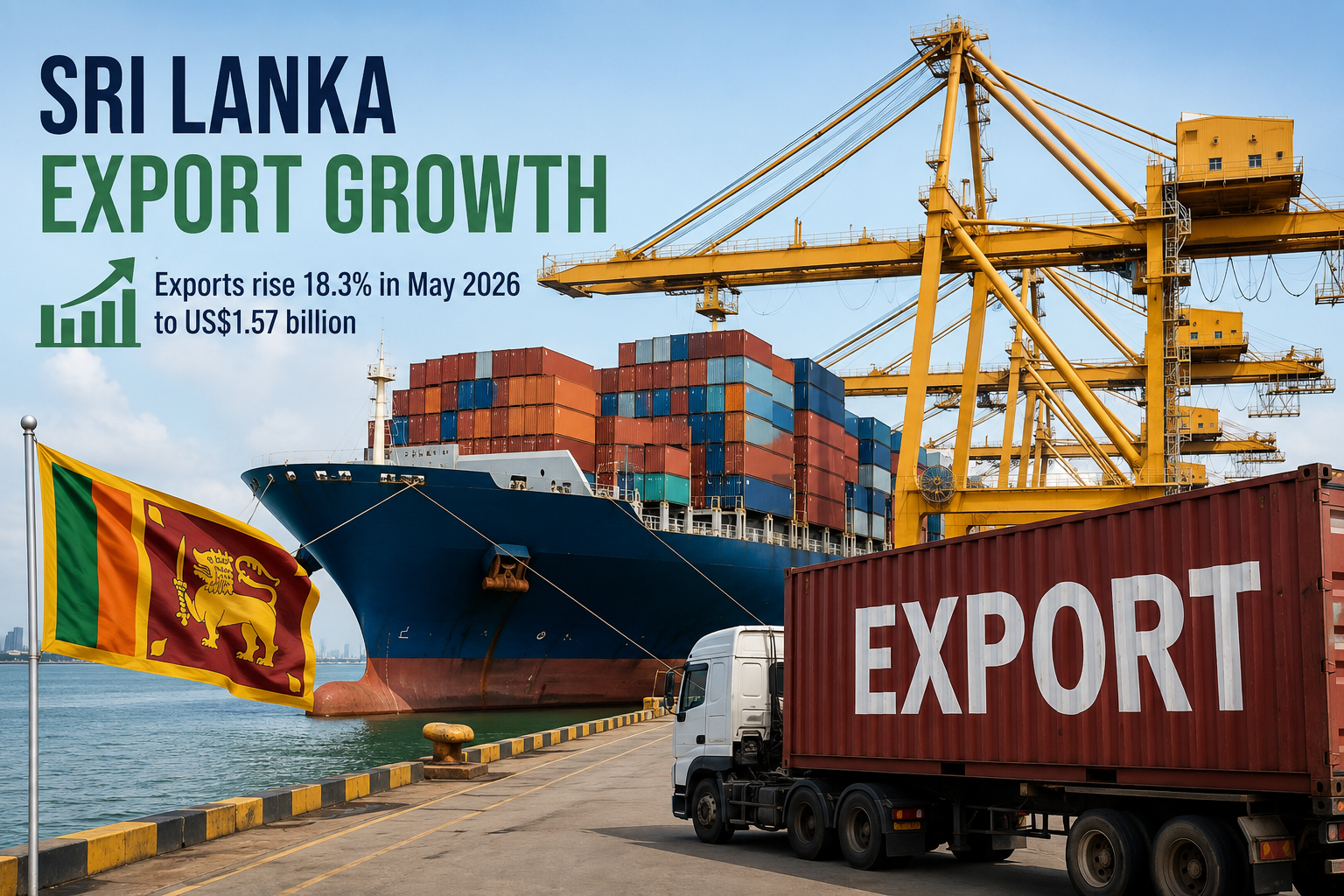
Sri Lanka export growth reached 18.3% in May, but weaker apparel demand, disrupted tea markets and rising costs threaten the recovery.
Sri Lanka export growth accelerated sharply in May 2026, offering the country a welcome foreign-exchange boost as its wider economic recovery remained exposed to global disruption.
Total merchandise and services exports reached an estimated US$1.57 billion during the month. That represented an 18.34% increase from May 2025, according to the Sri Lanka Export Development Board.
Merchandise exports climbed 18.25% year-on-year to US$1.22 billion. Services export earnings increased by 18.67% to an estimated US$347.15 million.

However, the strong monthly headline conceals an uneven recovery. Several value-added industries expanded rapidly, while apparel, tea, spices and seafood faced weaker demand or market disruption.
The figures also measure export earnings rather than physical shipment volumes. Therefore, they do not establish how much of the increase came from greater production, larger volumes or higher international prices.
Sri Lanka Export Growth Reaches US$7.39 Billion
Combined exports reached an estimated US$7.39 billion between January and May 2026. This marked growth of 7.56% compared with the same period in 2025.
Merchandise exports generated US$5.76 billion during those five months, up 7.63%. Services exports rose 7.31% to US$1.63 billion.
The expansion did not depend on one industry alone. Coconut products, processed food, electrical components, rubber goods and information technology services all contributed to the increase.
Coconut-based exports grew 20.45% to US$515.17 million during the first five months. Strong demand supported coconut oil, desiccated coconut, coconut cream, liquid coconut milk and activated carbon.
Processed food and beverage exports increased by 26.63% to US$293.16 million. Processed food alone rose 49.32% to US$141.14 million.
Electrical and electronic component exports recorded one of the strongest increases. Earnings surged by 51.79% to US$253.88 million.
The increase came from products such as electrical transformers, insulated wires, cables, switches, boards and panels. This performance suggests that Sri Lanka’s export base is gradually extending beyond traditional commodities.
Rubber-based export earnings also rose by 4.84% to US$404.7 million. Meanwhile, seafood earnings for the five-month period increased 19.2% to US$105.49 million.
ICT exports recorded estimated growth of 21.74%, reaching US$751.53 million. The rise strengthened the contribution of Sri Lanka’s digital and knowledge-based economy to total export earnings.
Apparel Recovery Remains Fragile
Apparel and textiles remain central to Sri Lanka’s export economy. However, the sector’s performance shows why one strong month should not create excessive confidence.
Apparel and textile exports reached US$394.14 million in May, rising 7.96% from a year earlier. It was reportedly the sector’s strongest monthly performance of 2026, supported largely by stronger demand from the United States.
Nevertheless, cumulative apparel and textile earnings remained below the previous year’s level. The Export Development Board reported a 4.84% decline to US$2.03 billion between January and May.
Exports to the United States fell 2.13% during the five-month period. Shipments to the European Union and United Kingdom dropped 6.25% and 7.95%, respectively.
Those three markets account for a major share of Sri Lankan clothing exports. Consequently, weak consumer demand or new trade barriers in Western economies could quickly reverse May’s improvement.
The United States is Sri Lanka’s largest single export destination and buys about US$3 billion in goods annually, mainly apparel. The industry also employs approximately 300,000 people.
Sri Lanka has faced the prospect of a proposed 12.5% US tariff, compared with proposed rates of 10% for competitors including Bangladesh and Pakistan.
The Government has said it plans to strengthen customs screening and implement additional international labour standards while continuing discussions with the Office of the United States Trade Representative.
A less favourable tariff than those imposed on competitors could weaken orders, squeeze factory margins and place jobs at risk, even when American consumer demand improves.
Tea Exports Hit by Middle East Instability
Tea presents another warning about the vulnerability of Sri Lanka export growth.
Tea earnings declined by 1.12% in May to US$130.33 million. Earnings from tea packets fell 1.32%.
The Export Development Board linked the decline to lower performance in major Middle Eastern markets. Tea exports to the region dropped 42.32% during May.
Shipments to the United Arab Emirates fell 76.92%. Exports to Iran and Iraq declined by 82.23% and 61.43%, respectively.
The cumulative figures were also weak. Tea export earnings fell 4.62% to US$581.91 million between January and May. Bulk tea exports dropped 6.97%, while tea packet earnings declined 5.04%.
However, Turkey provided a significant exception. Tea exports to Turkey surged by 235.35% in May. Cumulative tea exports to the market increased 150.17% during the first five months.
The Turkish increase demonstrates the value of market diversification. Nevertheless, it may not fully compensate for disruption across established Gulf and Middle Eastern markets.
Nearly half of Sri Lanka’s tea exports traditionally go to the Middle East. Regional conflict has already affected demand, shipping, payments and energy costs across the industry.
Energy, Freight and Insurance Costs Threaten Margins
Sri Lankan exporters must also confront costs that are not visible in headline export earnings.
Conflict affecting Gulf shipping routes has raised freight and insurance charges. Delayed shipments and higher regional risk premiums can increase costs even when Sri Lankan cargo does not travel through the most heavily disrupted waters.
Higher global oil prices can also affect factory operations, agricultural production, packaging and inland transport. Exporters may struggle to pass these additional costs to overseas buyers without losing orders to cheaper competitors.
Electricity remains another concern for manufacturers. During Sri Lanka’s 2026 electricity tariff consultation, business representatives warned that higher industrial power costs could weaken international competitiveness and reduce export earnings.
The Public Utilities Commission’s published decision also recorded concerns about international coal prices, bunkering charges and freight fluctuations affecting electricity-generation costs.
These pressures matter because growing export revenue does not automatically mean growing profitability. A factory may earn more dollars from shipments while retaining less income after paying for electricity, fuel, imported inputs, freight and insurance.
Earnings Rise, but Volume Question Remains
The May figures provide clear evidence that export earnings increased. However, the available headline data do not provide a complete explanation of whether exporters shipped substantially larger quantities.
Higher commodity prices can raise export earnings even when physical volumes remain unchanged. Currency movements and changes in the mix of products can also affect the final value.
Growth driven by larger volumes would suggest stronger production and overseas demand. In contrast, growth driven mainly by higher prices may offer less protection if global prices later decline.
Product-level volume data would therefore help determine whether May represented a structural improvement or a temporary rise in export values.
The sector’s mixed performance supports a cautious interpretation. Coconut products, processed food, electrical components, ICT services and May apparel shipments showed strong momentum.
However, cumulative apparel and tea earnings remained lower. Spices and essential oils declined 3.28% during the first five months, mainly because pepper exports contracted sharply. May seafood earnings also fell 10.32%.
Sri Lanka’s export recovery is real, but it is neither uniform nor secure. Sustaining it will require competitive energy prices, reliable shipping, stronger access to Western markets and greater diversification across both products and destinations.
The 18.34% increase in May is an important achievement. Yet the more decisive test will be whether exporters can protect their margins and maintain orders as global conflict, trade barriers and weaker demand reshape international commerce.