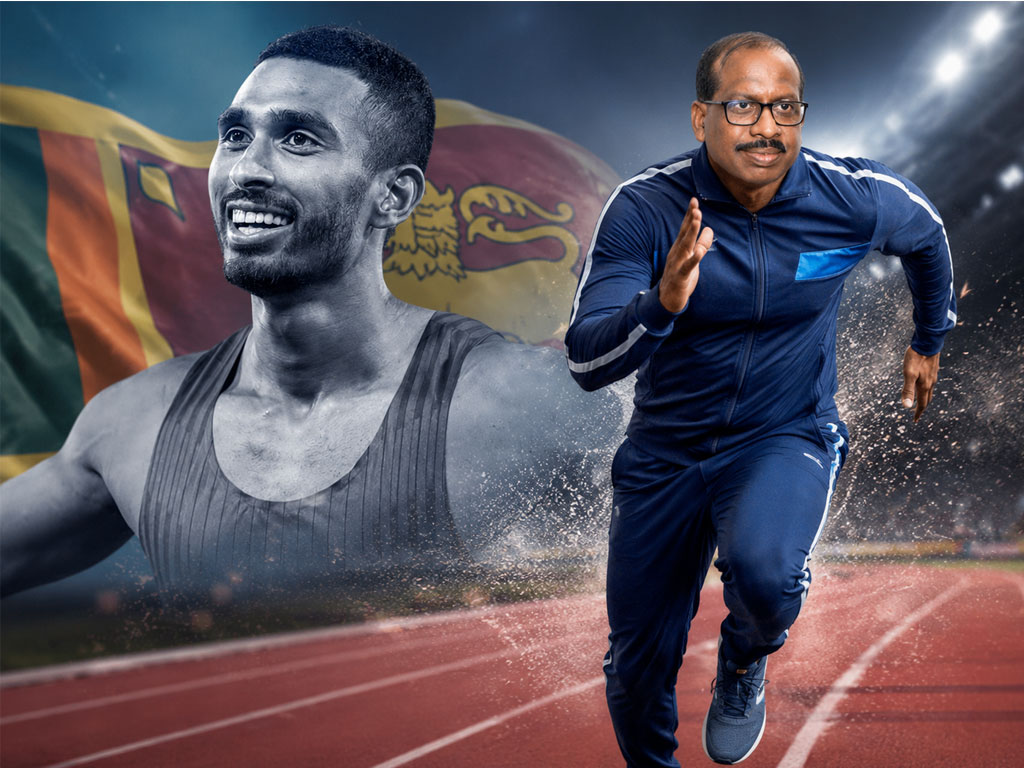
Yupun Abeykoon retirement raises painful questions about athlete funding, public respect and Sri Lanka’s failure to recognise national talent.
The Yupun Abeykoon retirement announcement should force Sri Lanka to confront an uncomfortable truth: this country celebrates talent publicly but often abandons it privately.
From birth until death, almost everything people do involves an exchange. Children receive education. Adults offer labour. Professionals exchange knowledge and skill for income, dignity and social recognition.
Families, friendships, religion and wider social relationships also depend on some form of value. People continue those relationships only while they remain meaningful, fair or satisfying.

That may sound harsh, but it reflects reality.
In the modern world, every person needs recognised value to survive. Whether someone becomes a journalist, doctor, engineer, artist or athlete, society places a value on that work.
The political system, the economic structure and the profession itself usually determine that value. The central question is whether Sri Lanka understands the value of its people before losing them.
Yupun Abeykoon has now brought that question into sharp focus.
He won Sri Lanka a Commonwealth Games medal after 24 years. He ran the 100 metres in under 10 seconds and established himself as South Asia’s fastest man.
His time of approximately 9.96 seconds placed him among a small group of sprinters to achieve that standard. He also represented Sri Lanka at the Tokyo 2020 Olympics, held in 2021.
He became the first South Asian male competitor in the Olympic 100 metres after 32 years.
Now, he has announced the end of his athletics career through a Facebook statement.
One sentence carried extraordinary weight:
“Leaving the sport without owing anything to the country, but owing to the world.”
That is not merely a farewell line. It is a statement about achievement, sacrifice, gratitude and disappointment.
It suggests that Yupun believes he fulfilled his duty to Sri Lanka. Yet, at the same time, he recognises that his journey depended on support, opportunities and people beyond the country’s borders.
Yupun Abeykoon Retirement Exposes Public Cruelty
The reaction to Yupun’s announcement has been disturbing.
Comments beneath his original post and subsequent media reports revealed how quickly sections of the public can turn against someone they once celebrated.
Some comments effectively told him not to frighten others simply because he had lost.
What does such a response say about us?
A country that once cheered his victories now permits people to mock him at retirement. The same social media pages that used his achievements to attract audiences now host contemptuous comments about his career.
There is a familiar saying: when you laugh, the world laughs with you. When you cry, the world may walk away and laugh at you.
That appears to describe Sri Lanka’s relationship with many successful people.
We praise them when their achievements give us national pride. We use their images, victories and stories to build political and media narratives.
However, once they struggle, retire or question the system, admiration quickly turns into suspicion or ridicule.
There is only one Yupun Abeykoon.
Political loyalty cannot manufacture another athlete of his standard within a few days. Party supporters cannot simply select someone, train him briefly and send him to the Olympics.
Talent at this level requires years of discipline, coaching, financial sacrifice, injury management and international competition.
Yupun tried. He did not try only for himself. Every time he wore Sri Lanka’s colours, he represented a country that too often failed to understand what his preparation required.
The Yupun Abeykoon retirement debate must therefore move beyond social media insults. It should focus on the conditions facing every athlete who attempts to represent Sri Lanka internationally.
Athletes Need Protection Beyond Their Winning Years
One of the most important issues raised through Yupun’s statement concerns the need for a proper sports agreement.
Sri Lanka should establish a system that defines an athlete’s entitlements, responsibilities and long-term protection.
A professional in another field does not automatically lose all support after suffering an injury. Yet athletes often receive allowances only while they remain capable of competing.
If they become seriously injured or disabled, the system may neglect them.
That is not fair. It is also not how a modern sporting nation should operate.
An athlete needs to know that injury will not destroy his livelihood. Such security creates motivation to recover, train and continue developing.
Without that protection, athletes carry the physical risks while administrators enjoy the public recognition attached to their success.
Financial support should also relate transparently to performance, training requirements and international standards.
A sporting career is not charity. It is professional work conducted under extraordinary pressure.
Athletes trade years of their lives, physical health and personal freedom for the possibility of representing their country.
Sri Lanka must recognise that transaction honestly.
The Hidden Cost of Representing Sri Lanka
International sport costs money.
According to Yupun’s account, some Sri Lankan athletes may need around Rs. 500,000 to attend a competition. That raises obvious questions.
Where does the money come from? Who pays for travel, accommodation, equipment, coaching, nutrition, rehabilitation and medical care?
Politicians and officials may arrive later with garlands. Cameras capture airport welcomes and congratulatory speeches.
However, those ceremonies do not reveal the suffering beneath the achievement.
They do not show how athletes continue their education, support their families or care for ageing parents.
They also do not show the financial strain carried during years when there is no medal and no public applause.
Too often, the Government does not carry that burden. Families, private sponsors, foreign coaches and the athletes themselves must find solutions.
Sri Lanka has created a culture that expects excellence without paying the true cost of producing it.
The same contradiction appears elsewhere in public life.
Politicians sometimes speak proudly about advisers working without salaries. However, professional people must still live.
They need food, housing, transport and family security. If the state expects full-time professional work without proper payment, those individuals must find income elsewhere.
That arrangement creates obvious questions about independence, legality and conflicts of interest.
Professional standards exist because expertise has value. Every individual’s time and ability carry a cost.
The demand that people work endlessly without fair compensation is not patriotism. It is exploitation disguised as sacrifice.
The eight-hour working day emerged because human beings require rest, family life, recreation and dignity.
People need music, films, relationships, humour and moments of foolishness. Life cannot consist only of labour and political slogans.
Athletes require the same balance. Their bodies are their workplaces, and relentless training places those bodies under exceptional strain.
Political Tribalism Destroys National Talent
Narrow political thinking is one reason Sri Lanka continues losing valuable people.
When discussions about athletes become arguments between party supporters, the nation loses sight of the individual’s achievement.
Reports have referred to an allocation of Rs. 250,000. But can that amount produce an Olympic-standard sprinter?
Can it cover international coaching, sports science, travel and high-performance nutrition?
Instead of attacking Yupun for not winning an Olympic medal, Sri Lanka should recognise what he already accomplished.
After 32 years, a South Asian male competed in the Olympic 100 metres. In another country, that achievement could become part of a long-term national sports programme.
Authorities could use his experience to inspire children, train coaches, attract sponsors and promote the country internationally.
How much positive global attention could Sri Lanka gain from one athlete of Yupun’s stature?
Could 70 ordinary politicians produce even a fraction of the international recognition one elite athlete creates?
That is the question leaders should ask.
Public office requires people who understand value. A person who cannot recognise human ability will not know how to develop it.
Sri Lanka’s political culture repeatedly treats individuals as disposable. People matter only while they serve a party, campaign or temporary narrative.
Once their usefulness ends, the system moves on.
That is the pain behind the Yupun Abeykoon retirement story.
His Farewell Still Expressed Gratitude
Despite his disappointment, Yupun’s statement was not an attack on Sri Lanka.
It showed remarkable gratitude.
He wrote:
“Being called the fastest runner in South Asia is not my achievement, but our achievement. I understood that after the day I ran the sub-10.”
Until that moment, he said he believed the victory belonged to him alone.
However, he later understood the rare experience of a boy who first belongs to his family and then becomes part of an entire nation.
He described it as a victory that thieves and enemies could never take away.
He thanked life and his country for giving him that experience.
Sri Lankans should pause and consider the generosity in those words.
Even after experiencing disappointment, he acknowledged the people and institutions that helped him.
He thanked his parents, family, schools and teachers. He recognised the sports teachers who guided him and the officers of the Sri Lanka Electrical and Mechanical Engineers.
He thanked both serving and former officers.
He also recognised retired Major General Palitha Praneeth, the former Athletics Association Chairman, and others who supported his progress.
Yupun thanked Italian professionals who invested time, knowledge and money in him. He acknowledged those who helped him build a life and training programme in Italy.
He also thanked former and current ministries, including the Sports Ministry.
The private sector and individual sponsors who financed his training also received recognition.
This was not the farewell of someone who had forgotten assistance. It was the reflection of an athlete capable of distinguishing gratitude from criticism.
That distinction matters.
Respecting those who helped him does not mean remaining silent about systemic failures.
Recognition Must Become Policy
Yupun also thanked individuals from the media and business sectors, including TV Derana Chairman Dilith Jayaweera, Lakshiri Wickramage and former Sri Lanka Cricket Chairman Shammi Silva.
His full statement contains many names and details. The essential point, however, is clear.
Sri Lanka must learn to recognise people’s value.
The country needs decision-makers who understand talent before it disappears. Only then can athletes, artists, scientists and other professionals continue developing.
A leader should ask what the country can gain from a person like Yupun, not what a political party can gain from him.
Elite athletes contribute through tourism, national branding, youth motivation, international recognition and commercial opportunities.
Losing such talent over inadequate or poorly delivered support is not merely a sports failure. It is an economic and national-development failure.
If Rs. 250,000 was promised, at the very least, authorities should have delivered it properly and transparently.
The deeper problem is not only the amount. It is the absence of a coherent system.
Sri Lanka needs athlete contracts, insurance, injury protection, retirement planning, education pathways and professional career support.
Yupun Is Part of a Much Larger Crisis
Yupun represents one person in one field.
What happens to Sri Lanka’s filmmakers, writers, musicians, actors and other creators?
What programmes exist to develop them?
The Cinema Corporation remains troubled. The teledrama industry faces its own unresolved problems.
Institutions responsible for culture often appear disconnected from the people they should support.
Where is Sri Lanka going? When will the country begin dreaming positively about its future?
The media sector faces similar pressure. Questions involving parliamentary privilege, journalism and institutions such as the BBC reveal how difficult it can become to protect professional independence.
How can the next generation develop in such an environment?
How can Sri Lanka produce professionals while treating athletes as though they are not professionals?
A nation cannot achieve global standing through party promotion alone.
Sports matter. Art matters. Science and technology matter.
The physical development of children matters because it shapes their health at 40 and 50.
Their mental development matters because it determines whether the next generation can think independently, innovate and lead.
Sri Lanka must stop reducing every national question to political loyalty.
Political personalities, including Anura Kumara Dissanayake, Harini Amarasuriya, Sunil Handunnetti, Saman Vidyaratna and others, should not become substitutes for serious policy thinking.
This is not about insulting individuals or blindly supporting them. It is about taking what is useful, improving it and rejecting what fails.
The country must think beyond leaders, parties and slogans.
The Yupun Abeykoon retirement announcement is therefore more than an athlete’s farewell. It is a warning about how Sri Lanka treats excellence.
A society that cannot recognise value will continue losing its best people.
It will lose athletes, artists, doctors, engineers, journalists and innovators. It will then wonder why the future feels darker.
Yupun has left athletics without owing the country anything.
The more difficult question is how much Sri Lanka still owes him, and how many others will leave before the country finally understands their worth.