By Dr. Praneeth Abhayasundara, Former Professor of Anthropology
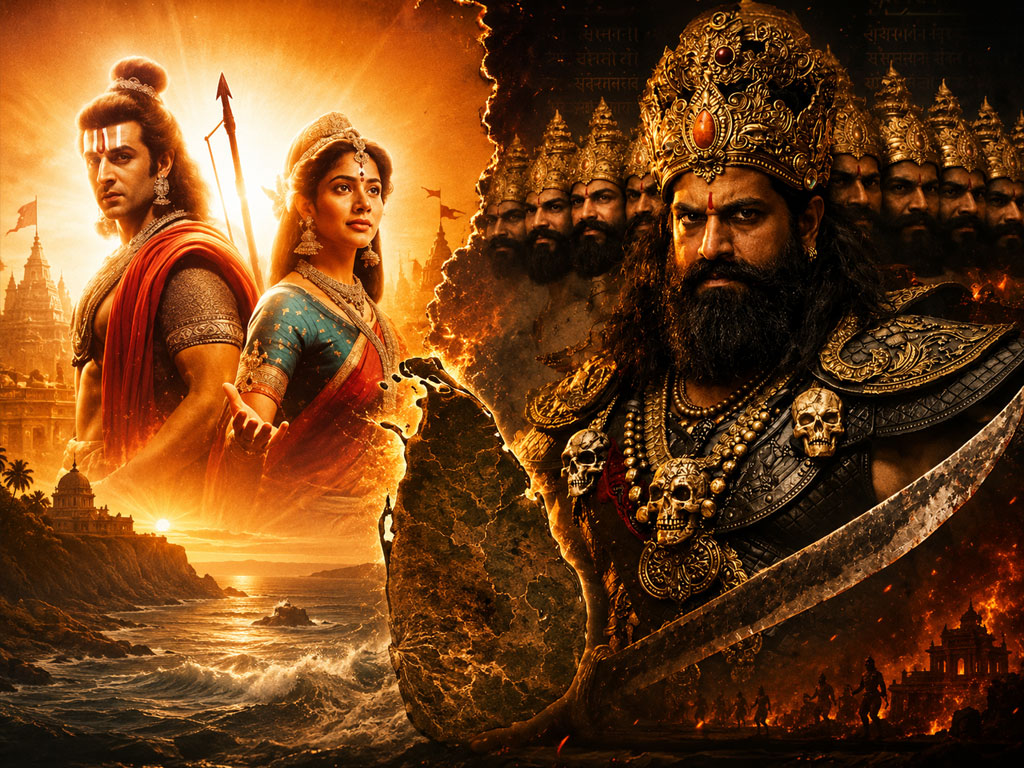
Ramayana cultural influence is expanding through an ambitious Indian film that could reshape global perceptions of Rama, Ravana and Sri Lanka.
The Ramayana cultural influence is preparing to enter a powerful new phase through one of the most ambitious cinematic projects ever attempted in India.
Nitesh Tiwari’s forthcoming Ramayana film duology has already generated widespread discussion across India and beyond. Critics and industry observers describe it as potentially the largest production in Indian cinema’s history of more than 130 years.
This is not simply another popular “bioscope.” It represents a vast cultural project capable of carrying the spiritual prestige and mythological power of ancient Bharatiya civilisation to audiences across the world.
Private investors are financing the production. However, its structure and ambitions appear closely aligned with India’s wider national vision and growing use of cultural soft power.
Current plans indicate that producers will release the two-part Pan-India project during the Diwali seasons of 2026 and 2027. “Pan-India” is a commercial term for a film, service or concept designed to reach audiences across India’s major linguistic and regional markets.
The first instalment is scheduled for a worldwide release on 6 November 2026. Its international rollout is expected to include premium cinema networks such as IMAX.
Ramayana Cultural Influence Meets Hollywood Technology
Indian cinema has sometimes struggled to present its grand mythological narratives convincingly to global audiences.
Technology often created the main limitation. Filmmakers could not always deliver the visual scale required by stories involving gods, legendary kingdoms, supernatural forces and epic warfare.
As a result, younger audiences occasionally ridiculed mythological films whose visual effects failed to match the power of the stories they attempted to portray.
The new Ramayana appears determined to remove that weakness.
This is not merely another Hindi-language Bollywood production. Its cast reflects a deliberate Pan-India combination of northern, southern and regional cinematic identities.
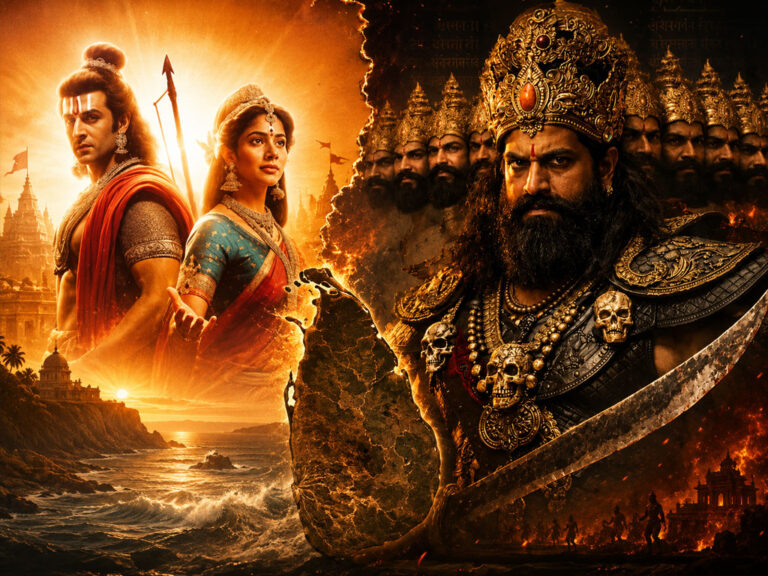
Ranbir Kapoor, a member of North India’s celebrated Kapoor film family, will portray Rama. South Indian actor Sai Pallavi will play Sita.
Yash, the Karnataka star who achieved immense popularity through the KGF films, will appear as Ravana, also known as Lankesh. Sunny Deol, from a Sikh background, will portray Hanuman.
Ravi Dubey, described as belonging to a North Indian Brahmin lineage, will play Lakshmana. Together, the actors represent a cross-regional cast designed to appeal across India.
The production’s technical foundations are equally significant.
Namit Malhotra, the head of Oscar-winning visual effects company DNEG, is producing the film. DNEG contributed visual effects to major Hollywood productions including Inception, Interstellar and Dune.
Meanwhile, Indian composer A.R. Rahman and Hollywood composer Hans Zimmer are reportedly collaborating on the music. This partnership brings together two globally recognised musical traditions.
Various estimates have circulated about the film’s cost. However, reports suggest the combined budget for the two films exceeds 8.35 billion Indian rupees.
Regardless of the final amount, the project is expected to become India’s most expensive cinematic production.
The strategy also extends beyond Indian audiences.
The producers reportedly plan to use artificial intelligence to dub the film into several languages, including English, Spanish and Japanese. China and other major international markets form part of the wider commercial target.
The producer has reportedly stated that the film will fail if the West remains unaware of it. That declaration appears to reveal the project’s deeper ambition.
India does not merely want to retell the Ramayana at home. It wants to establish the epic as a global cultural reference.
Diwali Release Carries Spiritual Meaning
The choice of Diwali for the film’s release carries importance beyond business.
According to the Ramayana tradition, Diwali marks Rama’s return to Ayodhya after 14 years in exile.
Releasing the film during that festival therefore connects commercial cinema with religious memory, national identity and spiritual celebration.
The decision transforms the opening date into part of the film’s cultural message.
The Ramayana unfolds across seven Kandas and 645 Sargas. Yet its deeper meaning extends beyond a personal conflict between Rama and Ravana.
When viewed anthropologically, the epic can represent a confrontation between two powerful cultural currents.
Rama stands for an Aryan civilisation shaped by Vedic values and the Varnashrama social system.
Ravana, the ruler of Lankapura, represents another cultural current associated with southern peoples described in Aryan literature as non-Aryan, Yaksha, Naga and Asura.
That opposing world appears linked with urban development, philosophy and advanced forms of technology.
Scholars often interpret such anthropomorphic characters as symbolic representations of broader social and anthropological processes.
From that perspective, Rama, Sita, Ravana and Hanuman are not merely individual personalities. They also embody communities, ideas, cultural conflicts and civilisational memories.
Sri Lanka’s Place Within the Aryan Cultural Orbit
The arrival of Mahinda Thera in the third century BC brought Buddhism to Sri Lanka. However, it also placed the island within the ideological orbit of a northern Indian cultural world based strongly on Pali and Sanskrit.
This was not simply the Vedic cultural empire of India.
Emperor Dharmashoka promoted a new moral and cultural order centred on Buddhism. He spread that influence across several countries through missions associated with the Dhamma.
Sri Lankan monks later wrote the Mahavamsa and Dipavamsa within this wider cultural environment.
Their chronicles attempted to connect the Sinhala people to an Aryan origin.
The Vijaya legend described the Sinhalese as descendants of Aryans who travelled from Sinhapura in Bengal.
That narrative naturally encouraged Sri Lankan society to identify with Rama. At the same time, it taught generations to treat Ravana, supposedly a ruler of their own land, as the villain.
However, modern archaeological and linguistic research has complicated that simplified account.
Carbon-14 tests linked to excavations in Anuradhapura have indicated the presence of urban settlements dating to around 900 BC.
Such findings have revealed dimensions of Sri Lanka’s ancient history that conventional narratives did not fully explain.
Evidence relating to Balangoda Man traces human development on the island to about 30,000 BC.
Professor Wilhelm Geiger also identified “Pre-Sinhala” indigenous elements within the Sinhala language.
Father Theodore G. Perera’s work, The Evolution of the Sinhalese Language, explored Dravidian and Austroasiatic connections.
Together, these lines of inquiry suggest that Sri Lanka’s people inherited a non-Aryan yet sophisticated civilisational foundation.
Ramayana’s Long Presence in Sri Lankan Culture
Valmiki’s Ramayana is not foreign to Sri Lankan society.
For centuries, Sinhala literature and folk traditions have absorbed poetic translations, prose adaptations and local retellings of the epic.
Lawyer John de Silva, a pioneer of modern Sri Lankan theatre, wrote Ramayana as his first play. It was staged at the Floral Hall theatre on Malwatta Road in Pettah on 27 May 1886.
John de Silva sought to redirect a Sinhala society increasingly influenced by Western culture under British colonial rule.
He looked towards the prestige of Eastern civilisation for cultural renewal.
For that purpose, he adapted Valmiki’s epic without fundamentally changing its established moral structure.
Rama therefore remained the noble hero. Ravana continued to appear as the evil ruler described within the traditional Valmiki interpretation.
A different ideological development emerged during the 1940s.
The Hela Havula movement, led by Munidasa Kumaratunga, placed the indigenous “Hela” identity at the centre of cultural discussion.
Its supporters promoted narratives about ancient rulers connected with sun and moon worship, including Bali, Tharu and Ravi.
They also emphasised Yaksha and Naga traditions, along with supposed achievements in aviation technology, medicine and alchemy.
Many legends, village names and locations are still presented as evidence of Ravana’s historical presence.
However, apart from the Ramayana tradition itself, no broadly accepted local historical source has established that a ruler named Ravana governed Sri Lanka.
Despite that absence, twentieth-century cultural movements transformed Ravana from a condemned villain into an exceptional local hero.
Sri Lankan society therefore inherited two broad ideas during the colonial period: Aryan Sinhala identity and Hela identity.
Yet these competing currents did not initially create an open national conflict.
War and the Modern Ravana Renaissance
The situation began changing after the northern conflict started in 1983 and gradually became more violent.
Sinhala society needed powerful cultural symbols capable of providing psychological confidence and hope during war.
Dutugemunu remained one of Sri Lanka’s greatest folk heroes. However, his historical identity was largely secular and human.
Sections of society appeared to seek a superhuman warrior figure who could offer even greater emotional power.
Ravana fulfilled that need.
The modern elevation of Ravana can therefore be linked with a social and psychological vacuum created during the conflict.
Arisen Ahubudu, an influential member of Munidasa Kumaratunga’s Hela Havula movement, wrote Sakvithi Ravana in 1988.
The play became an important milestone in Sri Lankan theatre and literature.
For the first time, a major modern work completely reversed the demonic figure presented through the Indian epic.
Ahubudu portrayed Ravana as a just, advanced, civilised and heroic Hela monarch.
His larger intellectual objective was to promote a mature and independent Hela history free from Indian or other foreign cultural dominance.
That effort reached one of its strongest expressions through Sakvithi Ravana.
The production later supported the Ravana Renaissance and the Ravana-centred subculture that developed across Sri Lanka.
Today, the Ravana idea has achieved remarkable popularity.
Temples, cultural organisations, businesses and even massage centres reportedly use his name.
However, popularity has also created opportunities for manipulation.
Sri Lanka recently encountered claims involving a deceptive woman who portrayed herself as Ravana’s younger sister and allegedly exploited vulnerable people.
Such incidents demonstrate how mythological pride can move from cultural revival into commercial or personal deception.
India Uses Cinema as Global Soft Power
Nitesh Tiwari’s Ramayana now appears ready to become India’s most advanced instrument of cultural soft power.
The United States spent decades exporting fictional heroes such as Superman, Batman and characters from the Marvel universe.
Those creations strengthened American entertainment, commercial reach and cultural influence.
India is now preparing to present its own ancient legendary heroes to the world through the highest levels of modern cinematic technology.
The difference is significant.
Marvel and DC heroes emerged largely from modern commercial fiction.
Rama, Sita, Hanuman and Ravana have existed within religion, literature, performance and social memory for thousands of years.
By combining those ancient figures with Hollywood-level visual effects, international music and global distribution, India can transform inherited mythology into contemporary geopolitical influence.
Cinema allows a country to expand its cultural presence without military force.
Audiences who watch the production may become interested in Indian spirituality, festivals, language, tourism, philosophy and history.
They may also absorb India’s interpretation of the civilisation represented within the epic.
That is the central power of cultural influence.
It does not openly command. Instead, it makes one nation’s stories emotionally familiar to the rest of the world.
What Happens to Ravana’s Lanka?
This development creates an important question for Sri Lanka.
What will happen to the local Ravana Renaissance when India presents a technologically overwhelming version of the Ramayana to global audiences?
Sri Lanka’s modern Ravana narrative developed through theatre, folklore, nationalism and cultural recovery.
However, it has never received financial or technological support comparable to the resources now driving the Indian production.
A film costing billions of rupees and distributed through IMAX, international dubbing and global marketing can easily establish its character interpretations as the dominant public version.
Ravana may again become the grand antagonist before billions of viewers, regardless of Sri Lanka’s efforts to reclaim him as an indigenous hero.
At the same time, the film may create new international interest in the island identified with Lankapura.
Sri Lanka could potentially benefit through tourism, archaeological discussion, cultural research and renewed attention to the Ramayana trail.
Yet these benefits will depend on whether Sri Lanka can articulate its own historical and cultural perspective responsibly.
Unsupported claims will not be enough.
Sri Lanka must distinguish archaeological evidence from mythology, cultural memory from verified history, and national pride from commercial invention.
Indian Expansionism and Changing JVP Politics
The film also arrives within an interesting Sri Lankan political context.
Rohana Wijeweera, founder of the Janatha Vimukthi Peramuna, taught the concept of “Indian expansionism” during his third political class.
The JVP later expressed that position through armed opposition to the Indo-Lanka Peace Accord signed on 29 July 1987.
The party once treated Indian political and cultural influence as a fundamental danger.
However, the political movement that now exercises government power appears to have abandoned much of that doctrine.
Modern economic and diplomatic realities have pushed the JVP and the broader National People’s Power administration towards a more pragmatic relationship with India.
The earlier theory of Indian expansionism appears to have entered the dustbin of contemporary politics.
However, influence does not operate only through agreements, investments, ports or diplomatic pressure.
It can also travel through music, cinema, mythology, language and emotion.
India’s new Ramayana could achieve culturally what direct political messaging cannot.
It may carry Rama across the world while returning Ravana to Lankapura under an Indian interpretation strengthened by unmatched cinematic power.
No one can yet predict whether this global Ramayana cultural influence will benefit Sri Lanka or weaken the island’s Ravana-centred cultural revival.
The outcome may bring tourism, renewed scholarship and international attention. It may also overwhelm local narratives that lack comparable resources.
What remains certain is that this is not merely a film release.
It is a major cultural event through which India is preparing to place one of its oldest epics at the centre of the global imagination.

By Dr. Praneeth Abhayasundara
Former Professor of Anthropology