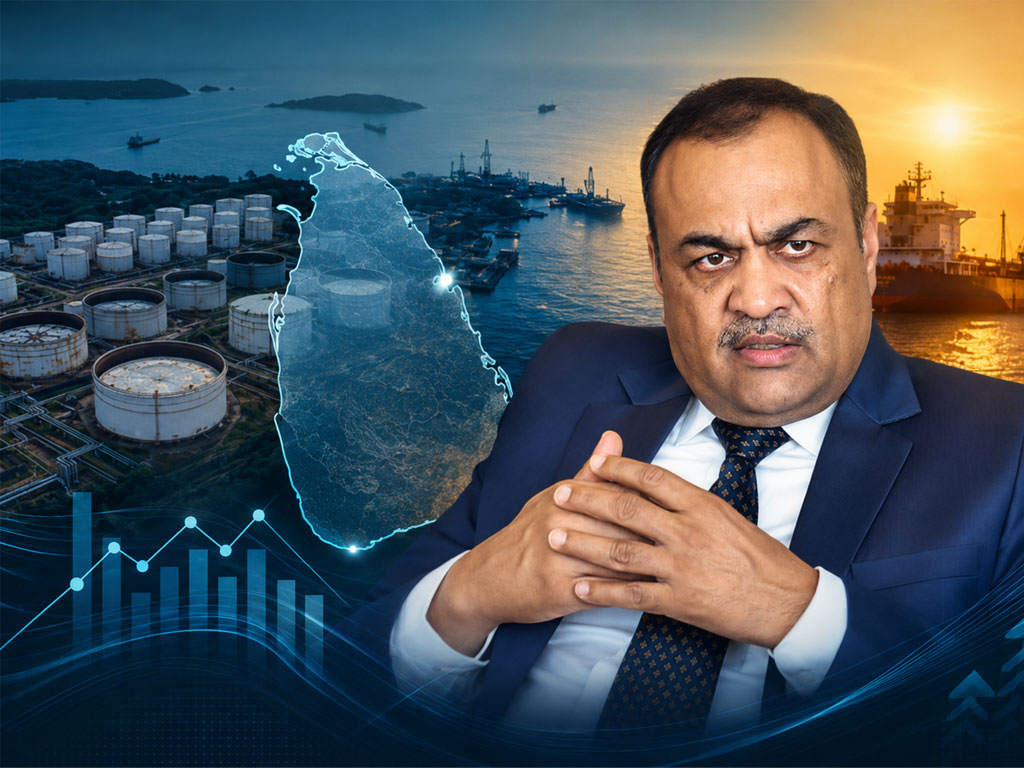
Sri Lanka energy hub plans need faster investment in refining, bunkering and Trincomalee storage, Lanka IOC Chairman Anuj Jain says.
Sri Lanka’s energy hub ambitions remain within reach, but delayed implementation continues to hold back the country’s potential, Lanka IOC PLC Chairman Anuj Jain has warned.
Jain said Sri Lanka already has the location, strategic advantage and industry roadmaps needed to become a major South Asian energy centre. However, the country must move faster on refinery expansion, bunkering infrastructure and the Trincomalee oil tank farm.
Speaking at Lanka IOC’s Annual General Meeting in Colombo, he said years of discussion have not produced enough practical progress. The main obstacle, he argued, is no longer a lack of planning but the slow execution of key petroleum infrastructure projects.
Get Breaking News First
on WhatsApp

Global Energy Risks Create an Opportunity
Global energy markets continue to face uncertainty from geopolitical conflicts, supply chain disruptions and shifting trade routes. For Sri Lanka, which depends almost entirely on imported fuel, those pressures have renewed concerns over refining, storage and distribution capacity.
Jain said the country could turn those weaknesses into long-term economic opportunities. Priority investments across the petroleum supply chain could strengthen national energy security while creating a regional business platform.
He highlighted the need to expand refining capacity, modernise pipeline networks, improve port facilities and develop larger fuel storage complexes. Together, these projects could help Sri Lanka become an important bunkering and supply point for vessels travelling along international maritime routes.
Sri Lanka’s position near one of the world’s busiest shipping lanes gives it a competitive advantage that other countries cannot easily reproduce. With the right infrastructure, Jain said, the island could move beyond its current role as a fuel importer.
Instead, it could serve international maritime traffic as a regional centre for petroleum storage, refining and distribution.
Sri Lanka Energy Hub Plans Need Execution
Jain, who previously served in Sri Lanka between 2015 and 2018, said policymakers and industry stakeholders have discussed many of these proposals for almost a decade.
“Our roadmap is very clear. The biggest challenge facing the country now is not planning, but execution on the ground,” he said.
His comments underline the widening gap between Sri Lanka’s strategic energy plans and the pace of implementation. Refining projects, bunker facilities and storage development require sustained investment, faster approvals and clear national direction.
Recent temporary disruptions around the Strait of Hormuz have also shown the risks facing fuel-importing countries without adequate strategic reserves. Sri Lanka needs a stable storage network to protect the economy from sudden supply interruptions and sharp price movements.
Lanka IOC, Jain said, intends to operate as more than a traditional retail fuel supplier. The company is expanding its long-term involvement in lubricants, bitumen, bunkering, petrochemicals and the Lower Tank Farm complex in Trincomalee.
However, he stressed that no single company can deliver Sri Lanka’s energy hub ambitions alone. Large refining and storage developments will require coordinated public and private sector investment.
The country will also need a clear regulatory framework, quicker approval procedures and long-term national energy planning. Jain said Indian Oil Corporation is prepared to provide technical, commercial and financial support if the Sri Lankan government commits to large-scale refining or storage projects.
Sri Lanka therefore has the geography, commercial opportunity and proposed roadmap. The remaining test is whether authorities can turn those advantages into functioning infrastructure before another global energy shock exposes the country’s vulnerabilities.