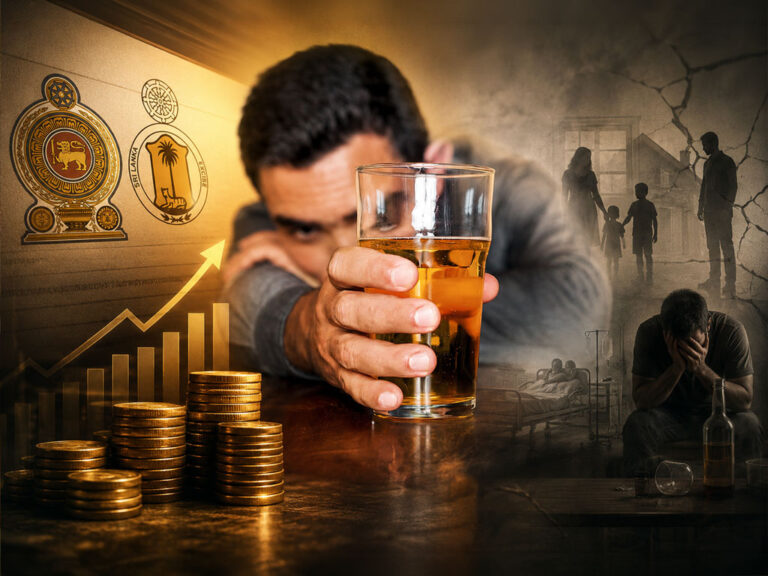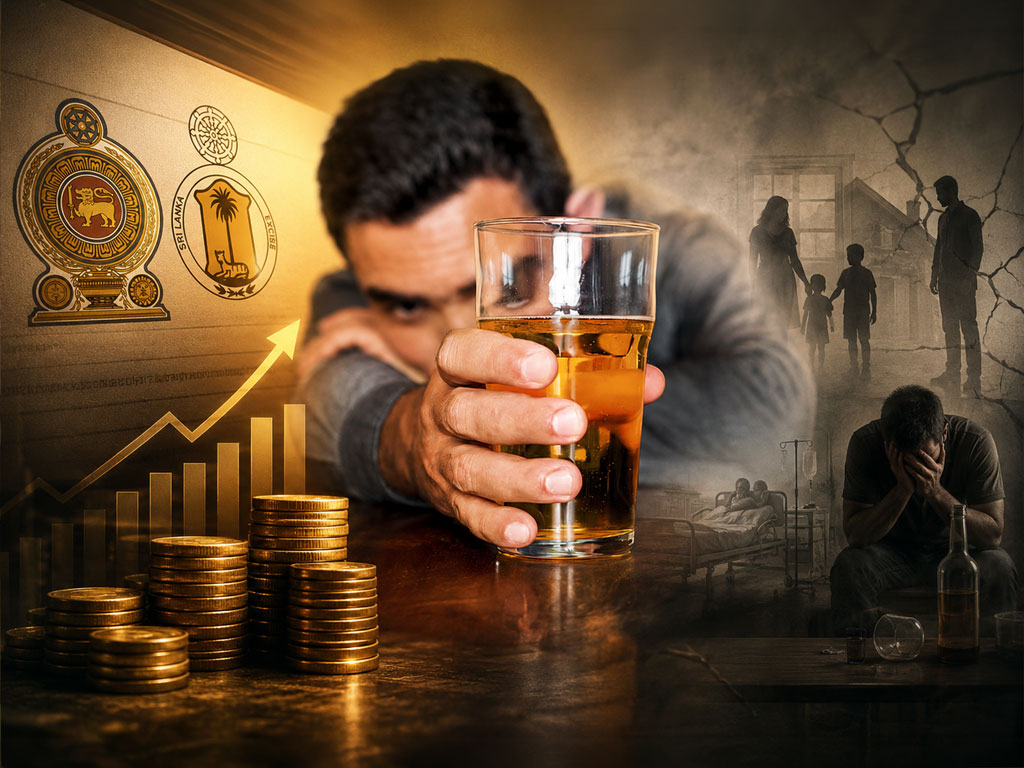
Sri Lanka excise revenue reached Rs. 141.5 billion as alcohol use rose, raising concerns over addiction, disease and family hardship.
Sri Lanka excise revenue reached Rs. 141.5 billion during the first half of 2026, delivering a major financial gain for the Treasury while raising difficult questions about alcohol consumption and its social cost.
The Excise Department’s performance appears impressive when viewed purely through government revenue figures. However, the statistics also reveal rising legal alcohol consumption and the damage that addiction can inflict on health, families and future generations.
The development therefore presents two sharply contrasting realities. It offers good news for government finances, but potentially troubling news for society.
According to an official Excise Department announcement, the agency collected Rs. 141.5 billion during the first six months of 2026.
That result represents a record achievement for the department.
During the first quarter alone, excise collections reached Rs. 70.4 billion. The department comfortably exceeded its quarterly target of Rs. 61.95 billion.
Get
Breaking News
First
on WhatsApp
Follow The Morning Telegraph for instant alerts, top stories and exclusive updates delivered straight to your phone.

Excise revenue reaches 118.6% of target
The Excise Department received a revenue target of Rs. 119.3 billion for the first half of 2026.
Its Rs. 141.5 billion collection amounted to 118.6% of that target.
The annual excise revenue target for 2026 stands at Rs. 245 billion. Excise duties are considered the Government’s third-largest source of tax revenue.
Revenue also rose considerably from the same period last year.
The department collected Rs. 117.03 billion during the first half of 2025. The latest result represents 120.91% of that figure.
The Excise Department also exceeded its annual target in 2025 for the first time in its history.
It reportedly collected between Rs. 231.3 billion and Rs. 233 billion against a target of Rs. 227.4 billion. That represented approximately 102% target fulfilment.
However, improved tax administration alone does not explain the growth.
The quantity of absolute alcohol used in liquor production increased by 13.6%.
Producers used 17.25 million litres during the first half of 2025. That figure rose to 19.6 million litres during the corresponding period of 2026.
The increase indicates quantitative growth in legal alcohol consumption within Sri Lanka.
When converted into 750-millilitre bottles, 19.6 million litres amounts to approximately 26.13 million bottles.
Security stickers and enforcement limit tax leakage
Excise Commissioner General M. B. N. A. Premaratne attributed the revenue performance to several factors.
He credited the commitment of officials across all ranks and strict monitoring of liquor factories and arrack distilleries.
Authorities also introduced new security stickers and intensified investigations into illicit alcohol.
Excise officers carried out regular inspections at licensed establishments as part of the enforcement programme.
These measures reportedly reduced the circulation of counterfeit liquor and untaxed products.
Sri Lanka needs to raise government revenue above 15% of gross domestic product following the domestic debt restructuring process.
The Excise Department, Sri Lanka Customs and the Inland Revenue Department therefore serve as the main pillars of public revenue collection.
Exceeding the half-year target by 118.6% suggests that stronger enforcement has reduced tax leakage.
The security-sticker system appears to have helped authorities identify unlicensed or counterfeit products before they entered the legal market.
From a fiscal perspective, this represents a clear success. Yet the wider implications remain more complicated.
Is Sri Lanka excise revenue a genuine victory?
Economists often describe duties imposed on harmful products as “sin taxes”.
Governments apply higher taxes to alcohol, tobacco and similar goods partly to discourage consumption. Raising prices should, in theory, reduce demand while generating funds to address the harm those products create.
Sri Lankan authorities have periodically increased alcohol prices with the stated objective of reducing consumption.
However, the latest figures appear to tell a different story.
Despite higher prices, the quantity of absolute alcohol used for legal liquor production rose to 19.6 million litres.
This suggests that alcohol demand is not highly sensitive to price increases.
Consumers may continue buying liquor even while facing pressure from inflation, debt, reduced household income and other economic difficulties.
The figures could therefore reflect deeper social problems rather than simple consumer preference.
The tragedy becomes clearer when alcohol spending occurs inside households already struggling to meet essential needs.
A husband or father may continue purchasing liquor while his wife and children face shortages of food, clothing, healthcare and educational materials.
The revenue enters the Treasury. However, the resulting personal and family costs remain hidden inside homes.
Alcohol conflicts with Sri Lanka’s cultural traditions
Sri Lanka’s mainstream cultural traditions have generally encouraged people to remain distant from alcohol.
Buddhist teaching, followed by the majority of the population, includes abstinence from intoxicating substances within the Five Precepts.
The fifth precept is expressed as “Surāmeraya majja pamādaṭṭhānā veramaṇī”, meaning abstention from intoxicating drinks and drugs that cause heedlessness.
This teaching is not merely a religious prohibition. It also carries a strong moral and social dimension.
Abstinence can help prevent crimes linked to impaired judgment, domestic disputes, marital breakdown, traffic accidents and reduced productivity.
However, modern society increasingly presents alcohol as a feature of sophisticated social life.
Some also view drinking as a symbol of masculinity or social status.
As these attitudes spread, the associated consequences may also become more common.
Health authorities warn no alcohol level is safe
The World Health Organization published a clear warning in The Lancet Public Health in January 2023.
The organisation stated that no level of alcohol consumption is safe for human health.
Ethanol, the substance contained in alcoholic beverages, has been classified by the International Agency for Research on Cancer as a Group 1 carcinogen.
This is the agency’s highest cancer-risk category.
Alcohol therefore appears in the same broad carcinogenic classification as tobacco, asbestos and radiation.
The WHO has linked alcohol consumption directly to seven types of cancer.
In Europe alone, approximately 23,300 cancer cases reportedly occur each year among light and moderate drinkers.
These findings underline the tragedy behind the Rs. 141.5 billion collected by Sri Lanka’s Excise Department.
The Treasury records the income immediately. However, health consequences may emerge slowly over years or decades.
Alcohol addiction creates multiple health risks
Alcohol consumption affects communities differently, but excessive drinking presents a major threat to personal health and family stability.
Heavy alcohol use can contribute to liver cirrhosis, high blood pressure, heart attacks and gastritis.
It also increases the risk of several cancers.
Alcohol weakens the nervous system and may contribute to depression, uncontrollable anger and restlessness.
It can also impair judgment and physical coordination.
Drunk driving increases the risk of road crashes, while intoxication can contribute to falls, assaults and other injuries.
These incidents can cause permanent disability or premature death.
The damage does not end with the person consuming alcohol.
Families may have to pay for repeated medical treatment, long-term medication, hospital admissions and rehabilitation.
When illness prevents the drinker from working, households can lose their main source of income.
Family finances suffer as alcohol spending rises
Money spent daily or weekly on alcohol reduces the amount available for essential household expenses.
Families may struggle to purchase food, clothing and school supplies.
Children’s tuition fees, transport costs and medical needs may receive less attention.
Meanwhile, illnesses caused or worsened by drinking create additional expenses.
Heavy drinkers may lose productivity at work, take frequent leave or become unemployed.
Once stable income disappears, families may borrow money at high interest rates.
They may also pawn jewellery, land documents or other valuable assets.
Over time, these decisions can push the entire household into severe debt.
Alcohol-related poverty therefore does not result only from the price of liquor.
It develops through medical costs, reduced earnings, unemployment, borrowing and the disposal of family property.
Children bear the deepest emotional damage
Alcohol misuse also contributes to domestic violence, suspicion between spouses and repeated conflict inside homes.
Children often suffer the greatest harm.
They may witness verbal abuse, physical violence or the collapse of relationships between their parents.
Some children lose access to stable education because household income has been diverted or destroyed.
Others experience fear, anxiety and psychological trauma.
These memories can remain with them throughout adulthood.
The effects may influence their education, future relationships, emotional wellbeing and ability to build secure families of their own.
Therefore, the social cost cannot be measured only through hospital bills or lost wages.
The emotional damage passed from one generation to another may be even greater.
Rising consumption may increase future public spending
The 19.6 million litres of absolute alcohol behind the revenue increase should not be viewed only as an economic achievement.
It may also signal rising future expenditure on healthcare, welfare and social protection.
Alcohol-related illness places pressure on public hospitals and medical professionals.
Road crashes and violence increase demand for emergency services, police investigations and court proceedings.
Families that lose income may require state welfare support.
Children affected by neglect or domestic violence may need counselling and protection.
Therefore, the same product that generates revenue can also create substantial government expenditure.
The State collects taxes when liquor is sold, then spends public money addressing the harm linked to its use.
Illegal alcohol adds another layer of danger
Legal alcohol consumption is only one part of the problem.
Illicit and toxic alcohol reportedly continues to spread in some rural communities.
These products can contain dangerous substances and may cause poisoning, blindness, organ damage or death.
Because illegal liquor avoids taxation and regulatory controls, the Government receives no revenue from those sales.
However, public hospitals must still treat the victims.
Emergency treatment, intensive care and rehabilitation can create substantial financial costs for the State.
Families may also lose income earners prematurely.
The financial and human burden associated with illegal alcohol therefore remains significant, even though it does not appear in official excise revenue statistics.
Praneeth Abhayasundara warns of double burden
The article attributes its wider social analysis to Dr. Praneeth Abhayasundara.
His argument is that alcohol addiction creates a double cost that the apparent success of the sin-tax system cannot control.
The Government earns revenue from alcohol duties.
Yet it must later spend heavily on healthcare, welfare, policing, social security and other consequences of alcohol misuse.
According to this view, the Rs. 141.5 billion cannot be treated as an uncomplicated national gain.
The calculation must also consider the cost of treating disease, responding to violence and supporting affected families.
Without that wider assessment, the financial picture remains incomplete.
Guidance needed from religious and civic leaders
The article calls on Sri Lanka’s lay intellectuals and religious leadership to provide clearer guidance to the Government.
Public policy cannot depend solely on raising taxes and celebrating higher collections.
Taxation may control some consumption and prevent revenue leakage, but it cannot address addiction by itself.
Sri Lanka also needs public education, counselling, rehabilitation and stronger family-support programmes.
Schools and communities require programmes that explain the health risks of alcohol before drinking becomes socially normalised.
Religious institutions, healthcare professionals and civil-society organisations could also help change public attitudes.
The goal should not be moral condemnation of individuals suffering from addiction.
Instead, policy should combine prevention, treatment and protection for families.
The self-consuming reptile
The article compares the situation to a self-consuming reptile found in world literature and ancient cultural texts.
The creature attempts to survive by eating its own flesh. However, that same act eventually destroys it.
Sri Lanka’s dependence on alcohol revenue risks producing a similar contradiction.
On one side, liquor taxes help fund the country.
On the other, the same alcohol can destroy health, weaken families and damage future generations.
The Government then carries the financial burden through healthcare, welfare and social-security spending.
Higher Sri Lanka excise revenue is therefore not automatically evidence of social progress.
Improved enforcement and reduced tax leakage deserve recognition. However, rising alcohol consumption should trigger concern rather than celebration.
The Treasury may receive Rs. 141.5 billion today, but the country could pay a far greater price through disease, poverty, violence, broken families and damaged childhoods.
Unless Sri Lanka balances revenue collection with effective prevention and treatment, the State risks feeding itself by consuming the wellbeing of its own people.