Sajith Premadasa farmers campaign focuses on paddy prices, estate land rights, judicial reforms and a series of diplomatic meetings.
The Sajith Premadasa farmers campaign expanded across several districts last week as the Opposition Leader confronted agricultural grievances, visited a struggling hospital and held high-level diplomatic meetings in Colombo.
Farmer protests have created growing political pressure across Sri Lanka. Farmers accuse the Government of abandoning promises made before coming to power and adopting policies that leave agricultural communities financially vulnerable.
Against that backdrop, Premadasa travelled through several regions to hear directly from farmers and present the Samagi Jana Balawegaya’s response.
Get
Breaking News
First
on WhatsApp
Follow The Morning Telegraph for instant alerts, top stories and exclusive updates delivered straight to your phone.

Farmers surround Sajith during Anuradhapura visit
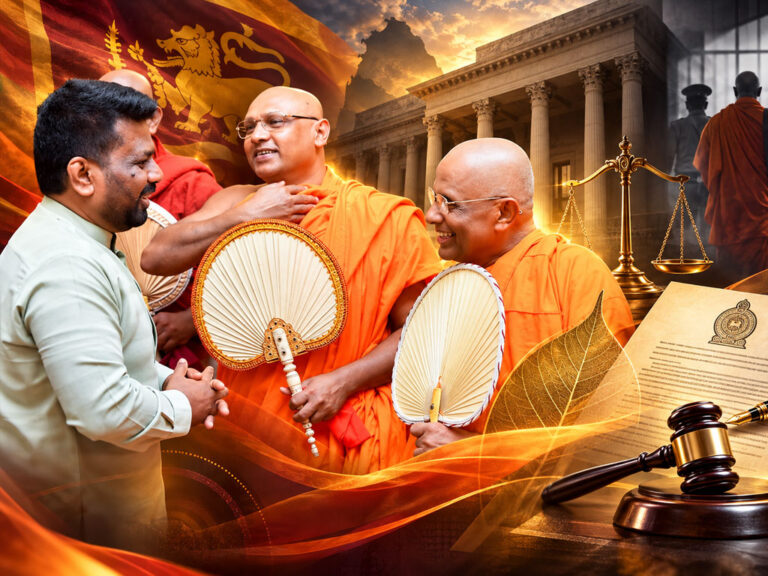
Premadasa attended the foundation-stone ceremony for a large Dharma Hall at the Horowpothana Wagollagoda Bodhirukkarama Maha Vihara.
The Maha Sangha and local residents had invited him to the ceremony.
Speaking there, Premadasa said the Malimawa Government had promised to pay Rs. 150 for one kilogram of paddy and make farmers “kings”.
However, he alleged that the Government was now insulting farmers by describing them as drug addicts.
After the event, farmers gathered around the Opposition Leader and described the problems they faced.
One emotional farmer said producing one kilogram of paddy cost approximately Rs. 137.
However, the Agriculture Minister had reportedly said the Government could offer only Rs. 120 per kilogram.
The farmer said Government purchasing centres had not opened, even at that price.
“We sell our wet paddy at Rs. 80 to Rs. 85,” he told Premadasa.
He added that private buyers were offering even lower prices under the Government’s price-regulation system.
“Sir, how are we supposed to survive?” the farmer asked.
“We gave both the presidency and the two-thirds majority, and now we have been left with nothing.”
Premadasa listened as farmers continued presenting their grievances over production costs, purchasing arrangements and falling market prices.

Rural hospital found without essential resources
During his Anuradhapura District tour, Premadasa also inspected the Horowpothana Thapugollawa Rural Hospital.
He visited the facility after receiving information that it faced serious deficiencies.
The hospital is the only facility providing treatment to residents of 20 villages across seven Grama Sevaka divisions.
During the inspection, Premadasa identified shortages of doctors, medical equipment and other physical and human resources.
He said those shortages had left the hospital largely dysfunctional.
Premadasa accused the Government of denying people their right to benefit from Sri Lanka’s free healthcare system.
“If there were Provincial Councils, these problems would not exist,” he said.
Premadasa argued that elected Provincial Council representatives would face pressure to resolve local problems.
He said both the Government and provincial authorities would have to address deficiencies if elections were held.
However, he accused the Government of deliberately postponing Provincial Council elections.
Premadasa said the SJB could provide equipment if the Government lacked the strength or resources to meet the hospital’s needs.
He urged authorities to examine the healthcare requirements of poor communities immediately.
Sajith Premadasa farmers campaign reaches Mihintale
After leaving the hospital, Premadasa travelled to Nachchaduwa in Mihintale.
Party activists, farmers and several other groups had organised a public meeting there.
A large crowd welcomed him when he arrived.
Addressing thousands gathered at the event, Premadasa said farmers would ultimately remove a Government that insulted them.
“The Government is engaged in a policy of destroying agriculture,” he said.
“The farming community is in great distress because of this.”
Premadasa said ministers had promised to make farmers kings during the election campaign.
After the election, however, he claimed they had reduced the farmer’s value to nothing.
“What are they calling the farmer today?” Premadasa asked.
A voice from the crowd replied: “Sir, they are now calling us drug addicts.”
Premadasa responded by telling the crowd that many of them had stood in line and voted for Anura Kumara Dissanayake.
“I know that even if you say no now, deep down you did give him your vote at that time,” he said with a smile.
The remark made the gathering laugh.
Indian protest movement cited as a warning
Premadasa also referred to what the translated source described as India’s “Cockroach People’s Party”.
He said the movement emerged after the Chief Justice of India allegedly described unemployed young people as cockroaches.
According to Premadasa, the movement later gained enough influence to affect the position of the Education Minister.
He used the example to warn that resentment could build when a Government insults the social groups that helped bring it to power.
“The end of this Government, which insults our farmers by calling them drug addicts, will be decided by the farmers themselves,” he said.
Premadasa accused the administration of having no concern for farmers.
He also recalled the numerous promises made to agricultural communities before the election.
“Today, those who ate the harvest are hiding, nowhere to be seen,” he said.
After the public meeting, Premadasa moved among the farmers and thanked them for attending.
They again asked him to help secure a fair price for their produce.
Farmers told Premadasa that he had been the only person speaking about them in Parliament during the previous week.
“You are the only one who speaks about the farmer, farmer rights and stable prices,” they said.
“Now, you are the only one left for us to tell our sorrows to.”
Premadasa asked them to remain patient a little longer before leaving.
Farmers raise concerns in Suriyawewa
Following the Anuradhapura programme, Premadasa attended another farmers’ meeting at Habaraththawala in Suriyawewa.
Farmer leaders and a large crowd attended the event.
Premadasa questioned them directly, took notes and explained the steps that could be taken to address their concerns.
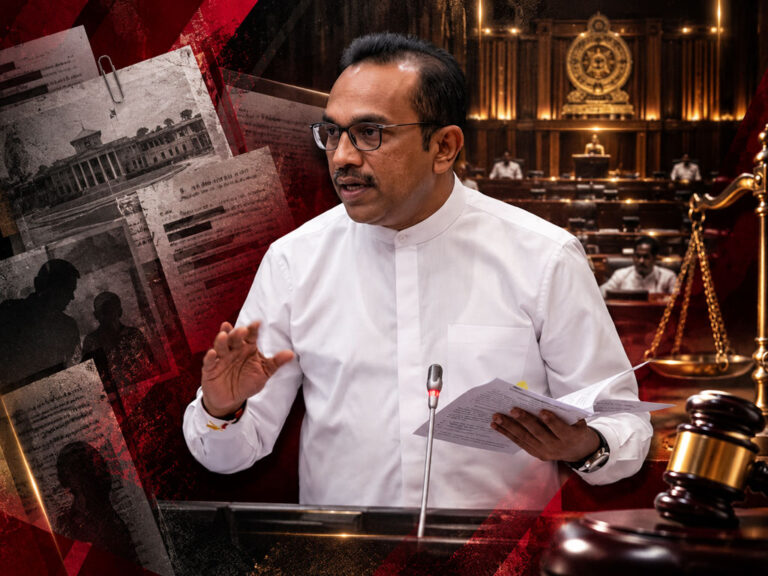
He said the Malimawa Government had damaged not only agriculture but also democracy and the judiciary.
Premadasa described the judiciary as one of the three central pillars of democracy.
The other two are the legislature and executive.
He accused the Government of attempting to change the retirement age of judges.
Premadasa asked whether that proposal had appeared in the Government policy statement titled “A Rich Country, A Beautiful Life”.
Revenue increase should fund farmer relief
On Friday morning, Premadasa attended a farmers’ meeting in Debarawewa.
Farmers raised problems involving paddy prices, fertiliser costs, cultivation loans and “egg paddy”, referring to damaged or rotten paddy.
Premadasa listened before accusing the Government of deceiving the entire farming community.
He said President Anura Kumara Dissanayake and Prime Minister Harini Amarasuriya must answer for the situation.
Premadasa referred to statements from ministers that state revenue had increased by 27% during the previous six months.
“If state revenue has increased that much, why are they deliberately working to impoverish the farmer?” he asked.
Premadasa questioned why part of the additional revenue could not support Government purchases of paddy at a fair price.
He accused the administration of giving one message to the country and another to farmers.
Estate community promised land and entrepreneurship
Premadasa also examined problems involving land rights for Sri Lanka’s estate community.
He convened a meeting of the Samagi Estate Workers’ Union in Ratnapura.
Parliamentarian Sujith Sanjaya Perera organised the meeting at the Sansiti Hotel in Balangoda.
Premadasa said members of the plantation community had long been described simply as estate labourers.
He argued that the description was inappropriate and called for those workers to become land-owning entrepreneurs.
“Although they said they would increase wages to Rs. 1,000, Rs. 1,500 and Rs. 2,000, even obtaining Rs. 1,750 remains very difficult,” he said.
Premadasa said election-time wage increases would not provide a sustainable solution.
Instead, he called for families to leave line-room housing and become small tea-estate owners or entrepreneurs.
He also highlighted problems involving education and healthcare in plantation areas.
Premadasa said a future Government under his leadership would establish a Presidential Task Force.
The proposed body would seek sustainable solutions to the estate community’s long-standing problems.
He said the current administration had promised justice to plantation workers but had not delivered.
Premadasa also referred to reports that the Government was using a 1979 law to remove estate residents from plantation land.
“What we want is to turn this estate community into entrepreneurs,” he said.

Proposal to distribute 200 acres among 85 families
Premadasa cited a letter handed to him by Velayudhan Kadiravel.
The letter referred to 85 families in the Meddekanda and Welekumbura areas.
According to the letter, approximately 200 acres of land were lying unused.
Premadasa asked whether the Government could distribute that land among the 85 families and provide facilities for cultivation.
He said families could build homes, leave the line rooms and increase their income through tea production.
Premadasa argued that such a programme would also raise Sri Lanka’s overall tea output.
He compared production by large plantation companies with production by smallholders.
Premadasa claimed large companies controlled 60% of tea-growing land but contributed only 30% of total tea production.
Small tea-estate owners reportedly held 40% of the land while producing 70% of the country’s tea.
He therefore called for unused plantation land to be allocated systematically to small producers.

Sajith meets Shashi Tharoor in Colombo
Amid his domestic campaign, Premadasa held a special meeting in Colombo with Dr. Shashi Tharoor.
Tharoor is a former United Nations Under-Secretary-General, former Indian minister and internationally recognised writer.
He also chairs India’s Parliamentary Standing Committee on External Affairs.
Tharoor was visiting Sri Lanka when the meeting took place.
In a Facebook post, he said the late-night discussion followed a busy day and continued for more than an hour.
The two discussed recent developments and trends in relations between India and Sri Lanka.
The meeting gave an international dimension to a week otherwise dominated by farmer grievances, estate rights and judicial controversy.

Chinese and Indian diplomats hold discussions
Premadasa also participated in several other diplomatically important meetings during the week.
Outgoing Chinese Ambassador Qi Zhenhong visited the Opposition Leader’s office in Colombo before completing his tenure and returning home.
Premadasa thanked the ambassador for supporting stronger diplomatic relations between Sri Lanka and China.
The new Indian Deputy High Commissioner to Sri Lanka, Mithriya Kulkarni, also met Premadasa in Colombo.
Their discussion focused on further strengthening bilateral relations.
Premadasa later met a delegation from the United States House of Representatives.
The meeting focused on economic cooperation, governance, education and regional stability.
Premadasa stressed the importance of continued US cooperation for Sri Lanka’s economic recovery and long-term development.


US support sought for apparel industry
Premadasa recalled the quota access granted during the administration of his late father, President Ranasinghe Premadasa.
He said that assistance had significantly expanded Sri Lanka’s garment industry.
According to Premadasa, the quotas increased employment and strengthened export revenue.
He asked the US delegation to provide further support for the development of Sri Lanka’s apparel industry.
The discussions placed economic recovery and export growth alongside governance and regional security.

Pelawatta tension grows over judicial amendment
The article also described rising tensions in Pelawatta following a July 23 meeting among opposition-party leaders.
According to the account, the full details became clearer after Malimawa’s executive committee held an emergency meeting on July 27.
Senior Attorney Lal Wijenaike, a member of the Malimawa executive committee, reportedly criticised the proposed 22nd Amendment.
Wijenaike had previously opposed the Government’s actions during a Bar Association media briefing.
He also attended the Bar Association meeting held on July 29.
The article said his participation prompted discussion among a group of SJB lawyers.
One senior lawyer claimed the Malimawa leadership understood the seriousness of the public pressure surrounding the issue.
The lawyer alleged that Tilvin Silva also understood the situation.
He further claimed individuals operating from Pelawatta were monitoring Malimawa executive members.
The lawyer predicted that JVP trade unions would soon experience similar pressure.
The source presented these statements as remarks made during a political discussion and offered no independent evidence supporting the surveillance allegation.
Claims that public-sector support has fallen
A university professor who participated in the discussion reportedly said Malimawa had enjoyed 80% support within the public service before the last general election.
However, the professor claimed that support had since declined significantly.
Public servants had become sensitive to the judicial controversy and the Government’s wider conduct, he said.
The professor referred to alleged insults directed at the public service after Anura Kumara Dissanayake became President.
He also mentioned the appointment of the Presidential Secretary and claimed divisions had developed within state institutions.
According to the remarks, the Administrative Service had been marginalised.
The professor also alleged that public officials had been placed under pressure to meet political requirements.
He claimed suspended officials were being blamed when allegations of theft, fraud or corruption emerged.
The professor questioned whether politicians had stopped influencing decisions merely because a new Government had taken office.
He accused the administration of describing former politicians as thieves while placing current allegations on public officials.
These were political claims made during a private discussion. The article did not provide independent evidence to establish them.
Former MP alleges campaign against institutions
A senior lawyer from Galle, described as a former parliamentarian, reportedly presented a broader interpretation.
He described the developments as the culmination of an alleged Malimawa conspiracy.
According to his argument, Malimawa first encouraged hostility towards politicians and leaders who governed the country during the previous 76 years.
He claimed the movement then weakened public confidence in civil-society organisations.
The lawyer also alleged that Buddhist monks and other religious leaders had been targeted through various methods.
He claimed lawyers were now facing similar hostility.
According to his interpretation, judges would become the next target through the proposed 22nd Amendment.
The former MP argued that weakening confidence in social organisations and institutions could allow Malimawa to present itself as the only trustworthy authority.
“That is their master plan,” he reportedly said.
The article offered no evidence establishing that such a coordinated plan existed.
After the discussion, the SJB-affiliated lawyers dispersed, according to the account.
The Sajith Premadasa farmers campaign therefore developed into a much broader political programme.
Farmer grievances over prices, fertiliser, purchasing centres and cultivation loans remained central.
However, Premadasa also connected those issues with healthcare, Provincial Council elections, judicial independence, estate land ownership and foreign relations.
His meetings with Shashi Tharoor, Chinese and Indian diplomats and a US congressional delegation strengthened the diplomatic element of his week.
Meanwhile, the claims emerging from Pelawatta showed how the proposed change to judges’ retirement ages had become part of a wider political confrontation between the Government and opposition.
SOURCE:- THE LEADER