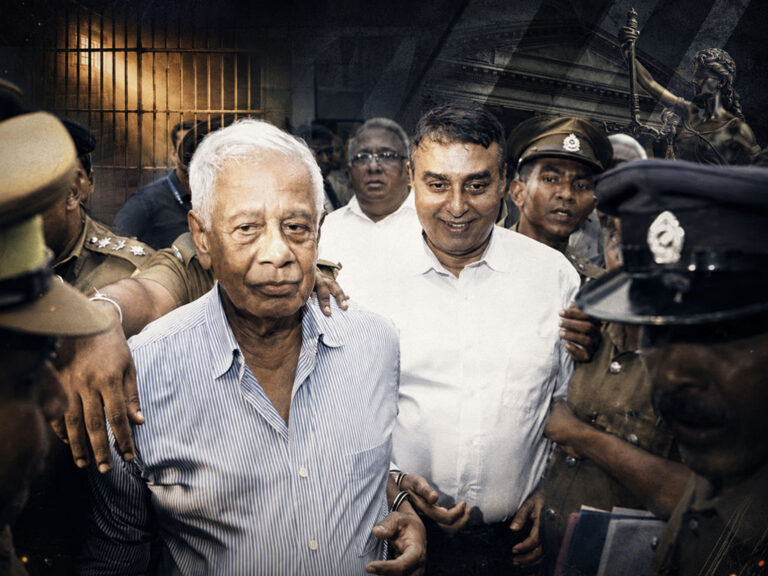
Pujith and Hemasiri prison privileges are reportedly banned after their death sentences, but questions remain over whether the rules will last.
Pujith and Hemasiri prison privileges will reportedly be denied after the former senior officials received death sentences over the 2019 Easter Sunday attacks.
Former Inspector General of Police Pujith Jayasundara and former Defence Secretary Hemasiri Fernando must follow ordinary prison rules, according to prison sources.
Senior officials have reportedly issued strict instructions requiring jailers to treat both men like other prisoners. Officers have also been told not to provide informal comforts sometimes associated with high-profile inmates.
The reported orders specifically prohibit food from home and private arrangements unavailable to ordinary prisoners.
Get
Breaking News
First
on WhatsApp
Follow The Morning Telegraph for instant alerts, top stories and exclusive updates delivered straight to your phone.

Strict Orders Against VIP Prison Privileges
The decision comes amid longstanding public concern that wealthy, powerful or politically connected inmates receive preferential treatment after media attention declines.
Sri Lanka has repeatedly faced allegations that prominent prisoners eventually secure comforts denied to ordinary inmates. Critics say money, influence and political connections can weaken the enforcement of prison regulations.
For now, officials have reportedly received instructions to maintain firm control and prevent special treatment for Jayasundara and Fernando.
However, the true test will not come during the first few days of their imprisonment.
It will come later, when public anger eases and attention moves elsewhere.
Why Pujith Jayasundara and Hemasiri Fernando Were Sentenced
A three-member High Court bench sentenced Jayasundara and Fernando after finding them guilty of criminal negligence connected to the Easter Sunday attacks on April 21, 2019.
The coordinated attacks targeted three churches and three luxury hotels. They killed more than 260 people, including foreign nationals.
The prosecution alleged that the two former senior officials failed to act despite receiving advance intelligence about an imminent terrorist attack.
Newsfirst previously reported that the Attorney General’s cases accused them of criminal negligence and dereliction of duty for failing to act on those warnings.
The court imposed the death sentences on July 31, 2026.
However, Sri Lanka has maintained a moratorium on executions since 1976. As a result, a death sentence generally leads to imprisonment rather than execution.
Jayasundara and Fernando also retain the right to appeal their convictions and sentences.
Will the No-VIP Rule Survive Public Attention?
The order denying Pujith and Hemasiri prison privileges may satisfy public anger for now.
However, many Sri Lankans remain sceptical because they believe the system often changes once scrutiny fades.
When powerful figures first enter prison, officials usually enforce the rules strictly. Officers become cautious. Regulations are repeated. Cameras remain nearby, while public attention stays intense.
Then time passes.
Headlines disappear.
Visitors begin arriving.
Food parcels appear.
Comforts are arranged.
Eventually, critics fear that money and influence may reopen doors that prison rules were meant to keep closed.
That is why the treatment of Jayasundara and Fernando requires continued public scrutiny.
Equality Cannot Stop at the Prison Gate
The issue is not whether prison officials should mistreat Jayasundara and Fernando.
They should not.
Like every inmate, they have the right to lawful treatment, medical care, personal safety and due process.
However, their former positions must not entitle them to comforts unavailable to ordinary prisoners.
Most inmates cannot rely on political connections.
They cannot summon powerful contacts.
They do not attract sympathy from elite circles.
Therefore, if Sri Lanka is serious about equal justice, equality cannot end once a powerful person enters prison.
Public Trust Now Depends on Enforcement
The Easter Sunday attacks remain among the darkest events in Sri Lanka’s recent history.
Families continue to grieve.
Survivors continue to live with their injuries.
Meanwhile, the country is still seeking full accountability for the failures surrounding the attacks.
The sentencing of Pujith Jayasundara and Hemasiri Fernando has reopened a painful national debate about responsibility, negligence and justice.
Their treatment inside prison now presents another test for the authorities.
Public trust will suffer again if officials enforce the rules for only a few days before quietly relaxing them for two prominent inmates.
The prison authorities must therefore demonstrate that their reported instructions are not temporary or performative.
No food from home.
No private comforts.
No special rooms.
No hidden privileges.
No VIP death row.
If the law has finally reached two of the country’s most powerful former officials, the prison system must now prove that it can hold them under the same rules as everyone else.