By Roy Denish, former US-based industrial hygienist.
Sri Lanka asbestos crisis exposes workers and households to airborne fibres linked to cancer
The Sri Lanka asbestos crisis remains one of the country’s most complex public health, occupational safety and regulatory challenges. White asbestos, or chrysotile, continues to appear widely in buildings, vehicles and industrial products despite its serious health risks.
Sri Lanka banned blue asbestos, known as crocidolite, in 1997 because of its recognised potency as a human carcinogen. However, white asbestos remains deeply embedded in the national construction and infrastructure sectors.
Historically, Sri Lanka has ranked among the world’s highest per-capita consumers of chrysotile. The country has imported large volumes mainly for corrugated roofing sheets, ceiling materials, vehicle brake pads and industrial insulation.
Understanding this threat requires more than examining local construction practices. It also demands attention to the global disease burden caused when friable asbestos releases microscopic fibres into the air.
Get
Breaking News
First
on WhatsApp
Follow The Morning Telegraph for instant alerts, top stories and exclusive updates delivered straight to your phone.

Airborne Asbestos Carries a Global Death Toll
The World Health Organization estimates that asbestos exposure causes more than 200,000 deaths globally each year. Other international estimates place the annual toll as high as 255,000.
Occupational exposure accounts for more than 90 percent of these deaths. Asbestos also causes more than 70 percent of all work-related cancer fatalities worldwide.
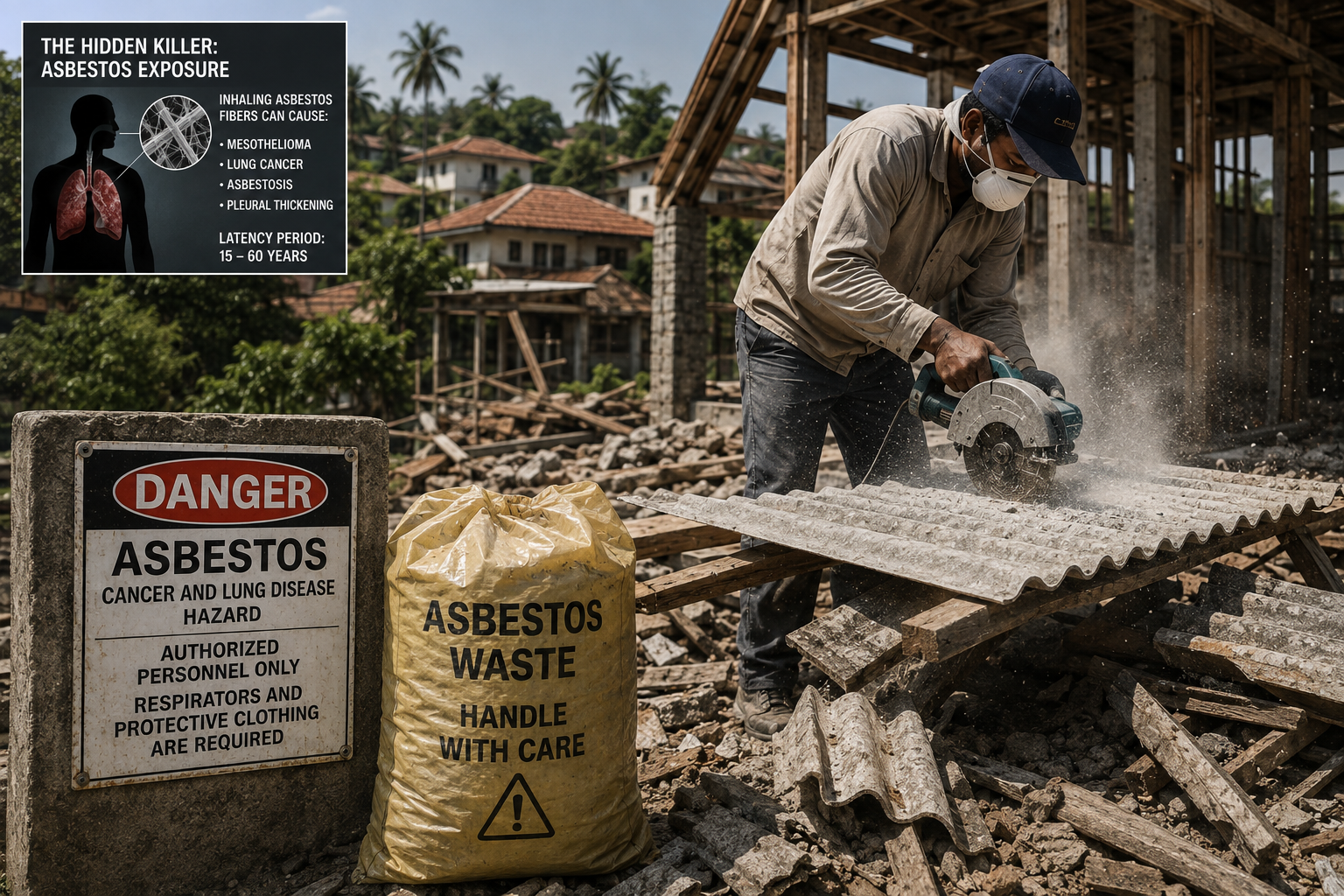
Friable asbestos refers to material that workers can easily crumble, pulverise or reduce to powder using hand pressure. It poses an exceptional danger because damaged material readily releases microscopic silicate fibres into the surrounding atmosphere.
When inhaled, these fibres can lodge deep inside lung tissue and the pleural membranes around the lungs. Over time, they can cause malignant mesothelioma, lung cancer, asbestosis and pleural thickening.
These diseases often emerge only after a latency period of 15 to 60 years. Therefore, exposed workers and residents may remain healthy for decades while irreversible damage develops silently.
Even countries with strict modern controls continue to record thousands of deaths from historical exposure. The United States and the United Kingdom still face a heavy burden from asbestos installed and disturbed decades ago.
Sri Lanka Asbestos Crisis Reaches Homes and Worksites
In Sri Lanka, residential construction, informal labour and unsafe waste practices intensify the danger.
Asbestos roofing covers many homes, often without an internal ceiling separating residents from the underside of the sheets. As roofing panels age, vibrate and weather in tropical conditions, damaged surfaces may release fibres.
Construction workers, carpenters, maintenance crews and demolition workers face more direct exposure. Many cut, drill, break or sweep asbestos products with power tools or manual saws.
Workers often perform these tasks without dust extraction systems, controlled wetting methods or certified respiratory protection. Dry cutting generates fine particles, while sweeping can return settled dust to the breathing zone.
Research involving Sri Lankan workers who handled asbestos-containing materials found respiratory abnormalities and lung fibrosis among exposed groups. Those studied included demolition workers and people involved in clearing debris after the 2004 Indian Ocean tsunami.
The findings highlight the danger created when workers disturb damaged asbestos without adequate controls.
Municipal waste practices create another long-term hazard. People frequently discard broken roofing sheets and structural rubble in open fields or beside public pathways.
Others reuse damaged sheets as temporary boundary fences. As these products continue to deteriorate, fibres can contaminate surrounding soil and air.
Local authorities largely lack specialised systems for collecting, transporting and containing asbestos waste. Consequently, a private construction decision can become a collective health liability for an entire neighbourhood.
Economic Pressure Has Delayed a Phase-Out
Sri Lanka’s policy response shows how public health priorities can collide with economic pressures and international trade interests.
Authorities proposed phase-out timelines during the mid-2010s to restrict chrysotile imports and encourage safer building materials. However, domestic manufacturing groups and important bilateral trading partners opposed the proposed restrictions.
The government later deferred or suspended the policy. As a result, chrysotile-cement products remain firmly established in the domestic market.
Consumers favour these products because they are affordable, durable and structurally resilient. They also reduce the sound of heavy monsoon rain and offer useful thermal insulation compared with some metallic roofing products.
Alternatives such as metal sheets and traditional clay tiles can cost more or require different structural support. These realities make an immediate transition difficult for low- and middle-income households.
However, affordability does not remove the health risk. Instead, it highlights the need for government assistance that makes safer alternatives accessible to ordinary consumers.
Weak Surveillance Conceals the Disease Burden
Sri Lanka also faces a major gap in occupational health surveillance and diagnostic infrastructure.
The long delay between exposure and illness makes asbestos-related disease difficult to detect. Doctors may misdiagnose mesothelioma, pulmonary fibrosis and other chronic respiratory conditions as infectious diseases or unrelated lung disorders.
Limited occupational histories, specialist services and national disease registries further weaken detection. Consequently, Sri Lanka lacks a reliable epidemiological picture of the harm asbestos may already have caused.
This scarcity of local data creates an informational vacuum. Commercial interests can then present the absence of documented cases as evidence that chrysotile remains safe.
However, poor reporting does not prove that disease is absent. It may instead show that the health system has not consistently identified, diagnosed or recorded asbestos-related illnesses.
Safer Materials and Immediate Controls Are Essential
Addressing the Sri Lanka asbestos crisis requires coordinated regulation, market intervention and practical exposure controls.
A complete phase-out of chrysotile imports should remain the final objective. However, the transition must include economic support for safer alternatives.
Non-asbestos fibre cement, concrete tiles and locally produced agricultural-fibre composites could reduce dependence on chrysotile. Tax incentives and support for domestic production could also make these products more affordable.
Until a phase-out occurs, authorities should prioritise safe containment rather than uncontrolled removal. Where asbestos-cement materials remain stable, property owners can apply suitable acrylic sealants and install internal ceiling barriers.
During construction or renovation, employers should require wet-cutting methods, certified respiratory protection and controlled work zones. Workers must avoid dry sawing, sanding or sweeping asbestos debris.
Authorities should also require secure plastic wrapping, clear labelling and controlled disposal of asbestos waste.
Sri Lanka cannot eliminate decades of asbestos use overnight. However, stronger laws, affordable alternatives, public education and enforceable workplace protections can prevent further exposure.
The fibres may remain silent and invisible, but the diseases they cause are preventable. Acting now can protect today’s workers and future generations from a chronic health burden that should never become the accepted price of affordable construction.