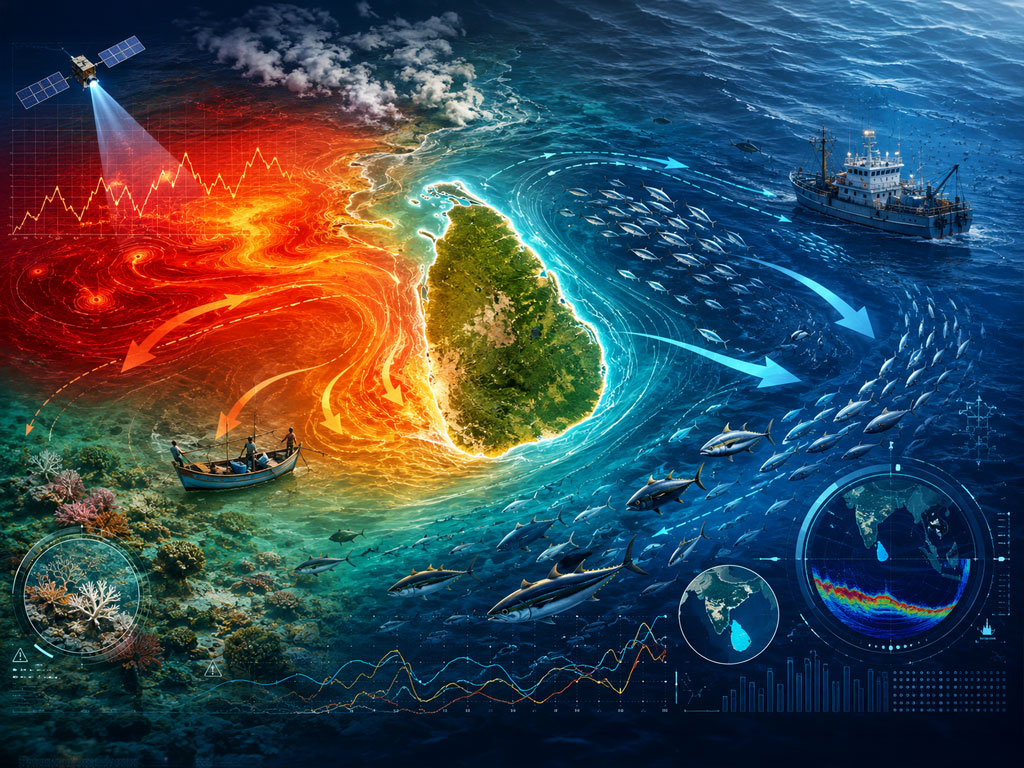
El Niño Sri Lanka fisheries concerns grow as NARA studies falling catches, warmer seas and possible changes to fish migration around the island.
El Niño Sri Lanka fisheries concerns are growing as fishermen report falling catches and researchers investigate whether warmer seas are changing fish distribution and migration patterns around the island.
Fishing communities say marine catches have declined rapidly, with multi-day fishermen who spend extended periods at sea among those facing the strongest impact.
There is growing concern that the global El Niño climate pattern may have altered the distribution of fish populations and their migration around Sri Lankan waters.
“We feel that the overall fish catch is being damaged. Research on this has been entrusted to NARA,” Deputy Minister of Fisheries Ratna Gamage told BBC Sinhala.

He also warned that if inland water sources dry up, freshwater fish populations could face serious destruction.
According to the Fisheries Ministry, the National Aquatic Resources Research and Development Agency, or NARA, has now started investigating the issue.
One-day coastal fishermen in the Southern, Western, North-Western and Northern Provinces currently fish only two or three days each week because of the monsoon season.
On those fishing days, they report catches of around 40 to 50 kg from coastal waters. Their catch includes paraw and other smaller fish species.
Dinesh Warnakulasuriya, a fisherman from Mampuriya in Norochcholai, told BBC Sinhala that this year’s catch shows a noticeable decline compared with previous years.
He said the local monsoon season should end by early October. Therefore, he expects the true impact of El Niño to become clearer after that period.
Five NARA Teams Study El Niño Sri Lanka Fisheries Impact
NARA has deployed five teams to investigate the possible impact of El Niño.
NARA Director General Dr. Lalith Amarasuriya said researchers can determine the precise effect on Sri Lanka’s seas and fish catch only after analysing data from the study.
Researchers have already started gathering data on ocean temperatures, wave heights and related changes.
NARA expects to complete the study within two months. However, it plans to release interim updates before the final findings become available.
Dr. Amarasuriya said that, generally, “with El Niño conditions, fish production could decrease. Fish may migrate towards colder areas. Consequently, fishermen’s income could also decline.”
He also warned about possible damage to coral reefs.
“If sea temperature increases, there could be some impact on our coral reefs and associated organisms. They may sometimes be destroyed or die.”
He said higher temperatures could also force shallow-water fish away from their usual habitats.
“If the temperature increases, sometimes fish in shallow seas may not be able to withstand the temperature and may swim away. There could be a decline in our coastal fish. If the temperature rises significantly, the catch will inevitably decrease, and fish will try to migrate to cooler areas,” he said.
The Director General added that production could also fall if fish move into areas where fishermen do not normally operate.
Fishermen Say Indian Trawlers Cause Greater Damage
Multi-day fishermen say El Niño has arrived while the industry is already confronting banned fishing practices and Indian fishermen engaged in bottom trawling inside Sri Lanka’s maritime boundaries.
They say these combined pressures have intensified the fall in catches.
Ruwan Fernando, Secretary of the All Lanka Multi-Day Fishing Vessel Owners’ Association, argued that Indian fishermen cause greater damage to Sri Lanka’s fish resources than El Niño.
“They engage in destructive fishing methods; dynamite use destroys fish resources. Destructive methods destroy small fish, large fish, egg-bearing fish, and breeding grounds,” he said.
“Indians come and exploit us. Indian trawlers come here and exploit us.”
Fernando acknowledged that El Niño affects fisheries but said the pressure from Indian fishing activity was stronger.
“El Niño has an impact. There is an effect. But a stronger impact comes from India. They are simply exploiting us. As a country, we are an independent nation, we are not a province of India,” he said.
“As long as banned fishing methods exist, fish won’t breed. It’s amid all this that El Niño arrives,” he added.
Mannar Bay Seen as a Critical Breeding Ground
Fernando said the Mannar Bay is a particularly important marine area for fish breeding.
He said many fish species are found in abundance in the coastal waters there.
“Fish breed around the Mannar Bay, just like how karulla fish come at a certain time to lay eggs. That is what the Mannar Bay is, that shallow sea area is where Indian fishermen come right up to our coast and take fish from breeding grounds,” he said.
The concerns are especially important for Sri Lanka’s multi-day fishing industry.
Deep-sea fishermen mainly target bigeye tuna, yellowfin tuna and swordfish.
Sri Lanka has more than 4,500 multi-day vessels involved in these operations. They fish in southern waters, off Trincomalee and across the Arabian Sea.
These vessels travel more than 1,500 kilometres and typically remain at sea for 40 to 60 days.
A single vessel can bring back between three and 10 tonnes of fish.
Fernando said most fish caught by multi-day vessels goes to export markets. Only around 10% to 15% reaches the domestic market.
He said the largest share of fish supplied locally instead comes from inshore fishing methods, including net fishing.
However, Warnakulasuriya said declining earnings aboard multi-day vessels are changing fishermen’s behaviour. Some workers who previously joined multi-day boats are now shifting toward one-day fishing vessels.
Satellite Data Guides Tuna Fishing Predictions
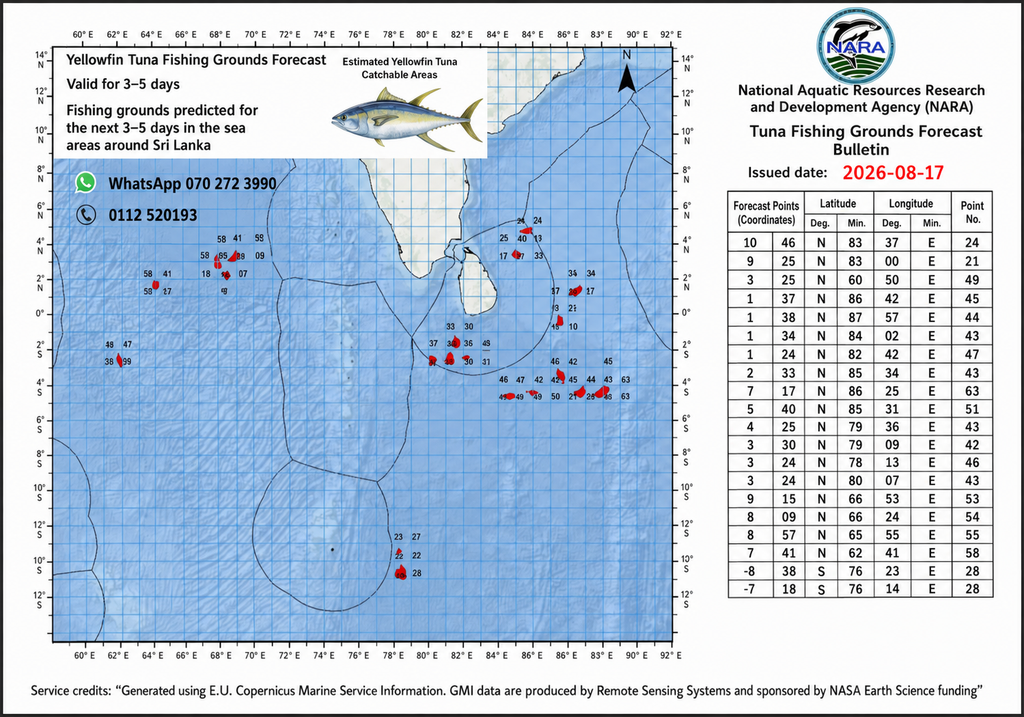
NARA already uses satellite data to issue predictions about potential tuna fishing grounds.
NARA Director General Dr. Lalith Chandralal said the agency releases these forecasts three days each week.
The predictions remain valid for periods of three to five days.
However, fishermen say the system is not always reliable.
“We cannot be 100% accurate. Sometimes we fall for the data, sometimes it’s completely wrong,” Fernando said.
The research comes as ocean temperatures continue to draw international concern.
The European Union’s climate monitoring agency has reported that the world’s sea surface temperature reached its highest July level amid the El Niño condition in the Pacific Ocean.
According to Copernicus, the global average sea surface temperature reached 20.96°C last July. That exceeded the 20.89°C recorded in 2023.
Last July was also recorded as the second-hottest July in history for global temperatures. It was 1.47°C warmer than the pre-industrial average.
Warmer Oceans Raise Wider Environmental Risks
El Niño is a natural climate pattern that develops in the Pacific Ocean.
When it combines with human-driven global warming, experts warn that global temperatures can rise rapidly and severe weather events may intensify.
Oceans play a major role in regulating Earth’s climate. They absorb most of the excess heat produced by greenhouse gas emissions and generate about half of the planet’s oxygen.
However, excessive ocean warming can make marine heatwaves stronger and longer-lasting.
That can cause major damage to coral reefs, while also affecting seaweed and fisheries.
When sea surface waters become extremely warm, they also release more heat and moisture into the atmosphere. This can strengthen tropical cyclones and contribute to heavier rainfall.
These changes add to concerns over El Niño Sri Lanka fisheries and whether warming waters could permanently alter where important commercial species are found.
Meanwhile, Sri Lankan weather authorities say the El Niño condition is continuing to develop.
Director General of the Meteorological Department Ajith Wijemanne said global forecasts indicate a probability of more than 90% that the event will develop into a very strong El Niño by the end of the year.
He also said there is around a 70% probability that it could become the strongest El Niño event recorded during the past 75 years.
For Sri Lanka’s fishing industry, the next few months could therefore prove crucial. NARA’s findings may show whether changing ocean temperatures are temporarily disrupting catches or beginning to reshape the fishing grounds on which thousands of coastal and deep-sea fishermen depend.