By Roy Denish.
National Youth Services Council audit finds procurement failures, weak oversight and no proof that millions spent delivered lasting youth benefits.
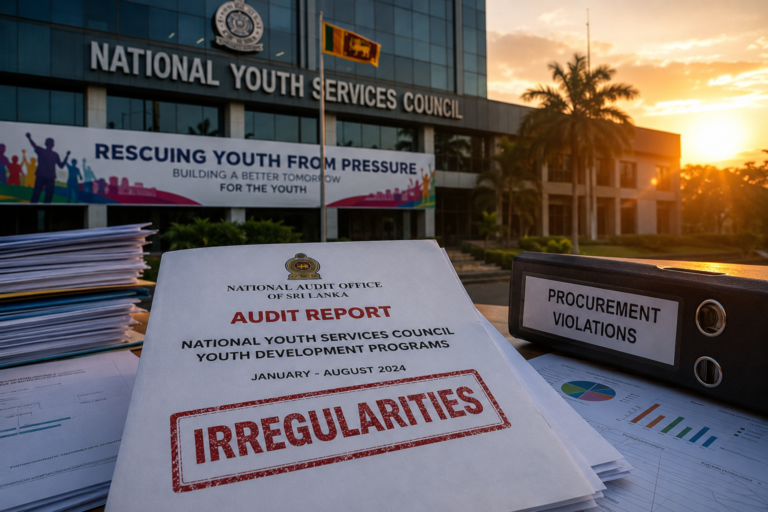
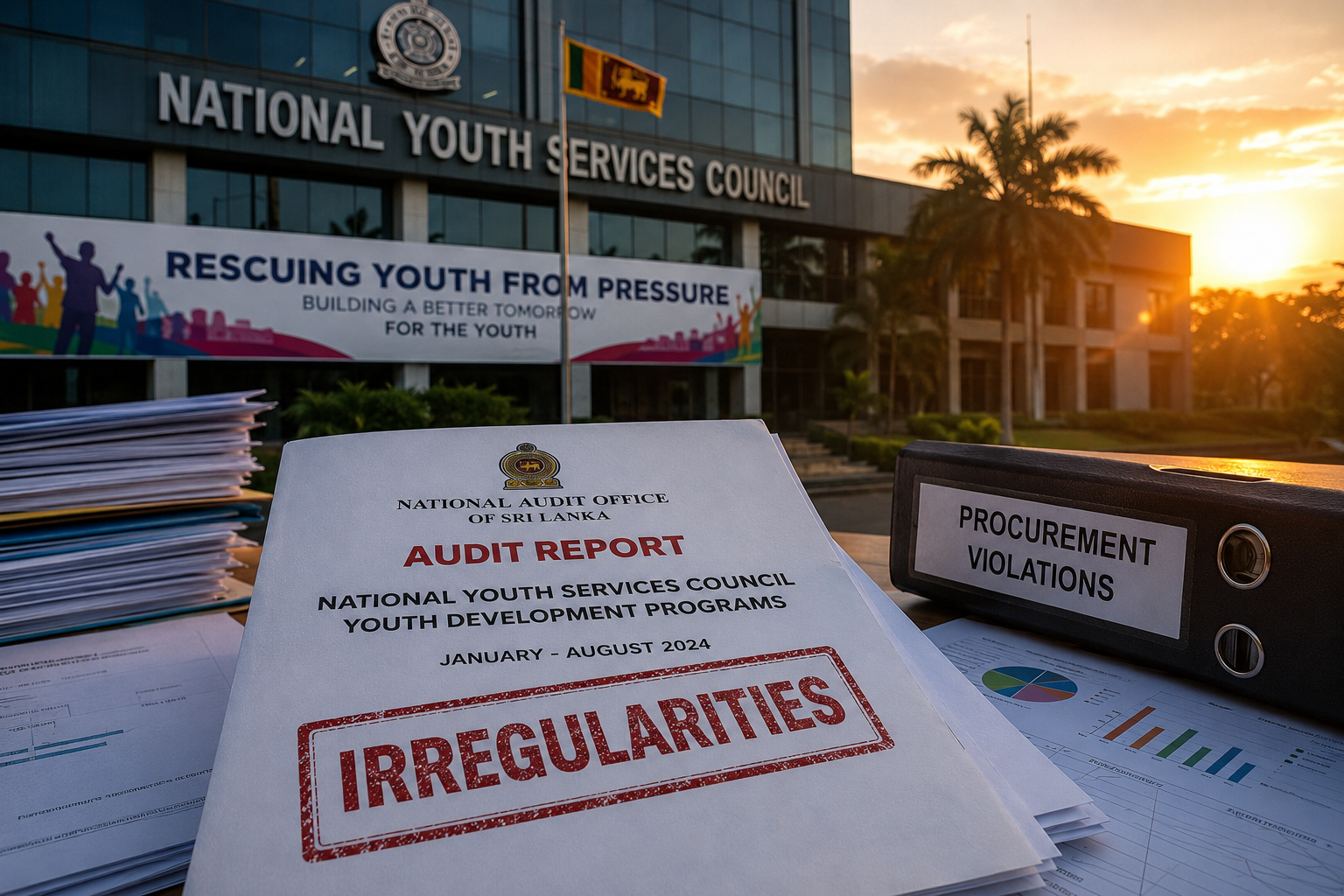
An orange sunset dipped behind the glass facade of the National Youth Services Council headquarters in Maharagama, casting long shadows across empty briefing rooms and quiet corridors. Outside those walls, Sri Lanka’s youth were grappling with the bitter aftermath of an unprecedented economic crisis, navigating skyrocketing living costs, a hyper-competitive job market, and deep-seated socio-economic anxieties.
The state had promised them a lifeline.
Through glossy promotional campaigns and high-decibel announcements, the National Youth Services Council launched a major national initiative under the hopeful banner, “Rescuing Youth from Pressure.” It was framed as an urgent, compassionate intervention designed to provide psychological relief and practical support to a struggling generation.

Inside the council’s administrative offices, however, a paper trail uncovered by state investigators tells a profoundly different story.
Rather than revealing an institution engaged in strategic planning and targeted aid, the council’s operations during the first eight months of 2024 exposed an organisation adrift in procedural chaos. A special investigation by the National Audit Office of Sri Lanka, recently tabled before Parliament, has laid bare a systematic breakdown of internal controls, severe non-compliance with public procurement standards, and a complete failure to demonstrate that a single young citizen meaningfully benefited from the state’s substantial expenditure.
The investigation focused on six high-profile youth development programmes executed between January and August 2024. Marketed as multi-faceted interventions to alleviate psychological stress and bolster socio-economic resilience, these events took centre stage in the council’s public outreach.
Yet, when state auditors scrutinised the administrative machinery behind the campaigns, they found that the urgency of “rescuing youth” was primarily used to justify bypassing the foundational rules of public finance. Standard operating procedures were routinely set aside and replaced by an expedited execution model that prioritised rapid, high-visibility events over fiscal discipline and statutory compliance.
Chief among the audit’s revelations was a pattern of pervasive procurement mismanagement. In any public institution, procurement rules exist to ensure that taxpayers receive the best possible value for their money while preventing favouritism and financial opacity.
The National Audit Office discovered that the council repeatedly ignored standard public procurement guidelines when organising events, purchasing equipment, securing logistics, and contracting media coverage. Public tenders were regularly bypassed, open competition was sidelined, and contracts were awarded under circumstances that raised immediate red flags regarding financial accountability.
Instead of running transparent bidding processes to ensure cost-efficiency, the council operated with a level of discretion that directly violated basic Treasury directives.
The failure extended far beyond the handling of receipts and vendor contracts. The report highlights a glaring absence of measurable impact, pointing to a fundamental flaw in how the programmes were designed and monitored.
Despite spending millions of rupees under the banner of reducing socio-economic and psychological pressures, the National Youth Services Council failed to establish a single baseline metric, key performance indicator, or post-programme evaluation framework.
Auditor General officials noted with concern that there was no structured mechanism in place to track whether attendees derived any long-term psychological relief, gained useful skills, or improved their socio-economic standing. Thousands of young people may have attended the rallies, workshops, and ceremonial gatherings, but once the stage lights were turned off and the banners packed away, the council had no way of determining whether any meaningful support had taken root.
This operational void stems from what auditors identified as a critical strategic disconnect.
The National Youth Services Council operates under a specific legal charter, which tasks it with building long-term capacity, fostering sustainable leadership, and equipping Sri Lanka’s youth with the tools necessary for modern economic participation.
However, the activities carried out under the “Rescuing Youth from Pressure” initiative routinely diverged from these core statutory goals. Instead of investing in sustained mental health support networks, vocational mentorship, or targeted economic relief, the council directed its resources towards short-term public spectacles.
The audit noted that the immediate nature of these event-driven activities lacked any structural alignment with the long-term objectives mandated by law, leaving a vast gap between the council’s legal mandate and its actual execution on the ground.
The implications of these findings go well beyond simple administrative oversight.
In a country recovering from severe financial instability, every rupee of public money carries immense weight. When state funds intended for vulnerable demographics are spent without oversight or verifiable outcomes, the loss is doubly damaging: it drains public coffers while leaving the intended beneficiaries without meaningful assistance.
The audit paints a picture of an agency using the rhetoric of youth empowerment as a cover for routine budget consumption, converting what should have been a transformative social programme into a series of ephemeral public relations exercises.
Faced with these widespread irregularities, the National Audit Office has demanded immediate and decisive intervention.
In its recommendations to Parliament, the audit authority urged the government to invoke the full statutory powers of the National Audit Act No. 19 of 2018. The report stresses that relevant supervising ministries can no longer treat the council’s operational lapses as minor administrative shortcomings.
It recommends the immediate enforcement of strict Treasury guidelines across all future projects, mandating that no media, logistics, or event management contracts be issued without strict and verifiable compliance with national competitive bidding procedures.
Furthermore, the Audit Office has called for a mandatory overhaul of how youth programmes are funded and reviewed. The report insists that the Ministry of Finance and related state bodies establish transparent post-programme evaluation frameworks before any future funding allocations are released to the council.
Under these proposed guidelines, the council would be required to prove the effectiveness and long-term utility of its programmes through clear data and independent reviews.
Most importantly, the audit urges the council to abandon its current focus on short-term event hosting and realign its operational strategy with the foundational goals of its governing charter, prioritising sustainable youth development over high-cost, low-impact public gatherings.
As parliamentary committees prepare to examine the audit’s findings and call council officials to account, the investigation serves as a stark commentary on institutional governance in Sri Lanka.
It demonstrates that good intentions and resonant national slogans are no substitute for statutory compliance, clear metrics, and financial integrity.
For the millions of young Sri Lankans waiting for genuine opportunities and meaningful support, the audit report is a troubling revelation that the programmes designed to relieve their burdens were themselves weighed down by systemic inefficiency and neglect.