22nd Amendment Sri Lanka battle reaches the Supreme Court as referendum pressure, political campaigns and wider geopolitical tensions intensify.
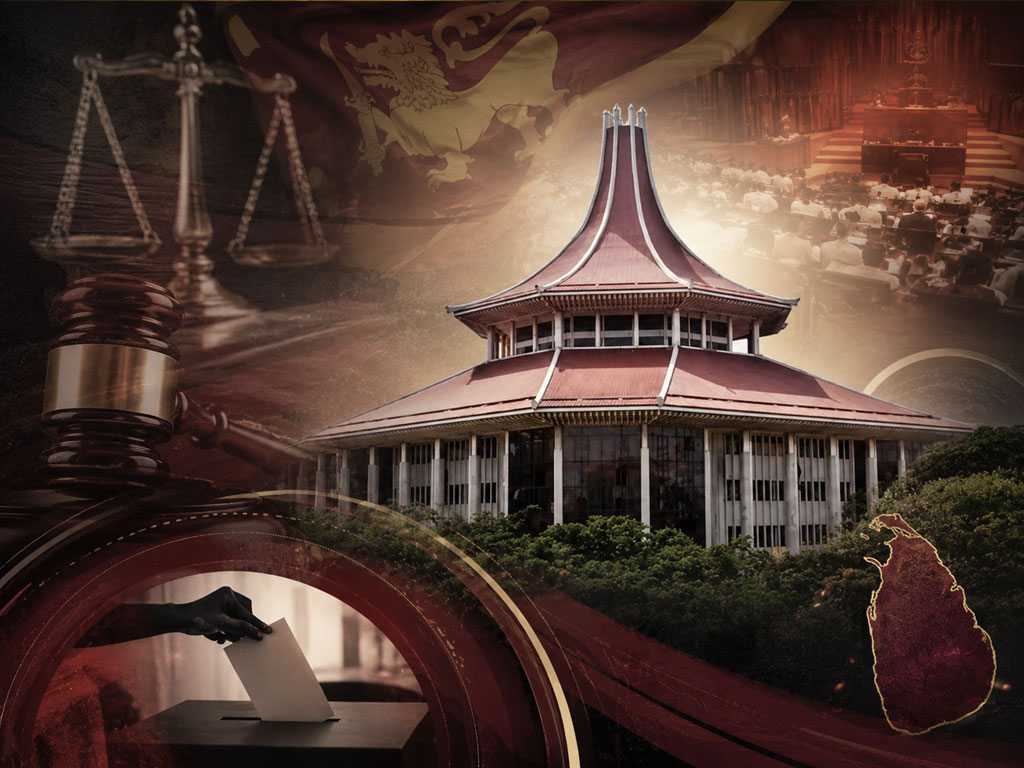
The 22nd Amendment Sri Lanka battle over extending the retirement age of senior judges has reached the Supreme Court, opening a political confrontation that could extend far beyond the judiciary.
Nearly 50 petitions have reportedly been filed challenging the proposed constitutional amendment. Opponents are seeking a ruling that would require both a two-thirds parliamentary majority and approval at a national referendum.
At the same time, the Government and Opposition are preparing for what could become a nationwide political campaign if the Supreme Court determines that a referendum is necessary.
The controversy is unfolding against a much broader political backdrop. China has renewed its engagement in Sri Lanka, India is closely watching Beijing’s growing influence, Iranian vessels remain off the southern coast, and investigations involving prominent politicians are gathering pace.
Together, these developments are creating one of the most politically charged periods faced by the Government since taking office.

22nd Amendment Sri Lanka Battle Reaches Final Stage
The Government’s controversial proposal seeks to extend the retirement age of judges serving in the Supreme Court and higher judiciary.
The Bar Association of Sri Lanka was among the first organisations to oppose the proposal when reports of the plan initially emerged.
The Association warned that the move could amount to political interference with the independence of the judiciary.
The Samagi Jana Balawegaya and several other opposition parties soon joined the campaign.
They raised objections both inside and outside Parliament.
The resistance then widened considerably when the Prelates of the three Nikayas wrote to the President expressing strong opposition.
Initially, the Government appeared not to publicly acknowledge the letter.
However, after the Opposition disclosed it, criticism widened further.
The Church of Ceylon subsequently raised objections.
The Catholic Church, through its archbishops, also entered the debate.
Despite the growing pressure, the Government has remained firm.
Within days of receiving the letter from the Buddhist prelates, the administration completed the draft of the 22nd Amendment and presented it to Parliament on August 18.
The legal battle began almost immediately.
Nearly 50 petitions have now reportedly reached the Supreme Court challenging the constitutional amendment.
Sajith Allows BASL to File First Petition
Opposition Leader Sajith Premadasa had prepared what was expected to become the first petition challenging the amendment.
However, the Bar Association requested that he delay filing it.
The Association argued that the proposal directly concerned the judiciary and that BASL had opposed the retirement-age change from the beginning.
It therefore asked to receive the opportunity to file the first challenge.
Following discussions, Premadasa agreed.
The Bar Association subsequently filed the first petition, while the SJB filed another challenge soon afterwards.
The dispute then moved back into Parliament.
At its parliamentary group meeting on Monday, the SJB unanimously decided to oppose the 22nd Amendment regardless of other business before the House.
The party also decided to invite the Bar Association to brief all Members of Parliament on the proposed constitutional changes.
Premadasa had already informed the Speaker about the proposed briefing.
However, BASL made clear that it would participate only if MPs from both sides of Parliament were willing to attend.
Eventually, Premadasa and the Association reached an understanding.
The briefing was scheduled to take place in Parliament on Wednesday.
That plan quickly became another political confrontation.
Bimal Ratnayaka Opposes Parliamentary Legal Briefing
Premadasa announced the planned Bar Association briefing in Parliament on Tuesday.
Leader of the House Bimal Ratnayaka objected.
Other Government MPs also raised concerns.
Ratnayaka argued that it was inappropriate for the Leader of the Opposition to arrange a briefing for Members of Parliament inside the parliamentary complex.
The Government benches made clear that Government MPs would not participate.
Premadasa subsequently received information that Bar Association representatives could be denied parliamentary passes if they attempted to enter.
SJB MPs then discussed a contingency plan.
If BASL representatives were stopped at the security entrance, Opposition MPs planned to walk out, meet them and escort them into Parliament.
However, the Bar Association chose not to escalate the confrontation.
Instead, it decided to write formally to Premadasa and postpone the proposed programme.
BASL President Rajeev Amarasuriya wrote to the Opposition Leader on August 19.
He said the Association regarded the matter as one of “great importance and urgency” and had hoped for bipartisan participation.
Amarasuriya said such a briefing could have allowed MPs to assess concerns surrounding the proposed amendment more fully.
However, he said the events in Parliament had shown there was no consensus.
He also referred to what he described as a “threatening position” expressed by Government members.
The Association therefore asked Premadasa to postpone the briefing until bipartisan participation could be secured.
BASL Says Government MPs Should Hear Both Sides
The BASL letter argued that the Opposition had already made its position clear.
For that reason, the Association believed the proposed session would have been particularly important for Government MPs.
It said those MPs should have received an opportunity to consider the constitutional proposal independently and objectively.
The Association thanked Premadasa for proposing the initiative and described the briefing effort as constructive.
The episode, however, further intensified an already bitter constitutional dispute.
The next decisive stage will take place before the Supreme Court.
Those challenging the 22nd Amendment argue that Parliament alone cannot approve it.
They maintain that the proposal requires a two-thirds majority in the House and approval by the people at a referendum.
The Bar Association and several other petitioners have reportedly also raised another important procedural issue.
Because the amendment directly concerns the retirement age of Supreme Court judges, they argue that the petitions should be heard by the full bench.
The Supreme Court currently comprises 13 judges.
The request therefore carries particular constitutional significance.
Speculation is already growing over whether the Court could rule that a referendum is required.
Government Says It Is Ready for a Referendum
Political observers have begun asking whether the Government could win a national vote on the judicial retirement proposal.
Many critics believe such a referendum would be difficult for the administration.
However, Minister Nalinda Jathissa signalled last week that the Government would not retreat simply because a public vote might become necessary.
Speaking publicly on the matter for the first time, he said the Government was prepared if the Supreme Court ordered a referendum.
He also expressed confidence that the administration could win.
Behind the scenes, both the Government and Opposition are already preparing for the possibility.
According to political sources cited in the original report, the Government is developing a nationwide propaganda strategy.
President Anura Kumara Dissanayake is expected to travel district by district.
Meanwhile, the JVP and National People’s Power are preparing a door-to-door political campaign.
The strategy reportedly emerged after a special meeting at party headquarters.
District organisers had raised concerns about a widening gap between the Government and rural communities.
The leadership discussed ways of rebuilding those relationships.
Direct engagement between the President and village communities was identified as one of the main responses.
The first major meeting is reportedly planned for September 13 in Anuradhapura.
Opposition Launches Its Own Nationwide Campaign
The Opposition is making parallel preparations.
A large-scale campaign is expected to begin from next month.
Interestingly, both sides have selected Anuradhapura as an early political battleground.
Namal Rajapaksa is scheduled to hold a rally at the Salgadu Grounds on September 12.
The SJB, meanwhile, plans a major reconstruction campaign in the district on September 22 and 23.
It also intends to appoint constituency organisers across Anuradhapura.
The political preparations suggest that both sides are treating the constitutional dispute as something that could evolve into a nationwide test of public support.
Within the Government itself, however, debate continues over whether a referendum will actually become necessary.
The Palawatta faction reportedly maintains that it will not.
Government legal advisers are said to have argued that the amendment can proceed without a public vote.
Nevertheless, contingency plans have reportedly been discussed.
One possibility under consideration is significantly more ambitious.
If the Supreme Court rules that the retirement-age proposal requires a referendum, the Government could withdraw the 22nd Amendment entirely.
Instead, it could announce a broader constitutional reform programme.
Such a move would avoid holding a referendum focused solely on the retirement age of judges.
It could also transform the legal dispute into a national debate over a new constitutional framework.
Opinion Polls Underway as Both Camps Test Public Mood
Both the Government and Opposition reportedly want to know how the public is responding.
Sources indicate that the Government has commissioned an island-wide opinion survey.
The Opposition has reportedly launched a separate polling exercise.
Opposition leaders expect the findings within two weeks.
The results could influence decisions on whether to escalate the referendum campaign, broaden the constitutional debate or alter political messaging.
However, the judges’ retirement controversy is not the only issue placing pressure on Colombo.
Sri Lanka is simultaneously confronting a potentially dangerous maritime problem off its southern coastline.
The escalating confrontation between the United States and Iran has placed Iranian vessels operating near Sri Lanka under growing scrutiny.
According to the original report, three Iranian vessels travelling from India had earlier entered waters within Sri Lanka’s exclusive economic zone near Galle.
One vessel was reportedly struck and sank.
The source article claims the attack was later attributed to a torpedo launched by an American submarine.
That allegation triggered considerable political controversy in Sri Lanka, including claims that the Government had allowed US forces to use waters around the island for military action.
The original article does not present independent verification of those allegations.
Seventeen Iranian Vessels Add Maritime Pressure
A further development has now increased concerns.
Seventeen Iranian vessels are reportedly positioned for several days in waters within Sri Lanka’s exclusive economic zone off Galle after being unable to continue towards their intended destinations.
According to the report, American officials have informally pressured Sri Lanka to ensure that no supplies are provided to the vessels.
The Sri Lankan Government has responded by saying it has no role in supplying them.
Officials have maintained that any provisions received by the vessels came through private suppliers.
The vessels are also reportedly under close surveillance by US military assets and satellites.
Attention briefly focused on the US warship George Washington after reports suggested it was moving towards the Indian Ocean.
That prompted speculation that the vessel could be connected to potential action against the Iranian ships near Sri Lanka.
Subsequent reports, however, suggested that its deployment related instead to facilitating the return of the Abraham Lincoln from the Middle East to the United States.
The wider diplomatic problem remains unresolved.
Washington and Colombo have reportedly not reached an understanding over the vessels.
Officially, the United States has not issued formal communication to Sri Lanka on the matter, according to the report.
Military analysts nevertheless warn that such communication could follow.
Iran Tensions Could Spill Into Indian Ocean
Any renewed escalation around the Strait of Hormuz could have consequences well beyond the Persian Gulf.
If hostilities intensify, vessels operating in the Indian Ocean could become vulnerable.
That possibility has raised fears that Iranian ships positioned near Sri Lanka could draw the island into a confrontation it did not create.
The original article describes the vessels as potential “ticking time bombs” for Sri Lanka.
Although such language is clearly analytical rather than an official assessment, the underlying concern relates to the possibility of military confrontation, fires or environmental damage close to Sri Lankan waters.
As Sri Lanka manages those risks, another strategic contest is unfolding around the island.
China has begun increasing its activity after several months of relative quiet.
Former Chinese Ambassador Qi Zhenhong, who maintained close relations with the Rajapaksa family, has been replaced by Wei Huaxiang.
The change has been interpreted by political observers as part of Beijing’s attempt to strengthen ties with the JVP-led Government.
The new ambassador reportedly arrived with a delegation of Chinese investors and held discussions with President Dissanayake.
According to the original report, the investors expressed interest in expanding investment in Sri Lanka.
They are said to have agreed to pursue eight major projects connected primarily to Colombo Port City.
China reportedly intends to proceed with these as direct investments.
China’s Return Raises Fresh Concern in India
Beijing’s renewed economic engagement has quickly attracted attention in New Delhi.
The arrival of Chinese investors alongside the new ambassador has reportedly increased Indian concern about China’s strategic position in Sri Lanka.
The original report refers to comments attributed to Harivansh Narayan Singh, Deputy Chairman of India’s Rajya Sabha.
According to the article, he warned that China was systematically strengthening its strategic position around India.
He reportedly referred to plans involving deep-sea port infrastructure in regional countries, including Sri Lanka and Bangladesh.
The reference to Nepal in connection with deep-sea ports in the source material should be treated cautiously because Nepal is landlocked.
Nevertheless, the broader argument attributed to Singh concerns China’s expanding regional infrastructure presence and the resulting strategic implications for India.
The report describes him as politically close to India’s ruling establishment.
His comments therefore attracted attention because of their timing.
Within 48 hours, reports emerged that Indian Defence Minister Rajnath Singh could visit Sri Lanka.
Rajnath Singh is one of Prime Minister Narendra Modi’s most senior ministers and an influential figure within the Bharatiya Janata Party Government.
A visit would therefore carry considerable political and strategic significance.
Questions Surround Rajnath Singh’s Reported Visit
Reports suggest the Indian Defence Minister could travel to Sri Lanka in September.
However, the circumstances surrounding the proposed visit have generated speculation.
Only a limited number of Sri Lankan media organisations initially reported it.
At the time referenced by the original article, Indian media outlets had not widely reported the proposed visit.
Neither India’s Ministry of External Affairs nor Ministry of Defence had publicly released an itinerary.
That silence was unusual enough to attract attention.
The source article argues that the proposed trip could involve discussions on sensitive bilateral security issues.
It also claims that Rajnath Singh may carry an important message from New Delhi.
Some political observers have interpreted the limited publicity as evidence that confidential discussions may be under preparation.
The Sri Lankan Government’s limited public comment has added to that speculation.
India is also closely following developments in Sri Lanka’s Northern and Eastern provinces.
Reports cited in the article claim there has been an increase in visits by Chinese and Pakistani nationals to those regions.
India is also said to be monitoring two excavation zones in Mannar and Trincomalee.
Agreements involving a Chinese university have reportedly been connected to the projects.
New Delhi is said to be closely observing who participates and what activities take place.
Wijewira Family Property Issue Returns to Spotlight
Domestic politics has produced another unexpected development involving the family of JVP founder Rohana Wijewira.
His wife, Chitrangani Wijewira, has remained under Government protection since his arrest at the Aththanayake estate in Ulapane.
According to the original report, she is expected to be released soon.
She is currently said to be staying at the Welisara naval camp with one of her daughters.
Apart from their son Uvindu Wijewira, other members of the family reportedly live overseas.
The family is now said to be considering its future arrangements.
Its assets include the three-acre St Mary’s estate in Ulapane, together with a bungalow, and an ancestral home at Kotegoda in Matara.
Under an earlier administration, the Ulapane bungalow reportedly operated as a youth training centre.
The family now intends to reclaim it.
Parliamentary approval would reportedly be required for the transfer.
However, another complication has surfaced.
According to the source article, investigators discovered that the Ulapane bungalow had previously been sold for a substantial amount by a relative of a former powerful Kandy politician who had served as an MP.
A special investigation has reportedly begun.
More Political Arrests Reportedly Being Prepared
The Government’s anti-corruption and criminal investigations into politicians also continue.
According to information cited by Inside Politics, several prominent political figures could face arrest as early as next week.
The report claims the list includes the leader of a major political party.
A former senior minister is also reportedly under investigation over several allegations.
Another former politician, well known for fiery public speeches, is also said to be facing possible arrest.
No names were published in the original report.
It said this decision was made for ethical reasons.
Investigators have also reportedly examined bank accounts linked to the wives of several former ministers.
One investigation allegedly uncovered a substantial amount of money in the account of the wife of a Central Province politician.
The politician reportedly crossed from the Opposition to support Ranil Wickremesinghe’s administration and subsequently received a ministerial portfolio.
Another investigation reportedly identified millions of rupees in an account belonging to the wife of a prominent Opposition politician.
Authorities are said to suspect that the money may relate to a transaction carried out through an institution under that politician’s ministry during his time in office.
These remain allegations under investigation.
2012 Hotel Share Purchase Also Under Investigation
The source article further claims that authorities have launched a detailed investigation into another powerful political leader.
The inquiry reportedly concerns the purchase of shares in a prominent hotel in southern Sri Lanka during 2012.
Again, the original report withholds the name.
If the predicted arrests occur, the coming week could become another major test for relations between the Government and Opposition.
At the same time, both President Dissanayake and Opposition Leader Premadasa have increased their attention on the North and East.
Premadasa introduced a new practice in Parliament last week.
After meeting his parliamentary group, he held discussions with Tamil and Muslim MPs representing the Northern and Eastern provinces.
He intends to continue these meetings during parliamentary weeks.
Several issues affecting northern and eastern communities were raised.
Premadasa then took some of those concerns directly to the Government.
One involved land belonging to a salt company in the North.
Industries Minister Sunil Handunnetti agreed to discuss the issue directly with the relevant Northern MP.
The interaction marked a notable instance of cooperation across the political divide.
President Meets Northern Tamil MPs Over Land Releases
President Dissanayake also met Tamil MPs from the North.
They raised concerns over land that remains under military control.
The President subsequently held discussions with defence chiefs in Parliament.
According to the source article, he instructed them to release every possible parcel of land back to Tamil owners.
Land remains one of the most politically sensitive issues in the Northern and Eastern provinces.
Any large-scale release could therefore carry significant political consequences.
At the same time, protests in the North have introduced a separate referendum demand.
While much of the southern political discussion concerns a possible referendum over the retirement age of judges, northern demonstrators have raised demands centred on Tamil self-determination and accountability for alleged wartime abuses.
Large demonstrations were held last week.
Participants accused the Sri Lankan Government of war crimes during the civil conflict.
They also resolved to send a letter to the UN High Commissioner for Human Rights ahead of the 63rd Human Rights Council session in Geneva in September.
The letter contained 15 demands.
Northern Protesters Submit 15 Demands to UN
The first demand called for recognition of a Tamil homeland, nationality and right to self-determination.
The second sought immediate international justice for families of people who were forcibly disappeared.
The third demanded the unconditional release of Tamil political prisoners held for extended periods.
The fourth sought guarantees that journalists could work independently.
The fifth called for repeal of the Prevention of Terrorism Act and other restrictive legislation.
It also demanded protections for freedom of speech, protest, property rights and movement.
The sixth called for an end to land appropriation by state institutions and the return of seized property.
The seventh demanded an end to Sinhala settlements and what protesters described as “Buddhistization” intended to alter demographics in Tamil areas.
The eighth called for international justice regarding mass graves, including Chemmani.
It sought independent forensic investigations under United Nations oversight.
The ninth demanded international travel bans on Sri Lankan political, military, intelligence, police and administrative officials credibly accused of genocide and war crimes.
The tenth called on the UN to protect victims and evidence relating to alleged Tamil genocide.
Protesters Seek International Investigation and Referendum
The eleventh demand called for UN Human Rights Council member states to decide at the 63rd session on an international investigation into allegations of genocide.
The twelfth demanded the immediate withdrawal of the Sri Lankan military from areas protesters describe as the Tamil homeland.
The thirteenth sought the extension and strengthening of UN accountability projects concerning Sri Lanka beyond 2027.
The fourteenth called for an independent international investigation into allegations of genocide, war crimes and crimes against humanity.
The fifteenth demanded prosecution of Sri Lankan officials credibly accused of such crimes in domestic courts using evidence gathered by UN mechanisms.
The letter concluded by calling on the international community to recognise Tamil homeland claims, nationality and the right to self-determination.
It also sought a referendum allowing Tamils to determine their future governance.
These demands remain politically contentious and represent the position of the protesters who submitted them, rather than findings of an international tribunal.
Constitution, Geopolitics and Arrests Converge
Sri Lanka therefore enters the coming weeks facing several interconnected political battles.
The 22nd Amendment Sri Lanka dispute has become the immediate constitutional flashpoint.
The Supreme Court must now consider whether the proposed extension of judicial retirement ages can proceed through Parliament alone or requires approval from voters.
If the Court mandates a referendum, the Government says it is ready.
The Opposition is also preparing.
But the constitutional dispute is unfolding alongside increasingly complex geopolitical pressure.
Iranian vessels remain near Sri Lanka as tensions involving Washington and Tehran continue.
China is increasing investment engagement.
India is responding with greater strategic attention.
Northern politics is again moving towards questions of land, accountability and self-determination.
Meanwhile, investigators are reportedly preparing action involving influential political figures.
Any one of those developments would ordinarily dominate the political agenda.
They are now happening simultaneously.
The coming Supreme Court determination could therefore become more than a legal ruling on judges’ retirement.
It could trigger a referendum, reshape the Government’s political strategy, revive discussion of an entirely new Constitution and open another nationwide contest over the direction of Sri Lanka itself.