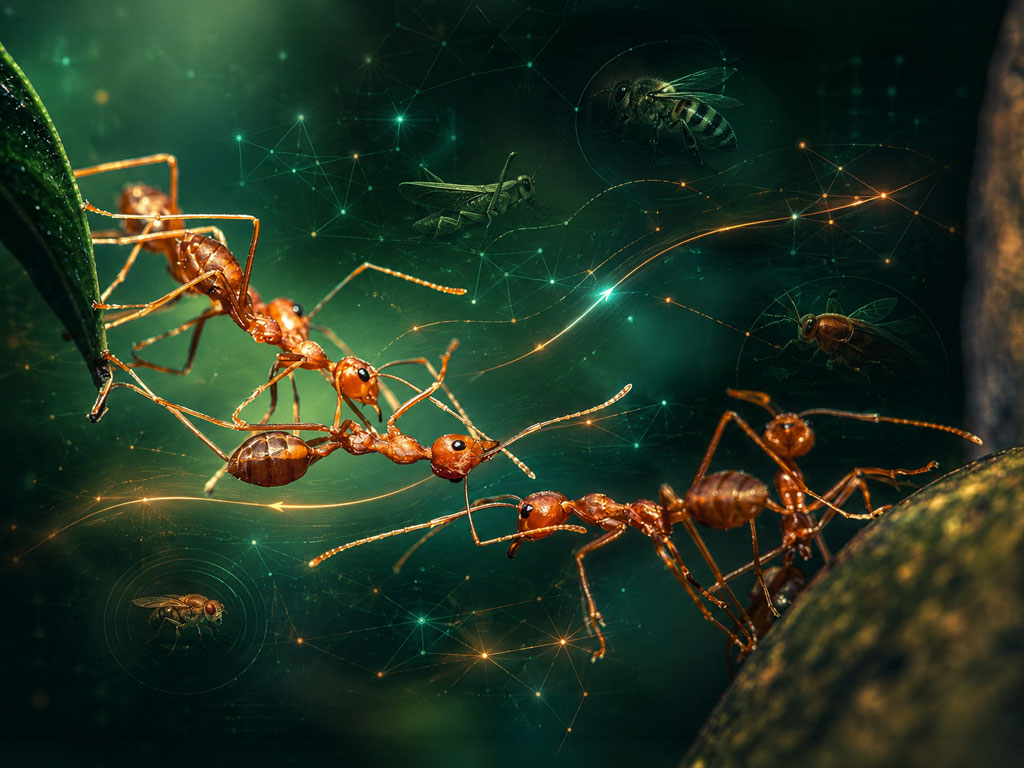
Insect decision-making reveals how ants, bees, locusts, cockroaches and flies can teach humans to make smarter individual and group choices.
Humans pride themselves on intelligence, yet insect decision-making shows that creatures with extraordinarily small brains can solve surprisingly complex problems with remarkable efficiency.
We like to think our ability to analyse, reason and plan places us firmly at the top of the evolutionary pyramid. However, sophisticated thinking does not guarantee good decisions.
People make mistakes. Groups become divided. Too many choices can overwhelm us, while emotion, stress and personality can distort judgement.
Insects face many of the same basic challenges.
Despite possessing tiny nervous systems, ants, bees, locusts, cockroaches and fruit flies have evolved methods for finding efficient routes, selecting homes, resolving group disagreement and weighing risk.
Some of these behaviours have even inspired algorithms used in human industries.
Here are five lessons insects can offer about making better decisions.

Ants Show How Good Decisions Can Emerge Without a Leader
Choosing the best way to accomplish something can be difficult, particularly when many alternatives compete for attention.
Psychologists often describe this problem as “choice overload.”
Ants encounter a similar challenge when searching for food.
A colony may have several possible routes between its nest and a food source. Yet the ants need to identify an efficient path without any central commander directing them.
Their solution relies on exploration and pheromones.
Initially, a small number of ants leave the nest and travel in different directions.
They do not necessarily know which route will prove best.
As they move, they deposit tiny chemical signals called pheromones on the ground. Other ants can detect those signals and follow the trails later.
However, pheromones gradually evaporate.
That detail is important.
An ant that discovers a shorter, more efficient path reaches the food and returns to the nest faster than ants travelling along longer routes.
Because it completes the journey more quickly, it reinforces its pheromone trail before the earlier chemical signal disappears.
Other ants are then more likely to follow that stronger route.
As more ants use it, they add additional pheromones.
The efficient path therefore becomes progressively stronger, while less useful routes fade as their chemical markers evaporate.
Eventually, the colony collectively converges on the shortest or most efficient route.
No single ant needs to understand the complete problem.
“The basic lesson to learn from this is that efficient collective decisions can be made without centralized control,” says Marco Dorigo, co-director of the Artificial Intelligence Laboratory at Université Libre de Bruxelles in Belgium.
“Ants are a group of simple organisms with limited capabilities and information about their surroundings, yet they are capable of collectively solving complex coordination problems.”
The principle has inspired Ant Colony Optimization algorithms.
Researchers and engineers have adapted the approach to scheduling, telecommunications, transport and logistics.
Experts have used ant-inspired optimisation in railway route design.
Dorigo also developed AntNET, a system that applies similar ideas to routing information efficiently through communication networks.
The human lesson is straightforward.
Rather than requiring one person to know everything, organisations can sometimes improve decisions by allowing multiple options to compete and strengthening whichever repeatedly proves most effective.
Bees Use Something Remarkably Similar to Democracy
Honeybees face another collective decision when a colony needs to establish a new home.
Their approach resembles the ants’ search strategy, although bees communicate differently.
Several scout bees leave to investigate possible nesting locations.
Each bee assesses potential sites independently.
When a scout finds a promising location, it returns to the colony and performs the famous “waggle dance.”
The dance communicates information to other bees.
Its movements indicate where the location lies, including its direction and approximate distance.
The intensity and duration of the dance also reflect how strongly the scout supports the site.
A location that appears safe, spacious, accessible and otherwise suitable receives a more enthusiastic performance.
Other scout bees then travel to inspect the proposed site themselves.
When they return, they also dance.
They may support the original recommendation or promote another location.
Therefore, several options can compete simultaneously.
Over time, support begins to concentrate around one site.
When enough scout bees independently indicate that the same location is best, the colony reaches a collective decision and moves.
The process resembles voting more than command.
No single bee orders the colony to relocate.
Instead, information is tested, repeated and gradually supported by a growing number of scouts.
For humans, the lesson is valuable.
Good group decisions can improve when individuals independently investigate options before everyone rushes toward consensus.
The quality of the evidence matters, but so does allowing competing alternatives to remain visible long enough to be tested.
Locusts Suggest That Sometimes Not Choosing Helps
Changing someone’s mind is difficult.
Changing the direction of an entire group can be harder still.
When people divide into two competing camps, discussion often becomes an “either-or” argument.
The more each side defends its position, the harder compromise becomes.
Research involving locusts suggests that neutrality may help break that deadlock.
Young locusts that cannot yet fly move by walking and are sometimes described as marching locusts.
Professor Christian “Kit” Yates of Mathematical Biology at the University of Bath studied how groups of these locusts select a direction.
The insects were placed in a circular research arena.
Yates observed that they would move in one direction, sometimes pause, and then change direction.
The important finding concerned those periods of inactivity.
When enough locusts temporarily stopped moving, the swarm became more capable of abandoning its previous direction and adopting another.
In other words, being temporarily undecided helped the group change.
Yates tested a similar principle with 19 people.
Participants played a game in which they could choose X, choose Y or choose neither.
When participants were allowed to abstain temporarily, the group found it easier to reach agreement.
According to Yates, groups reached consensus “with greater speed and less conflict” than when everyone had to immediately choose one of the two alternatives.
The reason involves group momentum.
When many people actively reinforce two competing positions, numerous small influences keep the division stable.
But if a meaningful number of participants move temporarily into a neutral position, fewer people actively determine the group’s direction.
A comparatively small shift can then have greater influence.
“When the number of people actively contributing to the decision decreases, even a small influence can have a larger effect on the group’s overall direction,” Yates explains.
“For example, a small number of people changing to a different opinion can significantly alter the group’s decision.”
The lesson is counterintuitive.
Indecision is usually treated as weakness.
But temporary neutrality can create room for reconsideration.
When disagreement becomes entrenched, forcing everyone to immediately take a side may make consensus harder.
Allowing people to pause could actually make change easier.
Cockroaches Reveal Why Different Personalities Can Help
Strong personalities can dominate group discussions.
In human teams, highly confident people often speak more, push harder and shape decisions disproportionately.
It might therefore seem logical that groups would operate more smoothly if personalities were relatively similar.
Cockroaches suggest otherwise.
Some cockroaches behave boldly and explore aggressively.
Others are more cautious and timid.
Assistant Professor Isaac Planas-Sitjà of Tokyo Metropolitan University examined what happens when those behavioural differences interact.
He used computer simulations designed to reproduce how cockroaches gather together, including their tendency to choose sheltered, dark locations.
The simulations tested groups in several configurations.
One model assumed no personality differences.
Another introduced moderate variation.
A third created greater behavioural diversity.
Models in which every cockroach behaved identically failed to reproduce real cockroach decision-making accurately.
Groups with greater personality diversity, however, reached collective decisions more quickly.
More behavioural variation produced more social interaction.
“I was very surprised,” Planas-Sitjà says.
“Although I expected to see some trend, I didn’t expect to see such a clear and repeated pattern.”
A group consisting entirely of bold, highly exploratory cockroaches can struggle to settle because too many individuals keep moving.
A group dominated by timid individuals can make a decision quickly, but it may settle for a poor shelter because too few members explore alternatives.
The best result comes from balance.
Different behavioural types contribute different strengths to the group.
Explorers discover options.
Cautious individuals help stabilise decisions.
Neither approach works as effectively alone.
“Ultimately, collective intelligence is guided by a subtle balance between the level of cooperation and the diversity of behaviors,” Planas-Sitjà says.
“If personality matters even in such small animals, we can imagine the impact it could have on animals living in societies with additional layers of social complexity.”
For workplaces and committees, the implication is obvious.
Personality diversity does not automatically create dysfunction.
The tension between cautious and adventurous thinkers may actually improve collective judgement when the group can use both effectively.
Fruit Flies Show Why Internal State Matters
The final insect decision-making lesson comes from fruit flies.
Humans frequently imagine that rational decisions exist separately from emotion, hunger, fatigue or stress.
In reality, internal state often influences judgement.
Fruit flies appear to integrate both external evidence and internal signals when choosing what to do.
Research suggests that when flies choose between two scents, they take longer when the scents are difficult to distinguish.
The closer the alternatives become, the more time they spend deciding.
Their behaviour resembles a process of weighing evidence before committing.
Food decisions reveal another layer.
When given a choice between food that tastes better but provides less nutrition and a less pleasant option offering more nutritional value, flies can assess the overall benefit.
They may tolerate an unpleasant taste when the nutritional reward justifies it.
Their approach to risk can also change according to circumstance.
Flies generally prefer a smaller, safer reward over a larger reward associated with danger.
However, hunger and severe stress can alter those preferences.
Experiments involving learned associations with positive and negative scents also show differences between healthy and stressed flies.
Healthy flies may approach an uncertain scent and investigate the potential reward.
Stressed flies are less willing to take the same risk.
The broader lesson is that judgement does not happen in isolation.
Our physical and emotional condition can influence what appears attractive, dangerous or worthwhile.
Recognising that fact can improve self-awareness.
Before making an important choice, it may be useful to ask whether the evidence has changed or whether our own internal condition has changed.
What Insect Decision-Making Can Teach Humans
None of these examples suggests that insects “think” exactly as humans do.
Their behaviours evolved to solve particular survival problems.
Nevertheless, the principles offer useful parallels.
Ants show that decentralised experimentation can identify efficient solutions.
Bees demonstrate the value of independent investigation before collective agreement.
Locusts suggest that temporary neutrality can loosen stubborn divisions.
Cockroaches show why behavioural diversity can strengthen group decisions.
Fruit flies remind us that good judgement requires recognising how internal conditions affect risk and preference.
Together, these creatures challenge the assumption that complexity always requires a complex decision-maker.
Sometimes remarkably effective solutions emerge from simple rules repeated across a group.
Humans possess vastly greater cognitive abilities, but those abilities can introduce their own problems.
We overthink.
We become attached to our opinions.
We allow dominant personalities to control discussions.
We mistake immediate certainty for wisdom.
We sometimes ignore the influence of stress or emotion while insisting that we are being completely rational.
Insects offer a different perspective.
Explore several possibilities.
Let evidence strengthen the better route.
Allow other individuals to verify what one person discovers.
Give people room to remain undecided.
Value differences in personality rather than eliminating them.
And recognise the internal conditions shaping a decision before assuming that judgement is purely objective.
The insect world does not provide a universal formula for human choices.
But it demonstrates that effective decision-making can emerge from cooperation, experimentation, diversity and patience.
For creatures with brains smaller than many seeds, that is not a bad set of lessons for humanity.