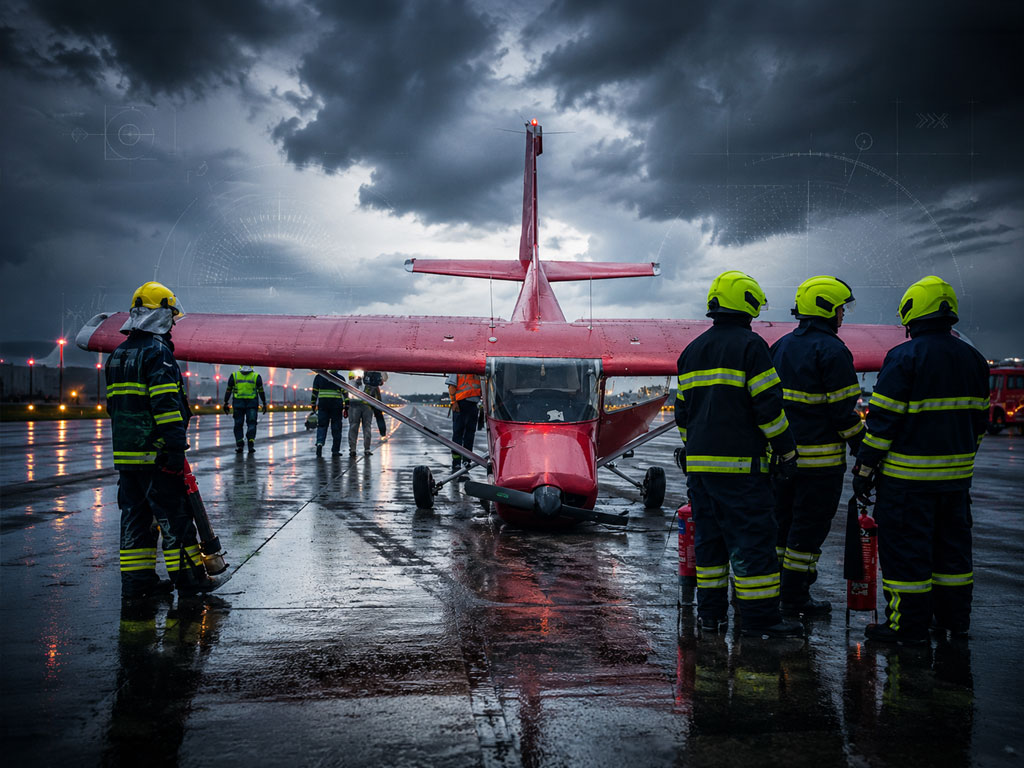
Redbird Ratmalana incident involving Cessna 4R-DRA raises fresh questions over training standards, ageing aircraft and regulatory oversight.
The Redbird Ratmalana incident involving Cessna 152 II aircraft 4R-DRA has raised fresh questions about flight training standards, ageing aircraft and regulatory oversight in Sri Lanka.
The light training aircraft made a hard landing on the active runway at Colombo Ratmalana International Airport yesterday, August 25.
The sole student pilot on board escaped without injury. Airport Rescue and Fire Fighting teams also responded immediately and helped restore runway operations.
However, the incident should not automatically be treated as a simple student-pilot error.
A wider examination is needed into the training, maintenance and regulatory systems surrounding the flight.
Redbird Flight Training Academy is one of the main flight-training schools operating in Sri Lanka. The aircraft involved, 4R-DRA, has reportedly been in service for nearly four decades.
Solo flying is an essential part of pilot training. Even so, investigators should establish whether all relevant conditions were properly assessed before the student departed.
Those questions include the prevailing weather, the aircraft’s technical and structural condition, and whether the student was sufficiently prepared for the flight.
Redbird Ratmalana Incident Raises Training Questions
Commercial pilot training can involve substantial fees. The article cites a course cost of US$45,950.
That financial structure raises another question for regulators.
The Civil Aviation Authority of Sri Lanka should determine whether any pressure exists within training organisations to complete flying hours rapidly, move students through courses quickly or maximise revenue.
Any such pressure, if it exists, could potentially influence the decision-making freedom of instructors.
That issue must be examined rather than assumed.
Aviation training depends on instructors having full authority to cancel, delay or alter flights whenever safety requires it.
The Ratmalana incident therefore provides an opportunity for CAASL to review whether existing supervision, maintenance procedures and student-release standards remain adequate.
The matter also attracts attention because of reports concerning Redbird’s wider operations in India.
Indian Parent Network Has Faced Previous Scrutiny
The Redbird network has operated from several bases in India, including Baramati, Sioni and Vijayapura.
Its safety history has previously drawn regulatory scrutiny following a number of reported technical failures and accidents.
The source article refers to two accidents occurring within three days in October 2023.
It also cites a February 2024 accident involving an approximately 50-year-old Cessna aircraft.
According to the account, that aircraft crashed after fuel exhaustion and broke into three sections.
Following a series of incidents, India’s Directorate General of Civil Aviation suspended operations at Redbird bases while investigations were carried out.
The article also cites findings attributed to India’s Aircraft Accident Investigation Bureau.
According to those allegations, investigators examined whether SD cards and CCTV hard drives had been removed before accident investigators arrived.
Such claims are serious and should be viewed in the context of the official investigations in which they were raised.
They should not, however, automatically establish wrongdoing by Redbird’s Sri Lankan operation.
That distinction is important.
Financial and Regulatory Allegations Also Add Concern
The source article further refers to investigations by India’s Central Bureau of Investigation into alleged bribery and financial misconduct involving Redbird-linked entities and regulatory officials.
It also raises allegations concerning aircraft leasing through shell companies to obtain regulatory advantages.
Those claims have intensified questions about governance and regulatory compliance within the wider network.
Ratmalana is both a civil and security-sensitive airport.
For that reason, any operator conducting training there must meet the highest standards of aircraft maintenance, instructor supervision and regulatory compliance.
The latest hard landing should therefore prompt a careful review.
It should not be used to make conclusions before investigators complete their work.
CAASL Faces Pressure for a Transparent Review
The most important next step is transparency.
Authorities should examine Redbird Aviation (Pvt) Ltd’s maintenance standards, the condition of ageing aircraft and the criteria used before authorising student solo flights.
They should also assess instructor decision-making procedures and determine whether the Sri Lankan operation remains fully insulated from any problems identified within affiliated operations overseas.
A special audit would allow those questions to be answered with evidence rather than speculation.
Sri Lanka has ambitions to develop its reputation as an international centre for flight training.
That reputation depends on confidence in the regulatory system.
Students and their families must know that training-hour targets never override safety.
Instructors must be free to make conservative decisions without commercial pressure.
Aircraft, particularly older training aircraft, must remain subject to rigorous maintenance and airworthiness oversight.
The Redbird Ratmalana incident ended without injury.
That is fortunate.
But it should still be treated as an opportunity to examine whether every layer of Sri Lanka’s training and aviation-safety system is functioning as it should.