Judges retirement age changes face Supreme Court scrutiny as Eraj de Silva PC argues they could affect judicial independence and require a referendum.
The proposed judges retirement age extension has come under Supreme Court scrutiny over whether it could affect judicial independence, separation of powers and the sovereignty of the People.
Making oral submissions before the Supreme Court on September 1, Eraj de Silva PC appeared for petitioners Ven. Ulapane Sumangala Thero and Attorney-at-Law Sudarshana Gunawardana.
He argued that the proposed 22nd Amendment to the Constitution and the related Judicature (Amendment) Bill could not be treated simply as changes to the retirement age of judges.
According to de Silva, the constitutional implications become particularly serious because the changes would apply not only to future judicial appointments, but also to judges who currently hold office.
His submissions argued that the proposal would effectively grant an additional period of tenure to identifiable sitting judges.
That, he said, could preserve the current composition of the Superior Courts for a further period.
De Silva therefore placed a broader constitutional question before the Court. He asked whether the Executive and Legislature could alter the tenure of sitting judges at a particular point and, through that decision, influence the composition of another branch of government.

Judges Retirement Age Cannot Be Viewed in Isolation
The petitioners urged the Supreme Court to examine more than the wording of the proposed legislation.
De Silva argued that the Court should also consider the circumstances and sequence of events surrounding the introduction of the Bills.
He described the process as having been “shrouded in a veil of secrecy” and said the proposal had appeared “like a ghost in the night.”
The timing of the amendment also formed part of his submissions.
The Court was asked to consider when the Bill was introduced and when its provisions were intended to take effect.
De Silva argued that this had to be viewed against the background of judicial vacancies, appointments and changes in the composition of the Superior Courts.
According to his position, those circumstances cannot be separated from the constitutional question.
Immediate implementation, he argued, could result in a particular composition of the judiciary remaining in place longer than it otherwise would.
However, de Silva stressed that his argument was not an attack on the competence, character or integrity of any judge currently serving.
Instead, he said the issue concerns whether political branches can grant additional tenure to identifiable judges and thereby alter the constitutional relationship between separate organs of government.
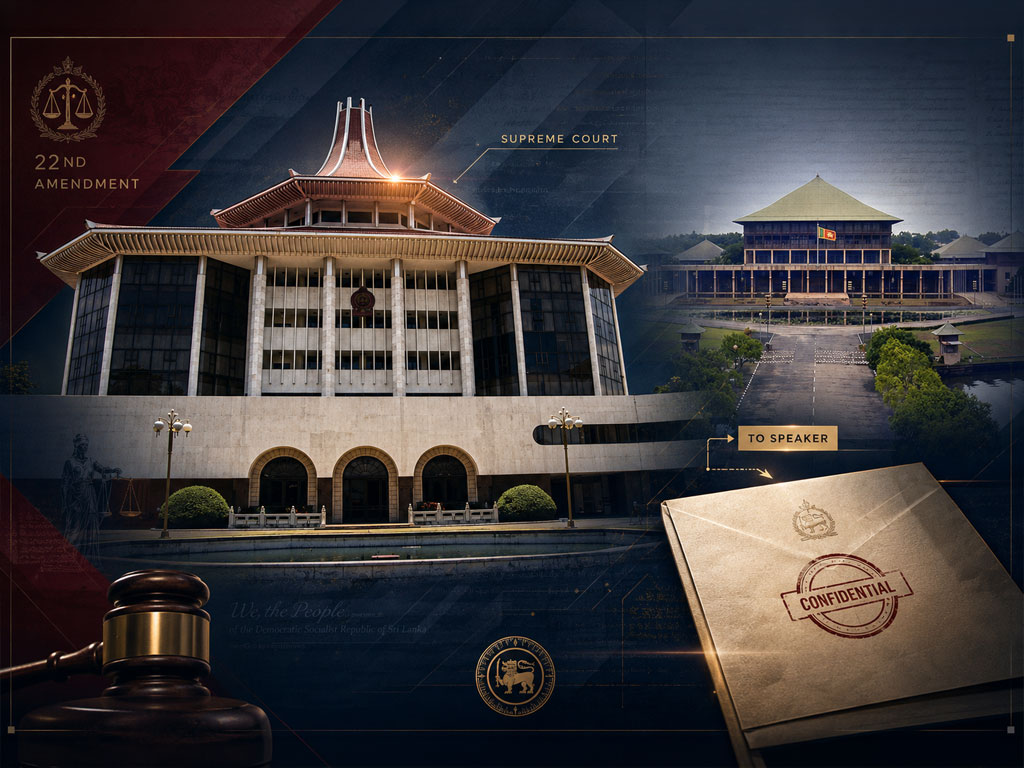
22nd Amendment Petitions End as Ruling Goes to Speaker
The Supreme Court has concluded the 22nd Amendment petitions hearing and will send its confidential determination to the Speaker after two days of arguments.
The Morning Telegraph • September 2, 2026 • 4 min readJudicial Independence at the Heart of the Challenge
A central argument before the Court was that judicial tenure does not exist as a personal privilege for judges.
Rather, the petitioners described security of tenure as a constitutional safeguard created for the benefit of the public.
They argued that judges must be able to decide cases without fear, favour, affection or expectation.
That protection becomes especially important when judges hear cases involving the Executive or Legislature.
De Silva referred to Alexander Hamilton’s Federalist Paper No. 78.
He argued that the judiciary is institutionally the weakest of the three branches because it controls neither the “sword” nor the “purse”.
Security of tenure, he submitted, is therefore critical to preserving the ability of judges to exercise judicial power independently.
The submissions also drew an important distinction between changing the retirement age for future judges and extending the tenure of judges already serving.
A new retirement age applied to judges appointed after a constitutional amendment would operate prospectively.
However, de Silva argued that extending the tenure of sitting judges creates a more immediate constitutional problem.
Those judges would receive an additional period in office that did not form part of the constitutional framework under which they were originally appointed.
Appearance of Dependence Also Raised
The petitioners argued that judicial independence must be protected from more than direct or actual interference.
They said the constitutional system must also guard against circumstances that create an appearance of influence or dependence.
De Silva specifically said he was not suggesting that any judge had requested or wanted an extension.
Nor did he argue that a judge receiving additional tenure would necessarily fail to perform judicial duties impartially.
Instead, he focused on the institutional relationship created when political authorities grant extra tenure to judges who are already in office.
According to his submissions, that situation could affect public confidence in the judiciary.
The concern could become particularly significant when those judges later have to determine the legality or constitutionality of decisions taken by the same political branches responsible for extending their tenure.
The argument therefore centres not only on actual independence, but also on how the relationship appears to the public.
Articles 1, 3 and 4 Form Part of the Argument
De Silva placed particular emphasis on Articles 3 and 4 of the Constitution.
Article 3 declares that sovereignty is vested in the People.
Article 4 sets out how that sovereignty is exercised, including through the judicial power of the People.
From that foundation, de Silva argued that judicial power does not personally belong to individual judges.
Instead, judges exercise that power on behalf of the People.
He therefore submitted that judicial independence forms part of the constitutional safeguards surrounding the exercise of the People’s judicial power.
The proposed amendment, according to the petitioners, cannot therefore be examined only through Article 107.
Article 107 deals with the appointment and tenure of judges of the Superior Courts.
However, de Silva argued that it must be read together with Articles 3 and 4, the principle of separation of powers and the broader requirement of judicial independence.
Article 1 was also introduced into the argument.
That provision describes Sri Lanka as a “Free, Sovereign, Independent and Democratic Socialist Republic.”
De Silva argued that the word “Independent” must carry substantive constitutional meaning.
He submitted that it cannot simply be treated as declaratory language without consequences for the structure of government.
Internal and External Judicial Independence
The petitioners also distinguished between external and internal judicial independence.
External independence concerns the ability of the judiciary, as an institution, to operate without control or interference from the Executive and Legislature.
Internal independence concerns the ability of individual judges to decide cases independently and impartially.
De Silva argued that security and certainty of tenure are fundamental to both forms of independence.
A judge, he submitted, should not be placed in a position where political branches grant an additional period of tenure while the same judge may later have to scrutinise decisions made by those branches.
The argument therefore extends beyond the personal conduct of individual judges.
It focuses instead on the constitutional structure governing the relationship between the judiciary and other branches of the State.
Immediate Application Comes Under Scrutiny
The petitioners maintained that even a future change in judicial retirement ages would have to be examined against Articles 3 and 4.
That is because judicial tenure forms part of the constitutional structure designed to protect judicial independence.
However, they argued that immediate application creates an additional and more serious issue.
If the amendment applies to judges already serving, identifiable individuals would receive longer periods in office.
The existing composition of the Superior Courts could therefore remain in place beyond the tenure currently provided under the Constitution.
De Silva argued that the Supreme Court should examine this practical effect rather than simply accept the proposal’s description as a general increase in retirement ages.
For the petitioners, the relevant constitutional question is not merely whether Parliament has the power to set a retirement age.
It is whether altering the tenure of sitting judges at a particular moment creates consequences for judicial independence and the separation of powers.
Referendum Question Emerges From Constitutional Challenge
The submissions ultimately placed the judges retirement age issue within the constitutional rules governing amendments that require approval beyond Parliament.
De Silva argued that the proposed amendment affects Articles 1, 3 and 4 of the Constitution.
On that basis, he submitted that it cannot become law solely through approval by a two-thirds majority in Parliament.
According to his argument, the amendment would also require the approval of the People at a referendum.
The Supreme Court’s eventual determination on the proposed 22nd Amendment and the Judicature (Amendment) Bill could therefore carry consequences far beyond the retirement age of judges.
At the centre of the case is a fundamental constitutional issue: how judicial tenure may be changed, who may change it and whether extending the terms of sitting judges can affect the independence and institutional legitimacy of the judiciary.
The petitioners’ case asks the Court to determine whether what appears on its face to be a retirement-age reform could, because of its immediate application, alter the constitutional balance between Sri Lanka’s judiciary, Executive and Legislature.