Sri Lanka taxi drivers describe debt, long hours, algorithmic pressure and falling returns while working through Uber and PickMe platforms.
Sri Lanka taxi drivers have transformed urban transport, allowing passengers to summon an air-conditioned vehicle within minutes by touching a button on a smartphone.
For passengers, the process is almost effortless. We watch a small dot move across the screen and wait impatiently for the vehicle to arrive.
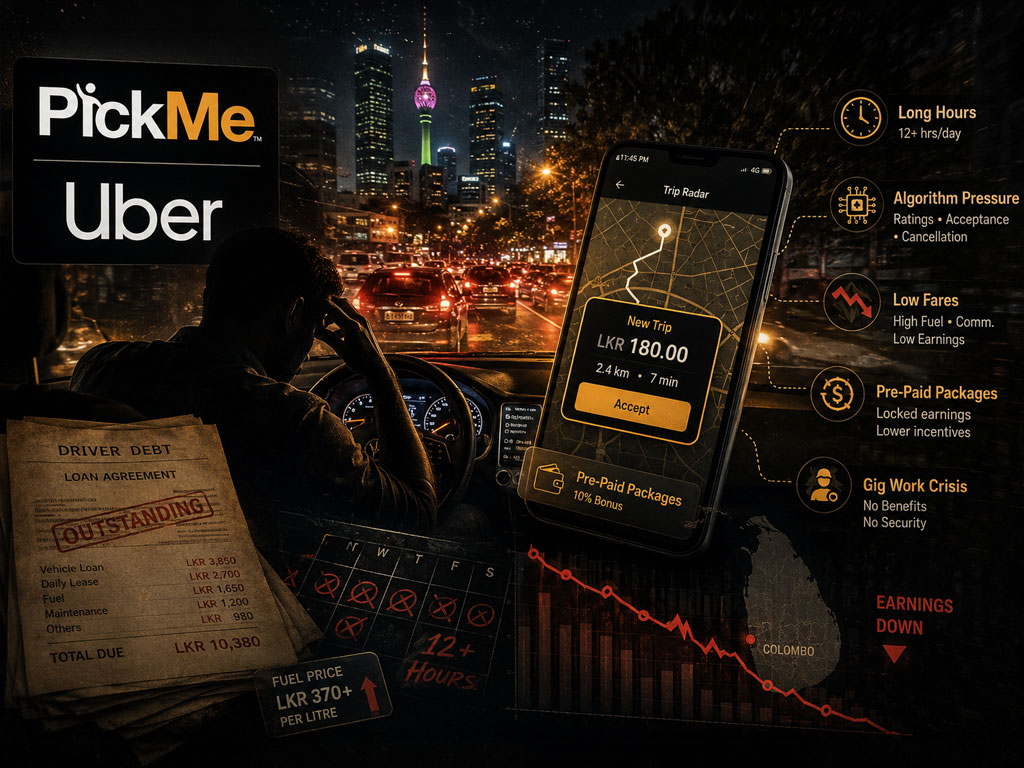
But behind that convenience sits a driver holding the steering wheel, carrying fuel costs, vehicle repayments and the pressure of making enough trips to survive.
Let us call him Akram.
The phone mounted inside Akram’s vehicle glows continuously as he navigates Colombo’s heavy traffic. His tired eyes repeatedly move between the road and numbers appearing on the screen.
His story reflects concerns raised by drivers who say the technological revolution promoted as flexible employment has also created a new form of economic dependence.

Demand for platforms such as Uber and PickMe remains high within Sri Lanka’s transport sector. Yet far less public attention has focused on the financial and structural pressures described by drivers using their own vehicles to provide these services.
This analysis draws on driver accounts, field testimonies and the research sources identified at the end of this article. Where specific platform practices are disputed or not independently established, they are presented as claims made by drivers.
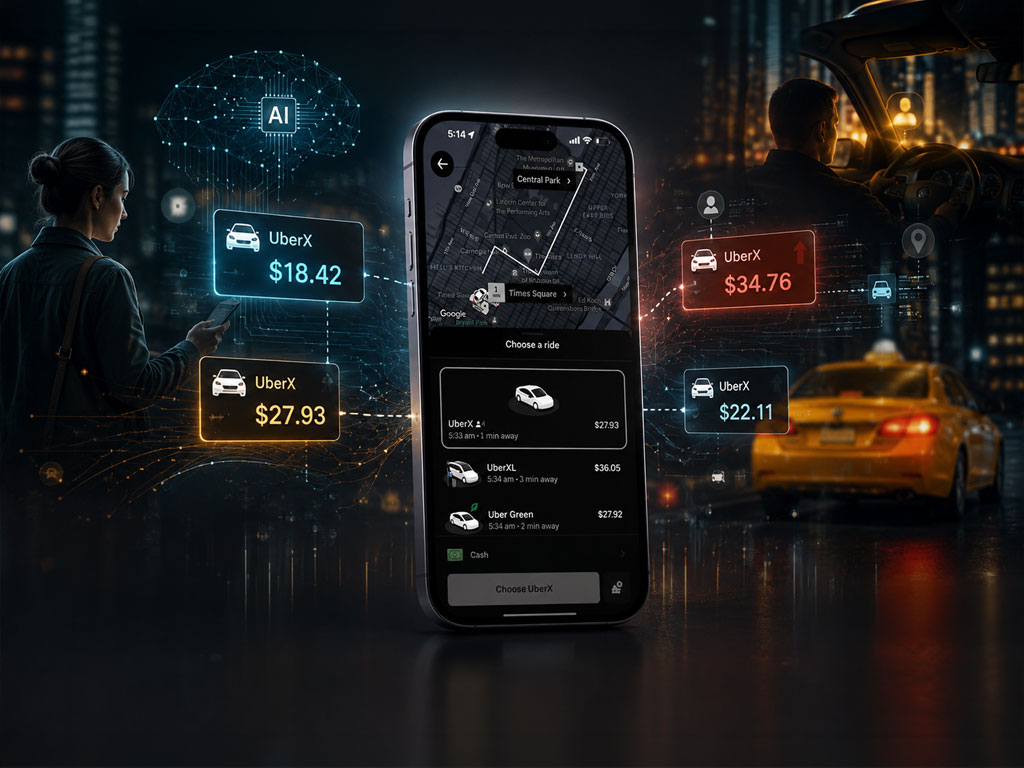
Same Ride, Different Price; Uber’s Billion-Dollar Scam!
Uber upfront pricing is under scrutiny over how algorithms set fares, what drivers receive and whether personal data can influence ride prices.
Sri Lanka Taxi Drivers and the ‘Be Your Own Boss’ Promise
Sri Lanka’s economic crisis and job losses in 2022 pushed more workers towards informal employment.
The informal workforce reached 56.9% of total employment, according to the labour force data cited for this analysis.
For people whose traditional sources of income had disappeared, digital platforms appeared to offer an immediate alternative.
The promise was attractive: choose your working hours, use your own vehicle and become an independent entrepreneur.
Some drivers say they bought vehicles by pawning gold jewellery or taking leasing and finance loans at high interest rates, believing ride-hailing work could provide a stable future.
Drivers interviewed for this analysis describe the beginning as almost dreamlike.
They claim newly registered accounts initially received greater access to profitable or longer trips. This early period is sometimes described as a “honeymoon phase.”
However, according to their accounts, the experience changed after they became financially dependent on the platform and committed to monthly vehicle repayments.
Some older drivers allege that trip priority then declined while newer drivers entered the system.
For someone facing leasing payments and daily household expenses, simply leaving the platform may no longer be realistic.
The result, according to drivers, is longer working hours and greater pressure to accept whatever work the system offers.
Pre-Paid Packages Before a Driver Earns Anything
One of the strongest complaints concerns Uber’s payment model as described by drivers.
Drivers say Uber initially operated in Sri Lanka using commissions of around 5%, 10% or 15% on individual hires.
They claim that this has since shifted for some drivers towards pre-paid packages.
According to accounts provided for this article, packages can range from approximately Rs. 1,000 to Rs. 1,200 per day. Weekly packages are said to range from Rs. 1,500 to Rs. 5,000.
The key complaint is that the driver pays before earning the day’s income.
Drivers say purchasing a package does not guarantee enough trips to recover its cost.
On some days, they claim, only one or two low-value trips arrive. The daily package then expires at midnight.
They further allege that unused value does not carry forward even when the number of trips provided is insufficient.
That creates a powerful psychological incentive to remain online.
Once money has already been spent on a package, drivers say they feel pressure to continue working until they recover the cost.
They also describe in-app messages encouraging continued activity and acceptance of trips.
Critics argue that such a model shifts demand risk onto the driver. Poor weather, congestion or a quiet day can reduce earnings while the platform has already received the package payment.
Trip Radar and the Pressure of a One-Second Decision
Another major concern raised by Sri Lanka taxi drivers involves Uber’s Trip Radar feature.
Drivers say a potential trip can appear simultaneously to many nearby drivers instead of being offered exclusively to one person.
According to their accounts, they may have only one or two seconds to react before another driver takes the trip.
Within that time, a driver must attempt to assess the destination, distance, offered fare and whether the journey will make a profit.
Many say that is practically impossible.
Fear of losing the trip can encourage instant acceptance before all details have been properly assessed.
Some drivers therefore report using third-party tools such as Auto Touch, Mystro and Z-Fair.
They say these programs can calculate factors such as earnings per kilometre within milliseconds or help automate acceptance decisions.
However, reliance on external software introduces its own risks and raises questions over the working environment created by rapid-fire trip allocation.
Cancellation is another source of anxiety.
Drivers say accepting an unsuitable journey and cancelling it later can increase their cancellation rate.
According to the accounts provided, drivers seeking to maintain Gold, Platinum or Diamond status may need to keep cancellation rates below 4%.
They further claim that once the rate exceeds 10%, important priorities or benefits can be lost.
From the driver’s perspective, the contradiction is obvious: the system demands a rapid decision, yet may penalise a driver who later decides the trip is unsuitable.
Vehicle Categories Can Create Further Losses
Drivers also complain about how vehicle categories are handled.
They say a passenger may request a smaller, cheaper category such as an Alto. If none is available, the system can sometimes direct the journey to a larger vehicle.
Drivers cite Sedans, Prius, Wagon R vehicles and Mini Vans as examples.
According to those accounts, the larger vehicle may still receive the fare calculated for the cheaper category.
That can create a financial disadvantage because larger vehicles usually carry higher fuel and maintenance costs.
The issue can also generate disputes with passengers.
Drivers describe situations where a passenger booking a smaller category sees a larger KDH-type Mini Van arrive and then expects to carry around six people.
If the driver refuses, the passenger may cancel.
The driver then loses the fuel and time used travelling to the pickup point and, according to the complaints presented, may receive no compensation.
Some drivers make a further allegation about trip allocation.
They claim profitable or longer journeys may first go to larger cars such as the Prius, followed by Wagon R vehicles and then Alto cars.
Drivers have described this as a discriminatory hierarchy within the algorithm. This allegation has not been independently established in the material provided.
Long-Distance Fares and Destination Mode
Long-distance journeys create another financial pressure.
Drivers interviewed for the analysis complain that upfront pricing can produce fares they consider too low after fuel, maintenance and vehicle depreciation.
One example provided is a roughly 110-kilometre uphill journey from Colombo to Hatton for about Rs. 10,000.
Another example involves a Colombo-to-Nuwara Eliya trip for which drivers say even a Mini Van may receive approximately Rs. 14,000.
They argue that uphill driving increases fuel consumption and operating costs.
Once fuel is deducted, drivers say the remaining amount may provide inadequate compensation for their labour and the depreciation of their vehicle.
They also compare those amounts with higher prices often charged by conventional taxi operators.
Destination Mode has attracted similar criticism.
A driver returning from the airport or another distant location may activate the feature to find a passenger travelling in the same general direction.
For the driver, earning something on the return journey is preferable to travelling empty.
However, drivers allege that the algorithm recognises this need and can offer a lower fare because the vehicle is already heading in that direction.
They argue that a feature designed to reduce empty journeys can therefore become another mechanism through which the driver’s economic vulnerability affects pricing.
Long Working Hours and a Gap in Labour Protection
The larger question concerns employment status.
The research cited in the source material states that 75% of workers engaged in the gig economy depend on it as their full-time livelihood.
Yet drivers are generally treated as independent contractors rather than conventional employees.
The article argues that this classification leaves them outside protections available under traditional employment frameworks, including provisions governing working hours.
The Factories Ordinance is cited as limiting work shifts to nine hours per day in covered employment.
Survey findings referenced for this analysis indicate that some platform drivers work between 11 and 16 hours daily.
Drivers also report occasions when they remain on the road for as long as 24 hours while attempting to meet loan repayments, package costs and household expenses.
Such hours create obvious concerns about fatigue and road safety.
Drivers say they work through temperatures exceeding 36 degrees Celsius, heavy rain and flooding.
Yet, as independent contractors, they do not receive conventional benefits such as paid sick leave, Employees’ Provident Fund contributions or occupational health insurance through an employer relationship.
PickMe operates differently in some areas. The local platform does not use the same pre-paid package system described by Uber drivers in this article.
However, PickMe drivers have also protested over commissions and working conditions.
Recent trade union demonstrations and strikes in Colombo and Nugegoda were described as representing approximately 100,000 drivers.
The complaints centred on commissions and alleged exploitation.
The article also cites Fairwork global research standards when raising concerns about fair pay, working conditions, management practices and collective bargaining rights in the platform economy.
What Should Change for Sri Lanka Taxi Drivers?
The growing importance of app-based transport makes regulation increasingly difficult to avoid.
The government, Department of Labour and National Transport Commission could play central roles in developing rules specifically designed for gig work.
One proposal is to reconsider whether every platform worker should automatically be treated solely as an independent contractor.
New labour legislation could create portable social-security accounts attached to workers rather than individual employers.
Such accounts could operate through digital wallets or a national digital identification framework, with platforms legally required to make contributions.
A minimum base payment per kilometre is another proposal.
That rate could consider fuel costs, maintenance, vehicle depreciation and the type of journey involved.
Destination Mode could also carry minimum compensation standards to prevent return journeys from being priced unfairly.
The pre-paid package model has generated particularly strong opposition among drivers.
Critics argue that drivers should not have to pay substantial amounts before they know whether enough work will be available.
Instead, they propose a transparent percentage deducted from actual earnings.
Algorithmic transparency is equally important.
Drivers should be able to understand how fares are calculated, why particular journeys are allocated to particular vehicles and how cancellation rates affect their accounts.
An independent human appeals mechanism could provide drivers with somewhere to challenge account suspensions or other automated decisions.
Regular technical audits could also examine whether vehicle categories and trip allocation systems operate consistently.
Digital transport platforms have become an essential part of modern urban life.
They offer speed, convenience and employment opportunities while helping thousands of passengers move around Sri Lanka every day.
But the convenience enjoyed by passengers cannot obscure the economics faced by the person behind the wheel.
If drivers must remain on the road for extreme hours, carry vehicle debt, absorb demand risk and make crucial financial decisions in seconds, policymakers need to examine whether existing rules are adequate.
The future of Sri Lanka’s digital transport economy should not require drivers like Akram to choose between financial survival and physical exhaustion.
Technology can improve transport. But a sustainable platform economy must also ensure that the people who make that technology work can earn a living under conditions that are transparent, fair and safe.
Sources: Direct statements and testimonies of drivers in the field | Department of Census and Statistics labor force data | Centre for a Smart Future (CSF) research reports | Solidarity Centre survey data | Fairwork global labor standards report