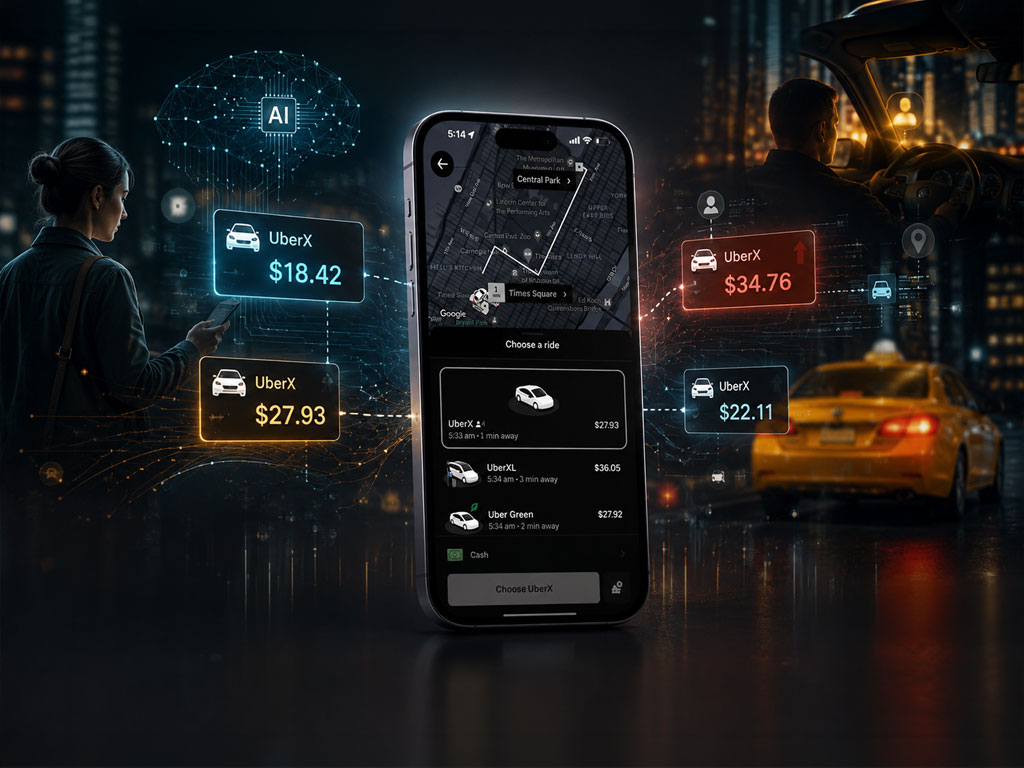
(Image is an AI creation. The prices shown are not real prices! The article was prepared based on an investigative report by Business Insider.)
Uber upfront pricing is under scrutiny over how algorithms set fares, what drivers receive and whether personal data can influence ride prices.
Uber upfront pricing has transformed how passengers see fares, but it has also fuelled questions over why people standing in the same place can sometimes receive different prices for the same journey.
Imagine three colleagues leaving the same office at the same time.
They select the same vehicle category and enter the same destination. Yet one app displays Rs. 1,000, another Rs. 1,200 and a third Rs. 1,500.
Most passengers immediately assume traffic, rain or demand caused the difference.
However, critics of algorithmic pricing argue that the story may be more complicated. They say ride-hailing platforms increasingly rely on sophisticated systems that estimate what customers are prepared to pay while also determining what drivers are willing to accept.
That has created a wider debate over transparency, personal data and how much control algorithms now have over everyday prices.

How Uber Upfront Pricing Replaced the Digital Meter
Uber’s early pricing model was comparatively straightforward.
A passenger’s fare was largely calculated using fixed rates based on distance and time, similar to a digital taxi meter.
Drivers also received a relatively predictable percentage of the fare.
In Uber’s earlier years, drivers commonly retained around 80% while the company took approximately 20%.
Customers were also attracted by fares that were often lower than conventional taxis.
However, that growth came at enormous financial cost.
Uber spent years reporting substantial losses while using investor capital to expand rapidly and attract both passengers and drivers.
By 2017, the company reported losses of roughly US$4.5 billion.
Dara Khosrowshahi became chief executive that year and inherited the challenge of turning a rapidly expanding but heavily loss-making platform into a sustainable business.
One of the major changes in the industry was the expansion of upfront pricing.
Instead of waiting until a journey finished before calculating the final cost through a simple rate card, passengers increasingly received a fixed estimated price before confirming the ride.
Uber says these prices can reflect factors such as estimated journey time, distance, traffic, demand and the availability of drivers.
However, critics argue that the lack of visibility into the complete calculation makes it difficult for either passengers or drivers to know exactly how a fare was determined.
Critics Point to Algorithmic Price Discrimination
Professor Len Sherman, who has written critically about ride-hailing economics, has argued that modern pricing systems can create what economists describe as algorithmic price discrimination.
The basic concern is simple.
A sophisticated pricing algorithm may attempt to estimate the maximum amount a customer is likely to accept for a journey.
At the same time, the platform can estimate the lowest amount at which a nearby driver might accept that same trip.
The difference between what the rider pays and what the driver receives can then become part of the platform’s revenue.
This has changed the traditional relationship between passenger fares and driver earnings.
Under a simple percentage-based model, a driver could easily understand how much of a customer’s fare the company retained.
Under modern upfront pricing, the passenger’s price and the driver’s offered payment can effectively be calculated separately.
As a result, the percentage retained by the platform can vary from trip to trip.
That variation is one reason passengers and drivers increasingly question how these systems operate.
Can Personal Data Influence the Fare?
The most controversial part of the debate concerns personal information.
Uber has said that it does not simply charge individual passengers more because of personal characteristics such as wealth.
However, algorithmic pricing systems can use large volumes of information about journeys, demand patterns and user behaviour.
New York has also introduced disclosure requirements around certain forms of algorithmic pricing and the use of personal data.
Critics have pointed to wording that can appear when prices are algorithmically determined using consumer information as evidence of how deeply data-driven pricing has developed.
Uber’s patents have added further fuel to the debate.
The company has explored technologies capable of analysing signals generated by smartphones and user behaviour.
These can potentially include how a device is moved, how people interact with applications and patterns in their regular journeys.
However, the existence of a patent does not prove that every technology described in it is actively used to calculate Uber fares.
That distinction is important.
Claims have circulated for years suggesting that Uber charges iPhone users more than Android users or increases prices when a passenger’s battery is low.
Such claims remain controversial and should not automatically be treated as established facts.
Uber has previously denied using a passenger’s remaining battery level to raise fares.
Nevertheless, the broader concern remains valid: passengers generally have limited visibility into exactly which signals influence an algorithmic price.
Why Two People Can Still Receive Different Prices
Different fares for apparently identical journeys do not necessarily prove that a platform is secretly targeting one person.
Prices can change rapidly.
Driver availability can shift within seconds.
Demand can rise or fall.
Different passengers may receive quotations at slightly different moments.
The algorithm may also predict different pickup routes or journey durations.
Promotions, account-specific discounts or pricing experiments can create additional differences.
However, the important issue is transparency.
When passengers cannot clearly see why their price differs from someone standing beside them, suspicion is inevitable.
Algorithmic systems can be legitimate while still requiring greater disclosure.
Customers should be able to understand what major factors influenced the price they were offered.
Drivers Say Their Share Has Become Harder to Predict
The same controversy exists on the driver’s side.
In earlier years, Uber’s commission structure was easier to understand.
If the passenger paid a particular amount, the driver generally knew what percentage would remain after Uber took its commission.
With upfront driver pricing, that relationship can be far less direct.
The source material cites the experience of a driver named Levie.
In one example, a passenger reportedly paid US$70.52 for a journey while the driver was offered approximately US$25.
That meant the driver’s payment represented only about 35% of the passenger’s total charge.
Individual trips can involve taxes, insurance, regulatory fees and other deductions, so the difference does not necessarily represent pure profit for Uber.
Nevertheless, examples such as this have increased concern among drivers about the widening gap between passenger prices and driver payments.
Drivers Face Seconds to Evaluate a Trip
Another complaint involves the time drivers receive to evaluate ride requests.
Depending on the market and app configuration, drivers may have only a short period to decide whether a journey is worthwhile.
During that time, they must consider the pickup distance, destination, expected duration and offered payment.
They may also need to estimate fuel costs, vehicle depreciation and the likelihood of receiving another passenger after reaching the destination.
That can be difficult to calculate in a few seconds.
Critics compare the experience to a game in which drivers repeatedly make rapid financial decisions without having access to all the information behind the algorithm.
The source article argues that this places drivers at a disadvantage because the platform has far more data than the individual accepting the trip.
Wait-Time Fees Raise Another Question
Driver complaints also extend to waiting charges.
When passengers keep drivers waiting beyond a specified period, the app may impose an additional fee.
The source material cites an example in which a passenger paid 56 US cents in waiting charges, while the driver reportedly received 37 cents.
That difference has prompted questions about why platforms retain part of a fee intended to compensate drivers for lost time.
Uber argues that its overall deductions can cover more than company revenue.
Depending on the market, passenger payments may include taxes, insurance, government fees and other operational costs.
However, critics say those deductions are often difficult for drivers to independently verify.
They argue that greater itemisation would allow both sides to see exactly where the money goes.
Insurance Charges Also Face Scrutiny
The source article also cites analysis questioning variations in insurance-related deductions.
According to that argument, apparently similar journeys have sometimes shown substantially different insurance charges.
Critics say inconsistent deductions make it harder for drivers to understand the true cost structure behind each fare.
Uber has maintained that insurance, taxes and regulatory requirements contribute significantly to the difference between what passengers pay and what drivers receive.
The key issue again becomes transparency.
If charges vary, drivers need a clear explanation of why they vary.
Without it, an automated deduction can appear arbitrary even when legitimate costs exist behind the calculation.
Uber Reached Profitability After Years of Losses
The pricing debate has intensified as Uber’s financial position has strengthened dramatically.
After years of large losses, the company reported its first full-year operating profit in 2023 and significantly improved its financial performance.
The source article cites a profit figure of approximately US$1.1 billion for 2023.
Uber’s market value also rose substantially as investors responded to improving profitability.
Critics argue that changes to passenger pricing and driver compensation played an important role in that transformation.
Uber, however, operates across several businesses and generates revenue from ride-hailing, delivery and other services.
Its improved financial performance cannot therefore be attributed to one pricing mechanism alone.
Still, the shift from a heavily subsidised growth model to a profitable technology platform has changed the relationship between Uber, its customers and its drivers.
Other Apps Have Adopted Similar Pricing Models
Uber is no longer alone.
Upfront and dynamic pricing now appears across much of the ride-hailing and food-delivery industry.
Algorithms constantly balance supply, demand, travel time, driver availability and customer behaviour.
That means the questions raised about Uber extend much further than one company.
Sri Lankan passengers also use app-based taxi and delivery services that calculate prices dynamically.
However, it would be wrong to assume without evidence that every international pricing practice described in the Uber debate is automatically being used by Sri Lankan platforms.
The relevant question is whether local operators provide sufficient transparency about how their fares are generated.
Regulators may eventually need to examine the issue more closely.
The Bigger Issue Is Trust
For many passengers and drivers, the central concern is not whether Uber is allowed to make a profit.
Technology companies need sustainable business models.
Drivers also need to earn enough to justify their time, fuel and vehicle costs.
Passengers want reliable transport at a reasonable price.
The problem begins when neither side understands how the algorithm dividing that money actually works.
When two passengers see different fares, they want to know why.
When a customer pays US$70 while the driver receives a fraction of that amount, the driver wants to understand where the remainder went.
When insurance or other deductions change significantly, drivers want an explanation.
These are reasonable questions.
Algorithms have become powerful intermediaries between buyers and sellers, but their decisions can remain largely invisible.
That imbalance creates distrust.
The lesson for passengers is therefore not that every higher fare proves they have been individually targeted.
Nor is there firm evidence that a low battery or an expensive smartphone automatically causes Uber to increase a fare.
But the rise of Uber upfront pricing does demonstrate how dramatically transportation has changed.
A taxi fare is no longer always a simple calculation of kilometres and minutes.
Increasingly, it is the result of a complex algorithm operating in real time.
The more power those systems gain over prices and earnings, the stronger the case becomes for explaining how they work.
For passengers and drivers alike, transparency may ultimately matter just as much as the final number appearing on the screen.