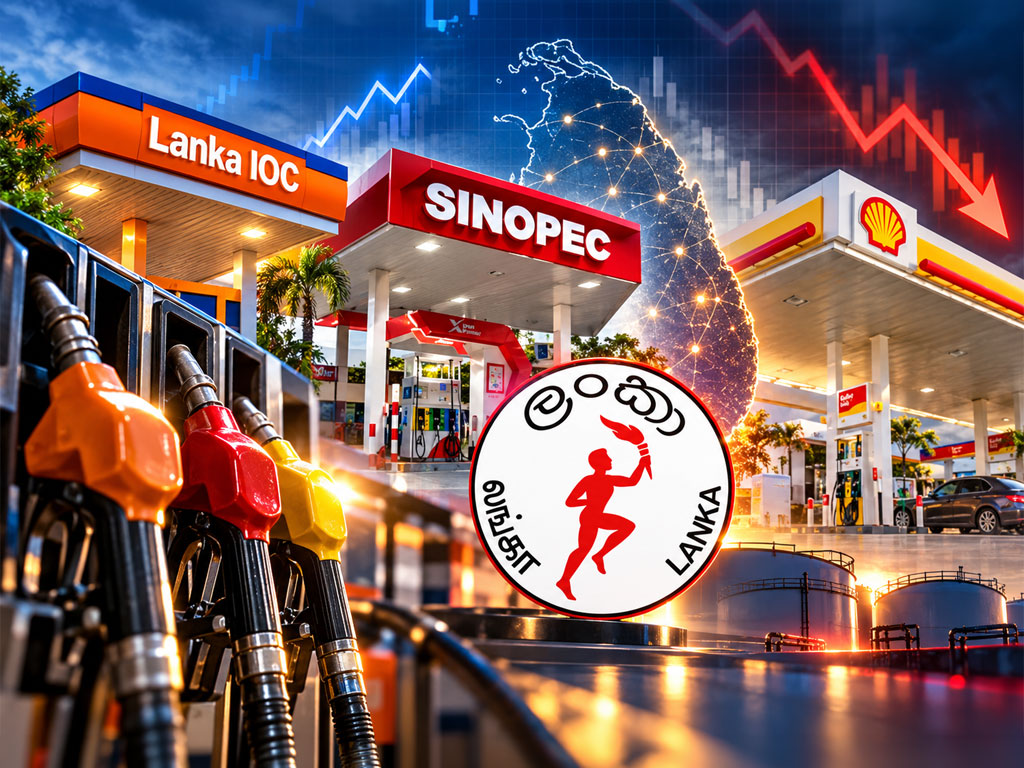
Sri Lanka private fuel prices are under scrutiny as CPC says firms facing losses are not bound by a written order to match Ceypetco rates.
COLOMBO — Ceylon Petroleum Corporation Chairman D. J. Rajakaruna has said private fuel companies operating in Sri Lanka are not currently acting under a written Government directive requiring them to sell at CPC prices, amid growing concern over losses reported by private suppliers and sporadic shortages at some filling stations.
Rajakaruna said private companies are presently matching Ceypetco prices voluntarily and argued that, if they are incurring losses under that arrangement, they have scope to determine a price at which they can continue selling fuel.
His comments come as private suppliers have complained that rising international petroleum costs have made it increasingly difficult to sell some products at prevailing domestic prices.
Rajakaruna also sought to reassure consumers that the CPC is not planning an immediate fuel price increase and expects to maintain both supplies and the present pricing environment over the coming months, provided there is no major disruption in global markets.

No Written Direction to Match CPC Prices
Addressing claims by private fuel companies that they are suffering significant losses, Rajakaruna said agreements governing their operations contain provisions dealing with losses where fuel is sold at prices stipulated by the Government.
He said that if companies were formally required by the State to sell at a particular price and suffered losses as a result, the Government could be required under the relevant contractual arrangements to address those losses.
The Chairman stressed, however, that no written order has been issued directing the private companies to sell fuel at a specific price.
According to his explanation, companies currently matching CPC prices are doing so voluntarily rather than in response to a formal written pricing instruction.
On that basis, he said firms facing unsustainable losses should not assume they are compelled by the CPC itself to continue selling at an uneconomic price.
The precise legal position governing maximum, minimum or fixed retail prices can also depend on applicable ministerial orders, gazettes and individual operating agreements. Rajakaruna’s comments therefore address the current administrative and contractual position as he described it, rather than eliminating the need for companies to comply with any binding price regulations in force.
Private Companies Report Heavy Losses
The debate over pricing has intensified in recent weeks as private suppliers report steep losses on fuel sold in Sri Lanka.
During discussions with the Government in September, companies reportedly presented figures showing substantial losses per litre, particularly on diesel.
RM Parks was reported as losing Rs. 173 per litre on diesel and Rs. 38.75 on petrol, while Sinopec cited losses of Rs. 192 per litre on diesel and Rs. 67 on petrol.
Lanka IOC was reported as losing Rs. 136 per litre on diesel and Rs. 57 on petrol.
Those figures were presented by the respective companies and should therefore be understood as their reported commercial positions rather than independently audited Government calculations.
The Government had earlier been subsidising part of the gap between import costs and domestic retail prices, particularly during periods of extreme international volatility.
Cabinet approved relief measures in March under which the State could absorb up to Rs. 20 per litre of Octane 92 petrol and up to Rs. 100 per litre of auto diesel when imported costs exceeded the declared retail price.
Supply Reductions Have Contributed to Queues
Private-sector losses have also had consequences for fuel availability.
Energy Minister Anura Karunathilake told Parliament on October 6 that private fuel companies had reduced the quantities released to the market because of higher international prices and the difficulty of selling at current domestic rates.
That reduction has placed additional pressure on the CPC, which has increased its own market releases to compensate.
Rajakaruna has separately said approximately 62 locations were identified where shortages could potentially arise because of reduced private-sector supply.
Discussions were subsequently held with companies to improve deliveries to those areas.
The Chairman said motorists who encounter shortages at privately operated filling stations should use nearby CPC outlets where supplies are available.
CPC Rules Out Immediate Price Increase
For Ceypetco customers, Rajakaruna said there is no proposal at present to increase fuel prices before the end of October.
He went further, saying the CPC expects the present price and supply situation could largely be maintained for approximately three months, provided there is no major upheaval in international petroleum markets.
That assurance is conditional.
Global fuel prices remain exposed to geopolitical instability, shipping disruptions and sudden changes in crude and refined-product markets.
A sharp external shock could therefore force another review.
At present, however, the CPC says it has sufficient financial and operational capacity to manage the market without immediately passing additional costs to consumers.
Current CPC Fuel Prices
CPC’s published retail prices currently stand at:
- Lanka Petrol 92 Octane: Rs. 414 per litre
- Lanka Auto Diesel: Rs. 392 per litre
- Lanka Petrol 95 Octane Euro 4: Rs. 475 per litre
- Lanka Super Diesel 4 Star Euro 4: Rs. 528 per litre
- Lanka Kerosene: Rs. 285 per litre
The latest revisions for several products took effect from midnight on September 30.
Those CPC rates have become an important reference point across the market, even as private suppliers argue that their landed costs differ.
Different companies can face different import prices depending on the timing of purchases, freight charges, supplier contracts, financing costs and the international market prevailing when cargoes are secured.
That means a price sustainable for CPC may not necessarily produce the same commercial outcome for every private distributor.
CPC Says Fuel Stocks Are Secure
Rajakaruna also rejected speculation that Sri Lanka is facing an immediate nationwide fuel shortage.
The Corporation reviews its fuel stocks every Tuesday and, according to the Chairman, the latest assessments showed no reason for concern over available reserves.
Two additional fuel shipments have been expedited, while arrangements have been made to import quantities exceeding the country’s expected October requirement as a precaution.
He urged motorists not to respond to rumours by forming unnecessary queues.
The CPC’s position is that isolated shortages at some outlets should not be confused with a national supply crisis.
Pricing Debate Exposes a Wider Policy Problem
The situation highlights a broader tension in Sri Lanka’s liberalised fuel market.
The Government wants competition among several suppliers, but competition becomes difficult when international costs rise sharply while retail prices remain politically and economically sensitive.
If private companies are required to sell below sustainable cost, they may reduce supply or seek compensation.
If they are permitted to raise prices substantially above CPC rates, consumers could face different prices depending on the filling station they visit.
A Government subsidy can temporarily bridge that gap, but it ultimately transfers part of the cost to the Treasury.
None of the options is cost-free.
The central policy challenge is therefore to establish a transparent system that defines how prices are determined, when subsidies apply and what obligations private suppliers have to maintain adequate market supply.
Written Rules Will Be Critical
Rajakaruna’s comments provide important clarification about the absence of a current written Government instruction compelling private suppliers to match CPC prices.
But the practical impact will depend on the wider legal framework.
Fuel pricing in Sri Lanka can be governed through ministerial orders under the Ceylon Petroleum Corporation Act, including provisions allowing maximum, minimum or fixed prices to be prescribed.
Any move by a private supplier to depart materially from prevailing prices would therefore need to be assessed against whatever gazette, ministerial order and contractual conditions are in force at the time.
For consumers, the immediate message from the CPC is more straightforward: Ceypetco does not expect an immediate increase in its own prices and says its stocks are adequate.
For private suppliers, the unresolved question is whether the Government will allow greater price flexibility, provide further support or establish another mechanism to prevent supply reductions when international costs rise.
That decision will determine whether Sri Lanka’s multi-supplier fuel market can remain both competitive and stable during the next period of global energy volatility.