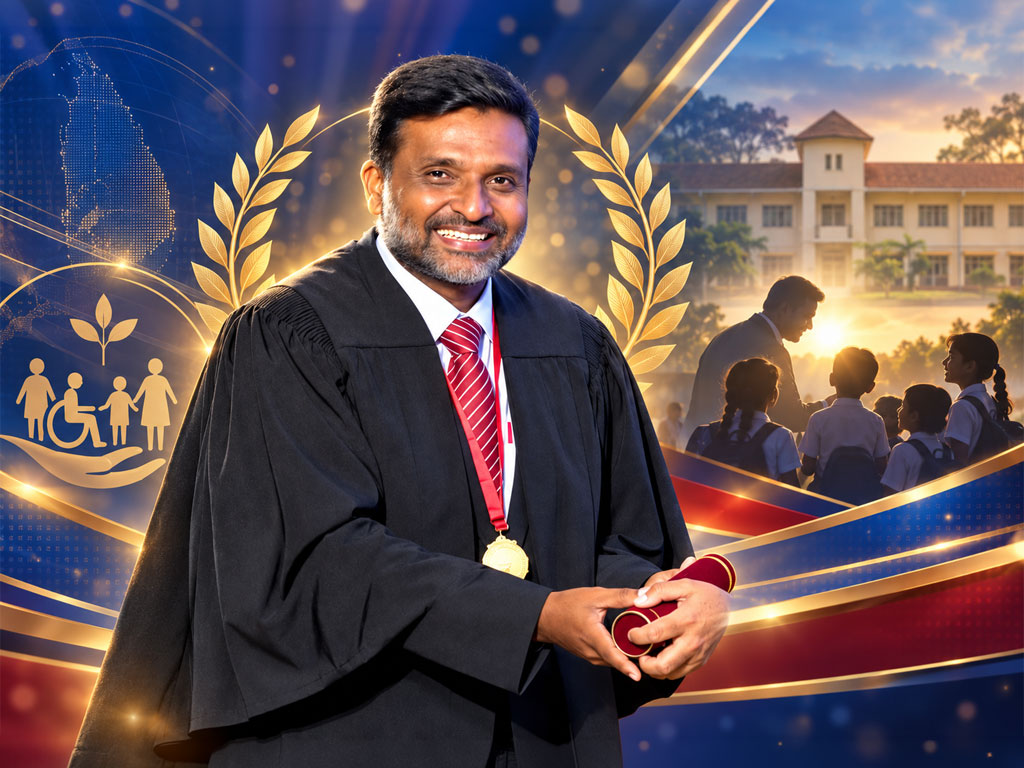
M. Z. M. Irfan of Iqra Primary College has been recognised for leadership that combines inclusion, English learning and community support.
HAMBANTOTA — Principal M. Z. M. Irfan of Iqra Primary College in Hambantota has been recognised under the 2026 Guru Prathibha Prabha awards programme, drawing attention to a style of school leadership that places initiative, inclusion and community participation alongside conventional academic performance.
The recognition is significant because it comes at a time when Sri Lanka’s public education system is frequently criticised for over-reliance on administrative circulars and rigid procedures that can discourage practical decision-making at school level.
Irfan’s work, as described in the material submitted for publication, presents a contrasting model: one in which a principal works within the existing system but does not allow bureaucracy to become an excuse for inaction.
The Guru Prathibha Prabha National Teacher and Principal Awards 2026, organised by the Ministry of Education, Higher Education and Vocational Education, were established to recognise professional excellence, leadership, innovation and effective educational practice. Applications for the 2026 programme closed on July 15.

Moving Beyond Exam-Centred Schooling
One of the strongest themes associated with Irfan’s administration is his attempt to move beyond a narrow examination-based model of education.
Sri Lanka’s school system is often judged through examination results, pass rates and academic rankings. While those indicators remain important, they do not by themselves measure whether children are receiving a balanced education or whether schools are responding to different learning needs.
At Iqra Primary College, Irfan is credited with introducing practices aimed at broadening the school experience.
Among the most significant is the establishment of a Tamil-medium special education unit for children with special needs in the Southern Province.
That initiative is important not simply because it adds another facility to the school, but because it addresses a group of children who can easily be marginalised when education systems are designed primarily around mainstream academic performance.
The principle behind the initiative is straightforward: inclusion should not depend on whether a specific administrative instruction arrives first.
Community Support Used to Overcome Resource Constraints
Another feature of Irfan’s leadership has been his use of parents and the wider community to help address shortages in physical resources.
Schools frequently face delays in receiving funding, equipment or infrastructure improvements through formal administrative channels.
According to the source material, Irfan sought to reduce the impact of such delays by building stronger relationships with parents and members of the community around the school.
Rather than treating the absence of ministry allocations as a reason to postpone development, the school used community participation to improve facilities and create additional learning opportunities.
That approach reflects an important distinction in public administration.
Following rules is necessary, but effective leadership also requires officials to use the lawful space available to them to solve practical problems.
English Activity Room and Practical Learning
The school is also credited with establishing what the source describes as the best English Activity Room in the Hambantota education zone.
The initiative was intended to challenge the assumption that English proficiency is beyond the reach of children in rural or less-resourced communities.
English education remains a major issue of equity in Sri Lanka. Access to strong English-language instruction often depends heavily on geography, family income and the availability of additional private tuition.
A well-developed activity-based environment can therefore provide children with opportunities to use the language in a more practical and less intimidating setting.
Irfan’s administration has also encouraged agricultural and environmental activities outside the conventional classroom.
Such programmes broaden the idea of education beyond books and examinations and allow children to engage with practical skills, their immediate environment and community life.
Academic Results Were Not Abandoned
The move towards broader learning did not come at the expense of conventional academic outcomes.
The school is reported to have secured the Southern Province’s best Grade 5 Scholarship Examination result in the Tamil medium.
That achievement is important because it suggests that innovation and academic discipline do not need to be treated as competing priorities.
Schools can promote social awareness, inclusion, language development and practical learning while still preparing pupils effectively for national examinations.
For education policymakers, that balance may be one of the most important aspects of Irfan’s example.
Nearly Three Decades in Education
Irfan began his professional career as a teacher in 1996 and has accumulated nearly three decades of experience within the education system.
That background gives added weight to the administrative approach now associated with his leadership.
His career has developed from classroom teaching to school administration, giving him direct experience of the pressures faced by both teachers and principals.
The lesson emerging from his work is not that circulars or administrative procedures should be ignored.
Circulars exist to provide consistency, accountability and lawful guidance across the public service.
The problem arises when rules designed to support administration become a substitute for judgment, initiative and responsibility.
A capable administrator should be able to comply with the legal framework while still responding creatively to the real needs of children.
A Wider Message for Public Administration
The significance of Irfan’s recognition therefore extends beyond one school.
Sri Lanka’s public institutions frequently operate within a culture in which officials may hesitate to make decisions unless every action is explicitly covered by a circular, letter or higher-level instruction.
That mentality can protect officials from personal responsibility, but it can also slow down institutions and leave practical problems unresolved.
School leadership requires something more.
A principal must manage teachers, students, parents, limited resources, academic performance, welfare concerns and administrative obligations, often at the same time.
Within that environment, leadership is measured not only by whether procedures are followed, but by whether children receive a better education as a result.
Irfan’s work at Iqra Primary College offers an example of how initiative can exist within the public system rather than in opposition to it.
If the practices attributed to his administration are sustained and replicated, the value of the recognition will extend beyond an individual award.
It will provide a practical reminder that public-sector leadership is strongest when rules, responsibility and initiative work together rather than against one another.