Bakir Markar legacy is remembered 29 years on, highlighting his vision of unity, social justice, parliamentary independence and coexistence.
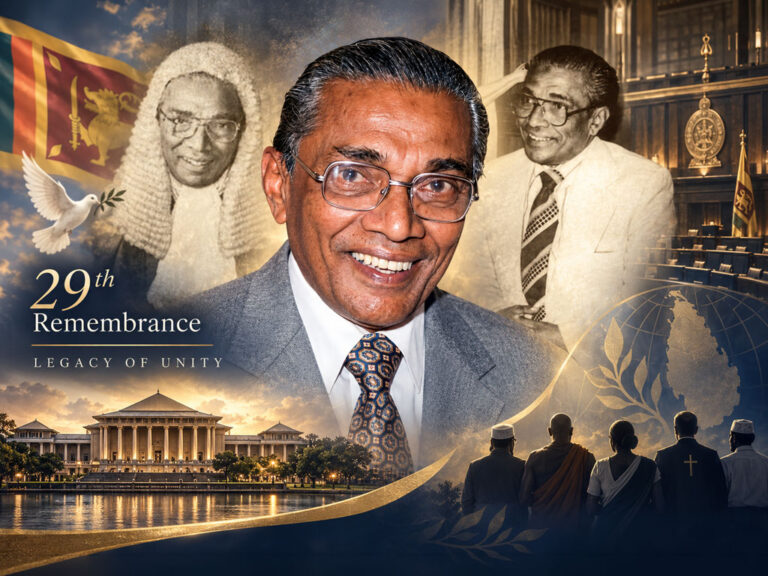
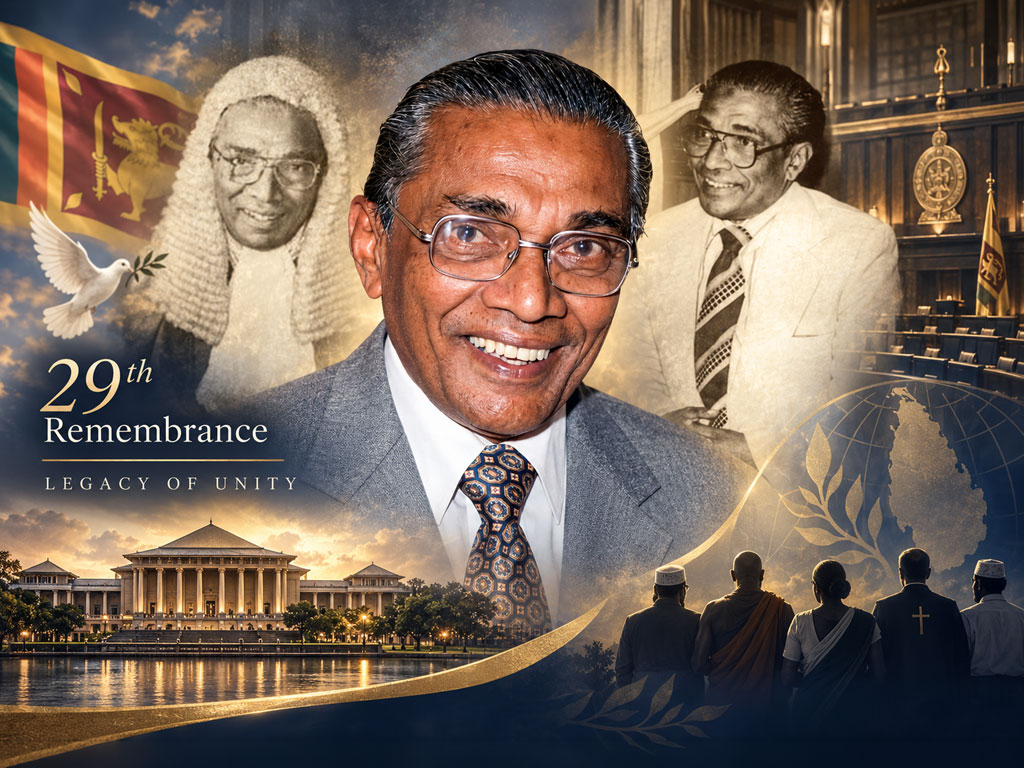
The Bakir Markar legacy is being remembered on the 29th anniversary of his passing, with renewed attention on his vision of national unity, coexistence and principled public service.
Deshamanya Alhaj M. A. Bakir Markar, a former Speaker of the Sri Lankan Parliament and the first Governor of the Southern Province, is again at the centre of discussion over leadership that placed values above office or political power.
His approach to politics, especially his emphasis on social harmony, continues to offer lessons for Sri Lanka as the country faces modern social and economic challenges.

Bakir Markar Legacy of Unity Through Diversity
Born in Beruwala in 1917, Bakir Markar received his primary education at Zahira College, Colombo.
From an early stage in public life, he believed national unity did not require cultural identities to be suppressed.
Instead, he argued that differences in language, religion and ethnicity should be recognised as strengths within the nation.
In Parliament, he consistently maintained that Sinhalese, Muslims, Tamils and the plantation community were all inseparable stakeholders in Sri Lankan identity.
His commitment to social justice was also visible during his legal career.
As a lawyer, he appeared free of charge for impoverished women seeking court remedies in maintenance cases. That practice became a distinctive example even within the Kalutara Lawyers’ Association.
An Independent Parliamentary Tradition
Bakir Markar won the multi-ethnic Beruwala electorate at the 1977 general election with a record majority, marking an important milestone in his political career.
He later served as Speaker during the final sittings held at the old Parliament building at Galle Face.
He also became the first Speaker to preside at the new Parliament in Sri Jayewardenepura Kotte.
Throughout that period, he worked to uphold the dignity and independence of the legislature.
His name remains associated with the democratic principle that the Speaker should not belong to either the government or opposition.
Instead, the Speaker must serve Parliament as a whole.
That approach became a defining part of the Bakir Markar legacy and his contribution to Sri Lanka’s parliamentary tradition.
Diplomacy, Youth and National Development
Beyond domestic politics, Bakir Markar also played a role in strengthening Sri Lanka’s international relationships.
His humanitarian intervention after a plane carrying Indonesian pilgrims crashed in Sri Lanka helped open a new chapter in bilateral relations.
He also took the initiative to establish the Iraq-Sri Lanka Friendship Association, promoting humanitarian cooperation at an international level.
At home, he pioneered the creation of the Beruwala tourist zone, contributing to economic activity and employment in the region.
As founding President of the All Ceylon Muslim League Youth Front, he built a platform aimed at steering young people away from extremism and destructive social tendencies.
The initiative also sought to encourage younger generations to contribute positively to national development.
Mohamed Fawzer Farooq, Sri Lanka’s Ambassador to Palestine, says Bakir Markar’s vision remains relevant to both national and international policy.
He points to its foundations in human dignity, social justice and respect for diversity.
Twenty-nine years after his passing, the central message of the Bakir Markar legacy remains clear.
His example was that Sri Lanka’s progress depends not on division or discord, but on coexistence built through mutual respect.
That principle continues to offer an enduring lesson for the country’s future.