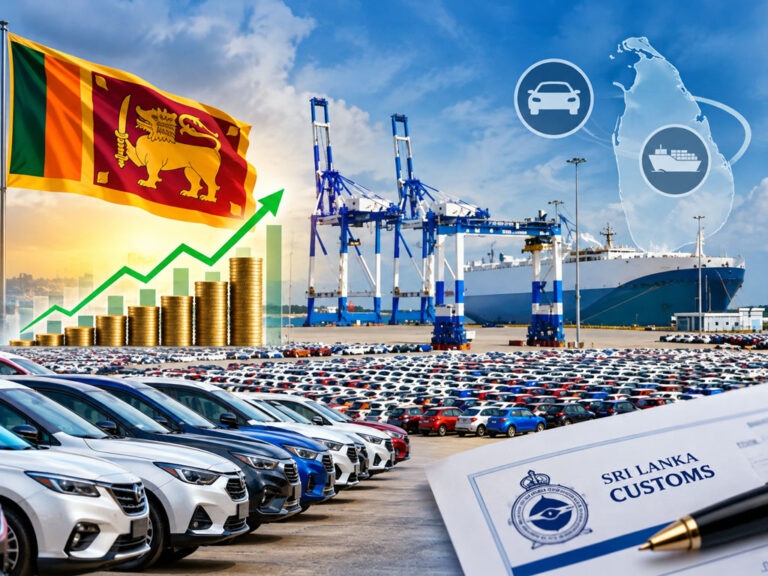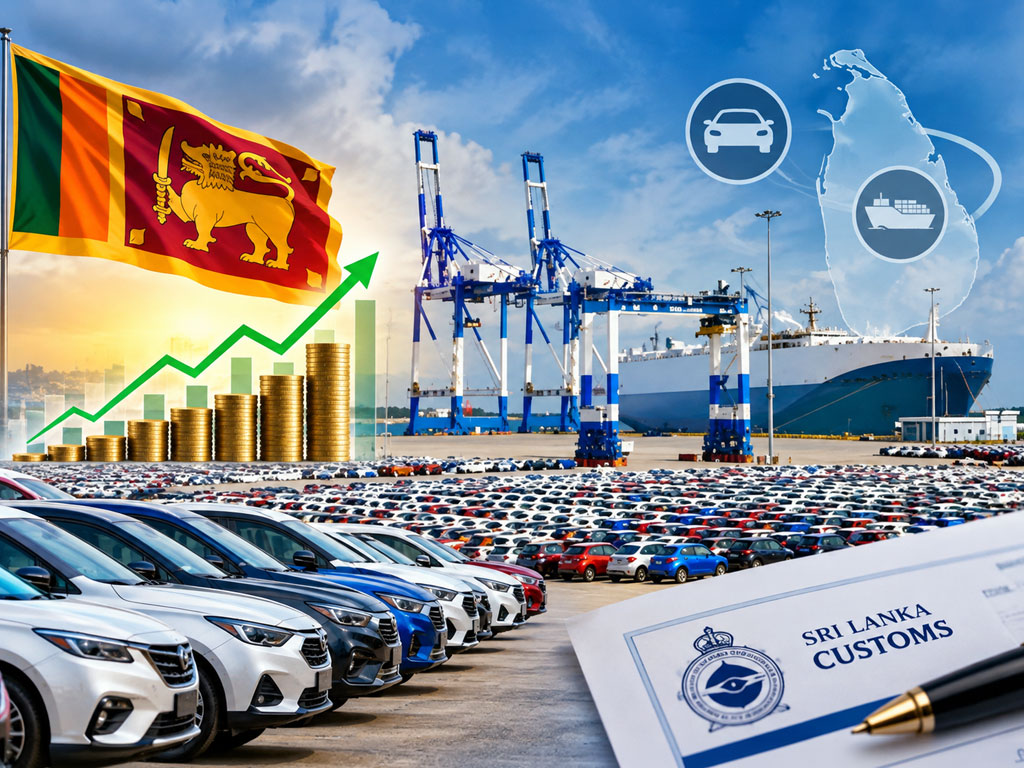
Sri Lanka vehicle imports reached 316,000 by June 2026, generating Rs. 512.5 billion and driving Customs revenue well beyond its target.
Sri Lanka vehicle imports have emerged as the biggest driver of Customs revenue in 2026, with 316,000 vehicles entering the country during the first six months alone.
There is an old story about the ascetic Hasitha, who first laughed and then wept upon seeing Prince Siddhartha. The latest figures from Sri Lanka Customs carry a similarly mixed message.
On one hand, Customs revenue has significantly exceeded expectations. On the other, much of that success depends on a surge in imported vehicles and the taxes collected from them.
When the Parliamentary Committee on Ways and Means recently examined Sri Lanka Customs revenue operations, officials presented striking figures.
Customs had expected to collect Rs. 1,060,559 million, or approximately Rs. 1,060 billion, by June 30, 2026.
Instead, revenue had reached Rs. 1,379,084 million, or about Rs. 1,379 billion, by that date.
That represents performance at around 130% of the expected target.
Moreover, every month during the first half of 2026 exceeded its revenue expectation. Each month also recorded higher growth compared with the corresponding month of 2025.

Sri Lanka Vehicle Imports Become Key Revenue Source
The main reason behind that revenue surge is straightforward.
By June 30, 2026, Sri Lanka had imported 316,000 vehicles. Taxes collected from those imports totalled Rs. 512,547 million, or approximately Rs. 512.5 billion.
Vehicle imports therefore accounted for nearly 37% of all Customs revenue collected during the first six months of the year.
Officials told the Parliamentary Committee that motor cars generated the largest share of vehicle-related tax income.
Revenue from motor car imports alone reached Rs. 386,726 million, or approximately Rs. 386.7 billion.
That represents nearly 75% of the total vehicle tax revenue collected during the period.
One particular category produced an especially notable contribution.
Petrol motor cars with engine capacities below 1000cc became the single commodity category generating the highest Customs revenue.
Those vehicles alone produced Rs. 137.4 billion.
That figure represents 9.96% of total Customs revenue. Put another way, approximately one in every ten rupees collected by Customs came from small petrol-powered cars.
Why Vehicles Matter So Much to Customs
To understand the importance of Sri Lanka vehicle imports to government revenue, the country must look back to the 2022 economic crisis.
Sri Lanka faced an acute foreign exchange shortage at the time. As a result, the government restricted imports of many goods, including vehicles.
Authorities gradually relaxed those restrictions only last year.
The government once again permitted vehicle imports for personal use from February 1, 2025.
The first batch of new vehicles then arrived on February 28, 2025, ending a five-year period without such imports.
The government introduced several additional taxes to prevent demand from rising too sharply.
However, years of pent-up demand quickly pushed vehicle imports higher.
Approximately US$2 billion in foreign exchange went towards vehicle imports during 2025 alone. That was considerably higher than the government’s initial estimate of US$1.2 billion.
Meanwhile, the country’s trade deficit widened to US$6.9 billion between January and November 2025.
The Sri Lankan rupee also depreciated by 5.6% against the US dollar during that year.
Will Vehicle Imports Fall During 2026?
Central Bank Governor Dr. Nandalal Weerasinghe addressed the outlook for vehicle imports at the monetary policy media briefing on January 28.
He said authorities had not yet prepared a specific estimate for 2026 vehicle imports.
However, imports could amount to around US$1.5 billion, representing a reduction of approximately 25% compared with 2025.
Dr. Weerasinghe argued that much of the strong 2025 demand resulted from pent-up demand following the five-year import ban.
Vehicle imports were particularly high between July and October 2025.
He also noted that LC openings, import volumes and vehicle prices subsequently declined.
Yet figures presented to the Parliamentary Committee show that vehicle imports remained the largest contributor to Customs revenue during the first six months of 2026.
Therefore, even if import volumes begin declining, the government’s revenue performance remains heavily linked to the vehicle market.
A fall in imports may help foreign exchange management. However, it could also expose how dependent Customs revenue has become on vehicle taxation.
Public Transport Remains the Bigger Question
The figures also raise a broader question about Sri Lanka’s transport policy.
Many Sri Lankans seek to buy at least a motorcycle, if not a four-wheel vehicle, because public transport remains weak and inadequate.
The popularity of petrol cars below 1000cc among the middle class reflects that pressure.
While vehicle imports generate substantial government tax income, the original analysis argues that they contribute relatively little to sustainable economic activity.
Meanwhile, Sri Lanka’s road network faces growing pressure.
Since 2020, the country’s main road system has seen no significant development, while the number of vehicles using those roads has continued to increase.
Consequently, severe daily congestion affects many urban roads.
At the same time, major improvements to public transport services such as trains and buses remain limited.
Train delays have again intensified. Repairs to railway lines following the ‘Dithwa’ disaster have also not been completed within the expected timeframe.
Services such as Metro Buses have been introduced, but they remain supplementary measures against a much larger transport problem.
Discussions around projects such as electric trains have also returned. However, Sri Lanka’s experience of turning such proposals into actual projects has not been encouraging.
The strong growth in Customs revenue during the first half of 2026 is therefore undeniable.
Yet that performance rests heavily on a vehicle market that reopened after five years.
The bigger question is how long Sri Lanka can sustain a state revenue model driven so strongly by vehicle imports.
Equally important is whether investment in reliable public transport could eventually offer a better outcome for government finances, foreign exchange management and millions of ordinary commuters.