Child consent must take priority over “good touch, bad touch,” says Dr. Thushara Wickramanayake, urging stronger child protection in Sri Lanka.
Child consent is far more important than the traditional concept of “Good Touch, Bad Touch” when protecting children, according to prominent child rights activist Dr. Thushara Wickramanayake.
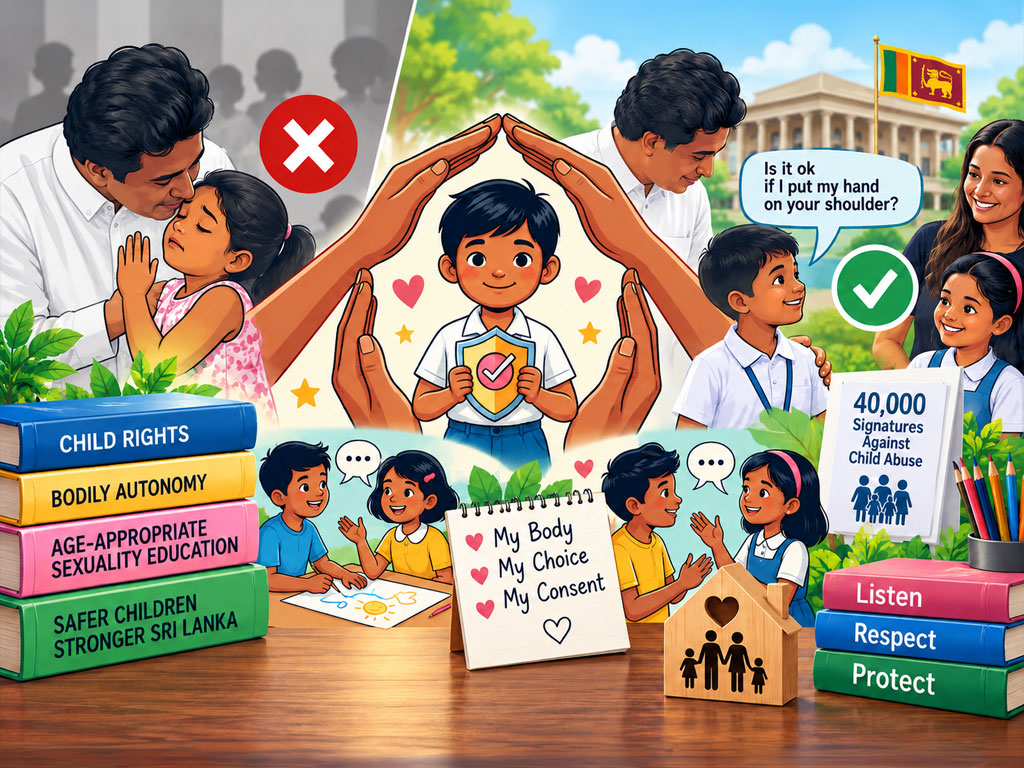
Dr. Wickramanayake, founder of the Stop Child Cruelty Trust, recently drew public attention to the issue through a social media post. Her post featured two contrasting photographs accompanied by an explanation about respecting children and their bodily autonomy.
One photograph showed what she described as inappropriate behaviour by a prominent politician towards a small child. Dr. Wickramanayake strongly criticised the action and expressed her opposition to such conduct.
The second photograph came from an event where a petition carrying 40,000 signatures against child abuse was handed over to Parliament. Parents and two children associated with the Stop Child Cruelty Trust attended the crowded gathering.
Dr. Wickramanayake also addressed questions that had emerged about that photograph and explained the circumstances surrounding it.

Child consent must come before physical affection
Modern child psychology increasingly questions whether teaching children only about “good touch” and “bad touch” provides enough protection.
Children may struggle to distinguish between acceptable and inappropriate contact, particularly when the person involved is someone they know, regularly meet and deeply trust.
Therefore, Dr. Wickramanayake argues that children should learn from an early age that their bodies belong to them. This principle is commonly described as bodily autonomy.
When an adult tries to kiss or hug a child to express affection or friendliness, adults should respect the child if they show reluctance or discomfort.
In her social media post, Dr. Wickramanayake wrote:

“GOOD TOUCH BAD TOUCH vs CONSENT!
More important than touch is the child’s consent!”
She said the photograph involving the politician demonstrated why parents must remain alert about protecting their children.
“Thank you to those who tagged me in the politician’s photograph on the left. This act is inappropriate,” she wrote.
Dr. Wickramanayake then explained the circumstances surrounding the second photograph, which featured Opposition Leader Sajith Premadasa.
She said the photograph was taken when the 40,000-signature petition was handed over to Parliament. The two children pictured, together with their parents, were involved with the Stop Child Cruelty Trust.
According to her account, despite the intense heat that day, Premadasa asked the boy for permission before placing his hand on the child’s shoulder.
She quoted him as asking: “is it ok to put my hands on your shoulder?”
Dr. Wickramanayake said she herself was surprised to hear the question.
Bodily autonomy can empower children
She said the central message was not simply whether adults considered a particular touch good or bad. Instead, child consent should determine whether physical contact is acceptable.
“The message we need to convey here is that more than touching a child in a good or bad way, the child’s consent is important,” she wrote.
She added that a child’s right to consent empowers that child.
“Therefore, without the child’s consent, any touch can become a BAD TOUCH, can become a violation of child rights.”
Dr. Wickramanayake also strongly criticised weaknesses in Sri Lanka’s child protection system.
She questioned the effectiveness of merely tagging the National Child Protection Authority when the country had failed to properly implement a national child protection policy.
She also criticised the expenditure of millions in taxpayer funds on what she described as a “sham called Student Ambassadors” while basic principles of children’s rights remained inadequately understood.
Dr. Wickramanayake called for age-appropriate sexuality education to become compulsory.
“Let us push to make age-appropriate sexuality education compulsory – first let’s tell politicians to bring benches!” she wrote.
She noted that permission existed to reveal the identities of the two children in the second photograph. However, their faces were blurred when sharing the message with the wider public.
Stronger child protection policy urged
Through the post, Dr. Wickramanayake also questioned weaknesses surrounding Sri Lanka’s existing national child protection policy.
She argued that inadequate enforcement of proper child protection mechanisms and failures by relevant institutions continue to place children at serious risk.
Her wider message calls for age-appropriate sexual and reproductive health education to enter the school system as an important step towards strengthening child protection.
The issue, she suggested, extends beyond laws and institutions alone.
Effective protection also requires a broader change in social attitudes, where adults recognise children’s rights, respect bodily autonomy and understand that a child has the right to say “No, not allowed.”
Teaching children about good and bad touch can remain part of child protection education. However, Dr. Wickramanayake’s central argument is that adults must go further by recognising the child’s right to decide what happens to their own body.
In that approach, child consent becomes not only a lesson for children, but also a responsibility that adults must learn to respect.