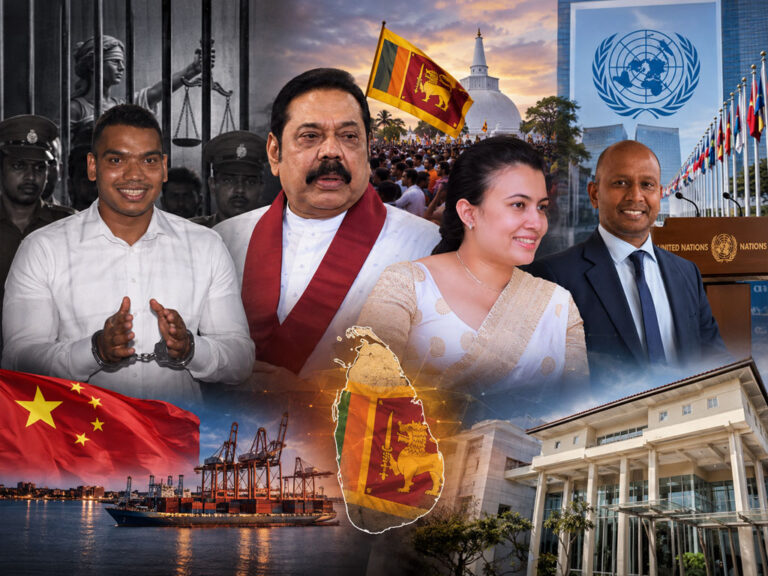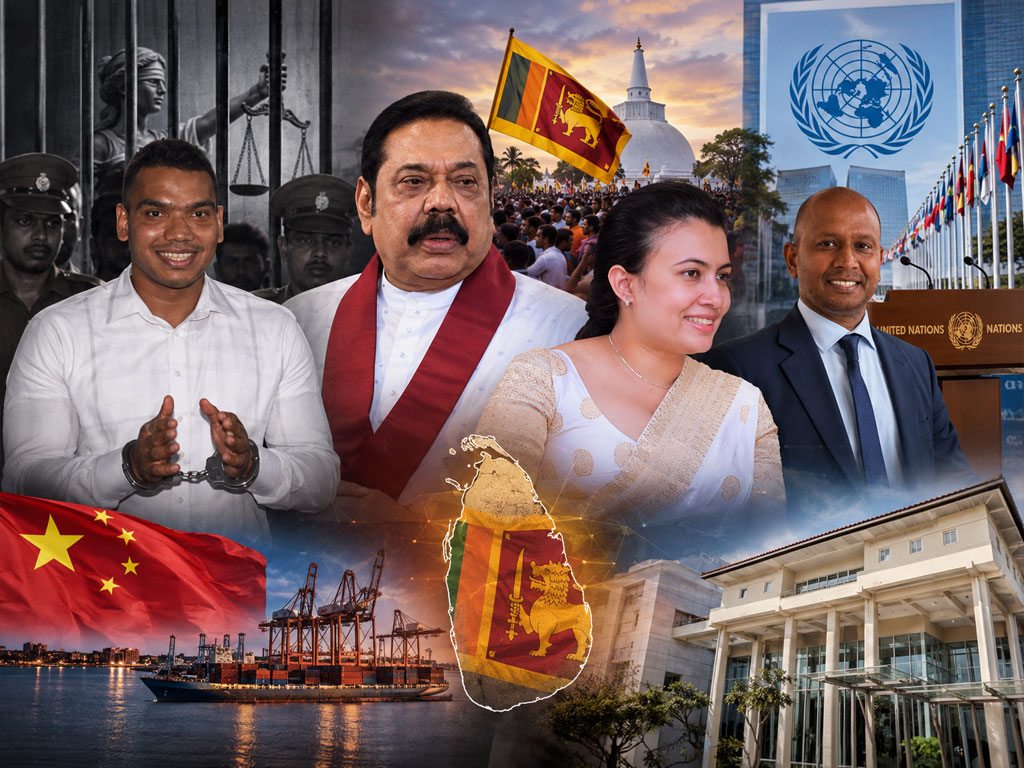
SLPP political strategy now spans Namal Rajapaksa’s arrest, Mahinda’s China outreach, Limini speculation and Milinda Rajapaksa’s Geneva campaign.
The SLPP political strategy is rapidly expanding across Sri Lanka and overseas as the Rajapaksa camp responds to Namal Rajapaksa’s imprisonment and growing legal pressure.
At a time when President Anura Kumara Dissanayake’s National People’s Power government is reshaping Sri Lanka’s political landscape, the former ruling Sri Lanka Podujana Peramuna appears to be pursuing a two-track operation.
The strategy combines a domestic effort to rebuild sympathy and political momentum with an international diplomatic campaign aimed at strengthening the party’s position.
The result is an increasingly complex confrontation involving Namal Rajapaksa’s arrest, Mahinda Rajapaksa’s return to prominence, speculation surrounding Limini Rajapaksa and overseas engagements by Milinda Rajapaksa.

Namal’s Arrest Becomes a Political Test
The centre of this unfolding drama is the arrest and imprisonment of Namal Rajapaksa.
In recent months, Namal had begun showing signs of a political resurgence. Several individuals who moved away from the SLPP during the economic and political crisis had also started gravitating back towards the party.
Against that background, the government would have been aware of the significance of the large Anuradhapura rally scheduled for September 12 and the crowds expected to attend.
Namal’s arrest just days before the event, as part of the new government’s anti-corruption drive, may therefore have consequences extending beyond the legal process.
The article argues that the timing could represent a political gamble by the government.
However, it remains uncertain whether the government will obtain the political outcome it may expect.
Rather than reducing attendance, Namal’s imprisonment could generate a sympathy wave and further intensify political interest in the rally.
The SLPP is likely to portray legal investigations as a “political hunt” and return to the familiar argument of taking its case before the “people’s court.”
For Pohottuwa, the arrest could therefore become an opportunity rather than a setback.
The party may use Namal’s imprisonment to energise its weakened rural vote base and bring former President Mahinda Rajapaksa back onto the public stage after a period of relative political silence.
In that sense, the SLPP political strategy could transform legal pressure into political mobilisation.
Limini Rajapaksa Enters the Political Conversation
Another major theme surrounding the December 12 Anuradhapura rally is the growing speculation over Limini Rajapaksa.
For some time, political discussion has suggested that Namal Rajapaksa’s wife could attend the rally in his place and potentially enter active politics.
The article argues that this media narrative is not accidental.
Instead, it describes the attention surrounding Limini as another extension of Namal Rajapaksa’s broader political promotion campaign.
Recent discussions have also revived predictions by astrologers that Sri Lanka’s next major leader could be a woman.
That speculation has produced political commentary involving Prime Minister Harini Amarasuriya, Limini Rajapaksa and even former President Chandrika Bandaranaike Kumaratunga.
The discussion has included suggestions about constitutional changes and predictions concerning the future political leadership of the country.
Reports surrounding Limini Rajapaksa have also focused on astrological claims about a supposed “Raja Yoga” in her horoscope.
The article presents this as part of what it describes as a carefully managed media exercise by the Rajapaksa camp.
Ironically, political figures connected to the government have also contributed to the discussion.
Whether deliberately or unintentionally, their comments have helped keep Limini and the wider Rajapaksa narrative in the public conversation.
The article argues that this reflects the Rajapaksas’ ability to turn pressure from opponents into publicity for their own political agenda.
It also suggests that government-aligned actors may be misreading the political impact of repeatedly amplifying those narratives.
Mahinda Renews the China Connection
While the SLPP seeks to generate sympathy at home, its international operation is also developing.
On September 9, former President Mahinda Rajapaksa met newly appointed Chinese Ambassador Wei Huaxiang in Colombo.
The presence of SLPP General Secretary Attorney Sagara Kariyawasam gave the meeting broader political significance.
According to the article, the encounter therefore appeared to go beyond a purely personal courtesy call.
Instead, it represented a possible renewal of institutional relations between the Communist Party of China and the Sri Lanka Podujana Peramuna.
Wei Huaxiang had presented his credentials to President Anura Kumara Dissanayake on August 25.
He also met the JVP General Secretary on September 1.
China’s approach therefore appears to involve maintaining relations with the current government while preserving its historical links with the Rajapaksa camp.
The Rajapaksas have been closely associated with major Chinese-backed projects, including Colombo Port City and Hambantota Port under the Belt and Road Initiative.
The article characterises China’s behaviour as a form of “dual balance.”
Beijing maintains diplomatic relations with the NPP administration while ensuring that its longstanding political connections with the Rajapaksas do not disappear.
For the SLPP, that relationship provides international visibility and allows the party to demonstrate that it retains geopolitical connections despite losing national power.
SLPP Political Strategy Moves to Geneva
The other side of the international campaign is unfolding in Geneva.
This represents an ironic shift for a political movement that previously portrayed Western governments and the UN Human Rights Council as hostile forces or “imperialist conspirators.”
The article argues that the SLPP is now attempting to use some of the same international structures to challenge the current government.
On September 8, Milinda Rajapaksa addressed the Geneva Human Rights session as a civil representative of the Global Sri Lankan Forum.
During his intervention, he presented a series of accusations against the Anura Kumara Dissanayake administration.
Milinda characterised the detention of Namal Rajapaksa and Suresh Salle as “political revenge.”
He also raised concerns over the 22nd Constitutional Amendment and the government’s new anti-corruption legislation.
According to his presentation, those measures could affect judicial independence.
He therefore called on the UNHRC to monitor legal developments in Sri Lanka.
The article portrays this as a significant reversal in the SLPP’s international political posture.
A movement that once rejected Western scrutiny is now using human rights and judicial independence arguments to seek outside attention over domestic developments.
Julie Chung Meeting Adds Another Layer
The most notable development highlighted in the article is Milinda Rajapaksa’s meeting in Geneva with former influential US Ambassador to Sri Lanka Julie Chung.
The article interprets that meeting as evidence of a systematic SLPP effort to build support among Western actors.
According to this interpretation, the party is attempting to frame domestic anti-corruption investigations through the language of human rights, political freedom and legal independence.
The strategy is presented as an effort to increase international pressure on the NPP government while the SLPP faces investigations at home.
The contrast is striking.
In Colombo, Mahinda Rajapaksa is renewing ties with China.
In Geneva, Milinda Rajapaksa is engaging with Western diplomatic and human rights circles.
At home, meanwhile, Namal Rajapaksa’s imprisonment is being used to generate sympathy, while speculation around Limini Rajapaksa keeps the family at the centre of political debate.
Together, these developments form what the article describes as a coordinated survival strategy operating across several fronts.
Government Pressure Could Strengthen Pohottuwa
The government’s attempt to weaken the SLPP through legal accountability could therefore produce unexpected political consequences.
Namal Rajapaksa’s arrest may not reduce participation at the Anuradhapura rally.
Instead, it may become the catalyst for a larger mobilisation.
The Rajapaksa camp can present Namal as a victim of political persecution, revive Mahinda Rajapaksa’s emotional appeal among loyal supporters and use the occasion to reconnect with voters who drifted away from the party.
The Limini Rajapaksa narrative adds another dimension.
Even speculation about her future political role creates publicity for the family and broadens the Rajapaksa brand beyond Namal and Mahinda.
Meanwhile, the party’s international activities demonstrate that it is not limiting its response to domestic politics.
China offers one channel.
Geneva and Western diplomatic circles provide another.
The SLPP political strategy therefore appears designed to operate simultaneously across Sri Lanka, the East and the West.
The article argues that the ultimate objective is political survival and a path back towards power.
Domestically, sympathy is being transformed into political capital.
In Colombo, the party reinforces its historic relationship with China.
In Geneva, it presents domestic legal pressure as a human rights and political freedom issue before an international audience.
The government must now contend with both dimensions.
It faces the domestic political storm that Namal Rajapaksa’s imprisonment could generate around the Anuradhapura rally.
At the same time, it must deal with international diplomatic pressure created by an opposition movement that is increasingly willing to use every available political platform.
The central question is whether the government’s anti-corruption drive will weaken the Rajapaksa movement or provide it with the political momentum it needs to rebuild.
For the SLPP, the battle is no longer confined to Parliament or the courts.
It is unfolding on rally stages, through media narratives, in diplomatic meetings in Colombo and before international audiences in Geneva.