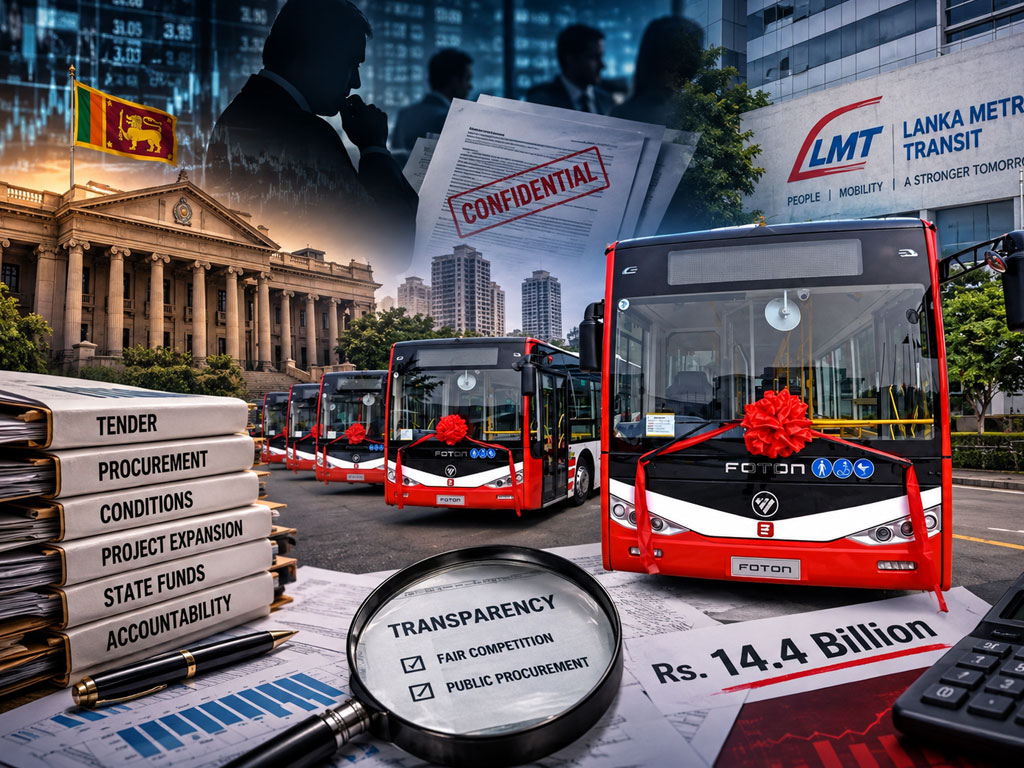
Lanka Metro Transit tender faces scrutiny over restrictive bid terms, project expansion and a Rs. 14.4 billion Foton bus procurement plan.
The Lanka Metro Transit tender has come under growing scrutiny amid serious questions over transparency, restrictive bidding conditions and the rapid expansion of a major Foton bus procurement.
The controversy centres on plans involving China’s FOTON buses for Lanka Metro Transit, or LMT, and whether the procurement process provided fair competition and sufficient public accountability.
Critics have raised concerns over financial qualification requirements, the short bidding period and the way the project allegedly expanded from a relatively small initial purchase into a multibillion-rupee programme.

Lanka Metro Transit Tender Faces Questions Over Bid Conditions
One of the most contentious aspects of the procurement is the financial threshold imposed on bidders.
According to the information presented, bidding companies were required to show an annual turnover of Rs. 6 billion.
They were also required to demonstrate working capital of Rs. 3 billion.
Industry figures cited in the article argue that such conditions could significantly reduce competition by excluding otherwise qualified suppliers.
Rather than encouraging broad participation, they say the thresholds may restrict the process to only a small number of financially powerful companies.
Another concern involves the time given to submit bids.
Tenderers were reportedly allowed only 21 days to respond to what is described as a large and technically complex procurement.
Critics argue that such a short period raises questions over whether potential bidders had sufficient time to conduct technical assessments, arrange financing and prepare competitive offers.
The combination of high financial thresholds and a limited bidding period has therefore intensified questions surrounding the transparency of the procurement.
COPF Scrutiny and Alleged Document Leak
The matter has now attracted the attention of Parliament’s Committee on Public Finance, known as COPF.
The article also refers to allegations that confidential tender documents may have reached stock market-related sources.
Those claims have prompted calls for an independent investigation.
If established, such a leak would raise wider questions about confidentiality, market-sensitive information and equal access within a major state procurement process.
However, the allegation requires proper investigation before any conclusion can be reached.
Project Expanded From Rs. 430.7 Million to Rs. 14.4 Billion
A central concern surrounding the Lanka Metro Transit tender is the way the project reportedly expanded in stages.
The first phase involved the purchase of 10 low-floor Foton buses at a cost of Rs. 430.7 million.
The second phase reportedly expanded the programme to 104 Foton C12 metro buses, each capable of carrying about 80 passengers.
According to the article, this expansion occurred without a fresh tender.
The third phase then involved Cabinet approval for a much larger allocation of Rs. 14.4 billion.
That funding was intended for 600 long-distance air-conditioned luxury buses with seating capacities ranging from 49 to 54 passengers.
Critics argue that this represents more than a simple increase in fleet size.
They say the project effectively shifted from an urban, short-distance transport concept into a long-distance express transport programme.
Such a major change in scope, they argue, should normally require a fresh assessment of passenger demand, revised technical specifications and a new competitive tender.
The article also points to a request for an additional Rs. 1 billion in capital for regional depots and garages.
Critics say that request raises questions over whether infrastructure and operational requirements were adequately planned at the project’s outset.
Can Urgency Override Procurement Rules?
The Ministry of Transport may argue that Sri Lanka urgently needs modern buses to improve public transport.
Few would dispute the need for a more efficient and reliable passenger transport system.
However, the article argues that urgency cannot replace transparency or justify bypassing normal procurement safeguards.
Public confidence depends not only on whether buses are delivered, but also on whether the process is competitive, lawful and financially responsible.
The key issue is therefore whether the original procurement framework remains appropriate after the project expanded so dramatically.
If the scope, specifications and financial commitments have fundamentally changed, critics argue that those changes must be subjected to fresh scrutiny.
The debate over the Lanka Metro Transit tender is ultimately about more than Foton buses.
It concerns how billions of rupees in public funds are committed, whether qualified competitors receive a fair opportunity and whether major transport investments are designed through clear planning rather than incremental expansion.
Unless the legal and procedural questions surrounding the original tender are addressed transparently, the controversy risks further weakening public confidence in state procurement.