Shani Abeysekara rights case ends with the Supreme Court ruling that investigations against him and Ravi Seneviratne violated fundamental rights.
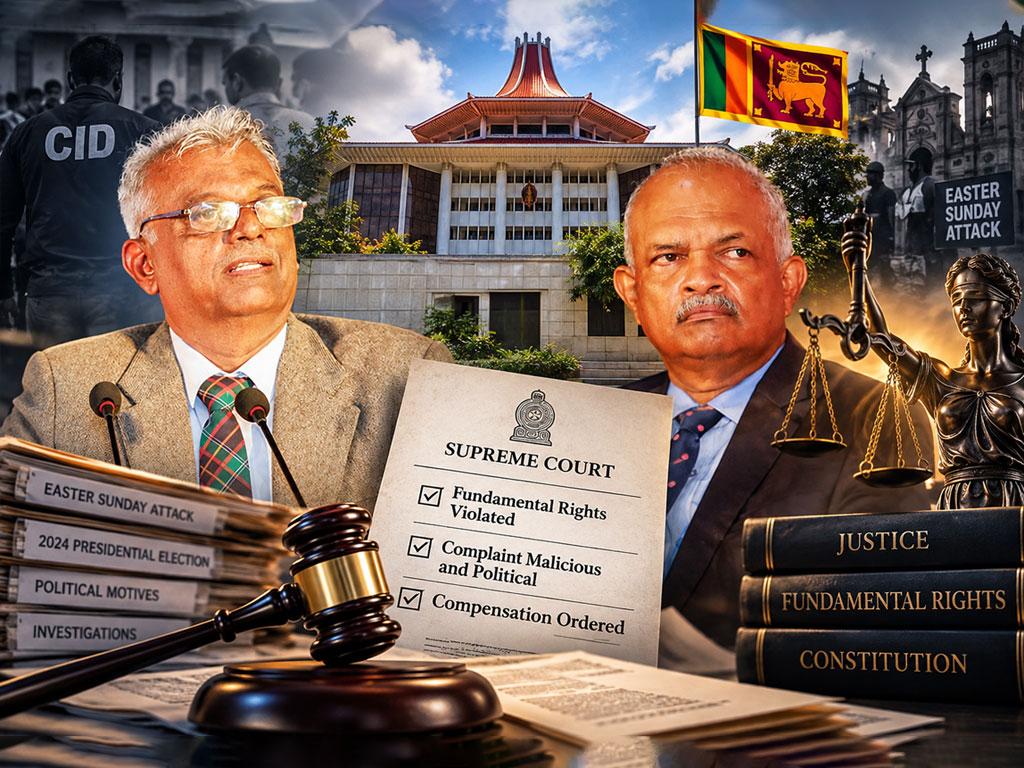
The Shani Abeysekara rights case ended with the Supreme Court ruling today (15) that investigations initiated against Shani Abeysekara and Ravi Seneviratne violated their fundamental rights.
The investigations arose from a complaint made during the 2024 presidential election period concerning the Easter Sunday terror attack.
Seneviratne currently serves as Secretary to the Ministry of Public Security, while Abeysekara is a Deputy Inspector General attached to the Criminal Investigation Department.
The three-member Supreme Court bench ruled that former Police Chief Deshabandu Tennakoon, then-Chief Inspector of the Criminal Investigation Department Induka de Silva, and retired Deputy Inspector General Palitha Siriwardena were responsible for the fundamental rights violations.
Supreme Court Justice Gihan Kulatunga delivered the judgment in open court. Chief Justice Priyantha Padman Surasena and Justice Achala Wengappuli agreed with the decision.

Compensation Ordered in Shani Abeysekara Rights Case
The court also ordered respondents to personally compensate petitioners Shani Abeysekara and Ravi Seneviratne for violating their fundamental rights.
Accordingly, retired Deputy Inspector General Palitha Siriwardena, who lodged the complaint, must pay each petitioner Rs. 50,000.
Then-Chief Inspector Induka de Silva, who led the investigation, must pay each petitioner Rs. 10,000.
The Supreme Court further ordered that authorities take no additional legal action against the petitioners based on Siriwardena’s complaint to the Criminal Investigation Department.
The court also directed that a copy of its judgment be forwarded to the Inspector General of Police.
Court Examines Political Background to Complaint
Justice Kulatunga, explaining the circumstances in the judgment, noted the political affiliations surrounding the parties during the previous election period.
The two petitioners had participated through a collective of retired police officers associated with one political stream. Meanwhile, retired Deputy Inspector General Siriwardena had operated within an opposing political stream.
Siriwardena referred his complaint to the Inspector General of Police on July 24, 2024. It alleged that authorities had failed to take action to prevent the Easter Sunday attack.
The bench found that the complaint had clearly been made with malicious and political intent.
The court also concluded that initiating investigations based on the complaint and reporting facts to the Colombo Fort Magistrate’s Court created an imminent threat to the petitioners’ fundamental rights.
Those rights are guaranteed under Articles 12(1) and 13(1) of the Constitution.
Attorney General’s Undertaking Comes Under Scrutiny
The Attorney General had previously informed the Supreme Court that investigations against the petitioners had been stayed.
The court was also told that proceedings connected to the “B” report before the Fort Magistrate’s Court had concluded.
However, the three-member bench observed that authorities had not properly implemented the undertaking given to the court.
The judgment noted that instructions had again been issued regarding the matter even after authorities declared the investigations concluded.
Therefore, the bench emphasized that the undertaking given by the Attorney General had not been properly fulfilled.
Easter Attack Intelligence Claims Challenged
The petitioners also rejected allegations concerning intelligence information connected to the Easter Sunday attack.
They told the court that Ravi Seneviratne was overseas on April 9, 2019, when the State Intelligence Service sent the relevant letter.
According to the petition, Seneviratne resumed duties on April 16 and promptly forwarded the information to the relevant sections.
However, a delay within the clerical section meant the information reached Shani Abeysekara only on April 20.
The petition also detailed Criminal Investigation Department inquiries in Wanathavilluwa and Mawanella aimed at arresting Saharan Hashim.
It further presented allegations concerning attempts by other intelligence agencies to mislead those investigations.
Against this background, the petitioners approached the Supreme Court claiming they faced a risk of arrest through political revenge and misuse of the Prevention of Terrorism Act.
After a lengthy hearing, the three-member Supreme Court bench delivered its judgment, finding that the investigations initiated against Shani Abeysekara and Ravi Seneviratne had violated their fundamental rights.