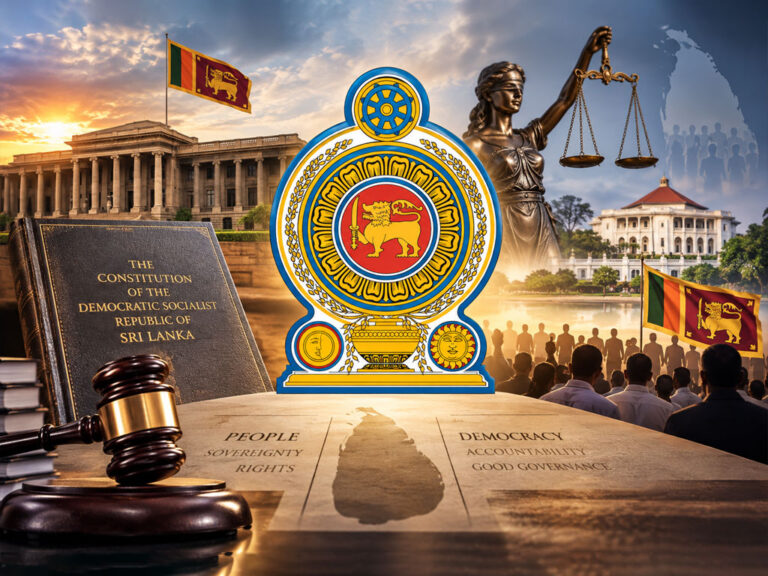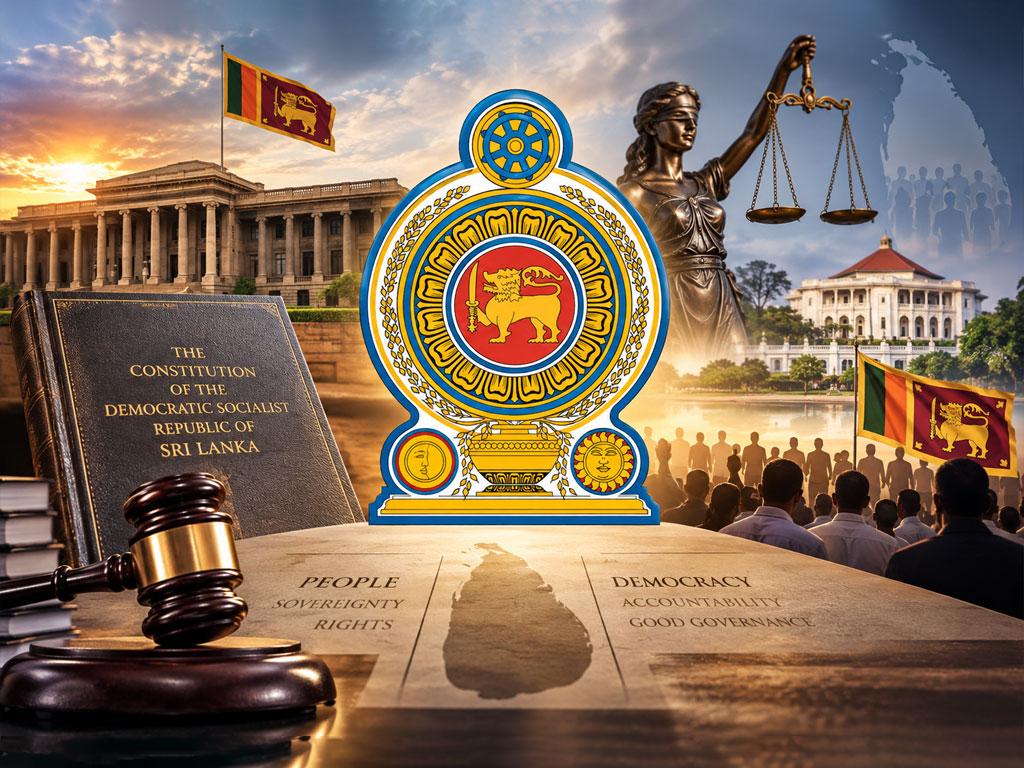
State power in Sri Lanka originates with the people. Here is how the Constitution divides sovereignty among Parliament, President and courts.
Understanding state power in Sri Lanka requires a distinction between the sovereignty that belongs to the people and the governmental institutions through which that sovereignty is exercised.
Articles 3 and 4 of the Constitution provide the foundation for this relationship. Article 3 declares that sovereignty is in the people and is inalienable. It includes the powers of government, fundamental rights and the franchise. Article 4 then explains how that sovereignty is exercised.

1. The Nature of State Power in Sri Lanka
State power ultimately derives from the people.
Article 3 states: “In the Republic of Sri Lanka sovereignty is in the People and is inalienable.” It further provides that sovereignty includes governmental powers, fundamental rights and the franchise.
Therefore, sovereignty does not belong personally to an individual politician, President, government or political party.
The people exercise aspects of that sovereignty through the constitutional structures established for representative government. They also directly exercise legislative power at a referendum in circumstances provided by the Constitution.
2. The Nature of Government Power
Governmental power forms part of the sovereignty of the people. Article 4 specifies how different components of that sovereignty are exercised.
- Legislative power is exercised by Parliament and by the people at a referendum.
- Executive power, including Sri Lanka’s defence, is exercised by the President elected by the people.
- Judicial power is exercised by Parliament through courts, tribunals and institutions established or recognised by the Constitution or law, subject to the constitutional exception concerning parliamentary privileges.
- Fundamental rights must be respected, secured and advanced by all organs of government.
- The franchise is exercised at presidential and parliamentary elections and referendums by qualified electors.
Governmental authority is therefore exercised through constitutionally established institutions. Those holding elected governmental office can change through elections, while sovereignty remains vested in the people.
3. State Power and Government Power: The Difference
The distinction can be summarised as follows:
| Feature | State Power / Sovereignty | Governmental Power |
|---|---|---|
| Ultimate source | The people | Derived from the sovereignty of the people |
| Constitutional basis | Article 3 | Article 4 |
| Character | Inalienable sovereignty | Exercised through constitutional institutions |
| Political office-holders | Sovereignty remains with the people | Office-holders can change through elections |
| Constitutional limits | Includes fundamental rights and franchise | Must operate within the Constitution |
This distinction is central to understanding Sri Lanka’s constitutional democracy.
4. The Principle of Separation of Powers
Sri Lanka’s constitutional structure distributes governmental functions among the legislature, executive and judiciary.
The legislature makes laws. The executive administers and implements governmental policy and law. The judiciary performs judicial functions and interprets and applies the law.
The Supreme Court has recognised the doctrine of separation of powers through Articles 3 and 4. Parliament itself has described the three governmental functions as constitutionally distinct, with judicial independence protected against interference.
At the same time, Sri Lanka’s Constitution assigns significant constitutional authority to the President, who exercises the executive power of the people, including defence.
5. The Principle of Checks and Balances
Checks and balances seek to prevent one institution from exercising governmental authority without constitutional restraint.
The President has constitutional powers concerning the summoning, prorogation and dissolution of Parliament. However, those powers operate subject to conditions contained in Article 70. The Constitution currently restricts when Parliament may be dissolved, unless Parliament itself requests dissolution.
Meanwhile, Parliament has a constitutional process for the removal of a President under Article 38.
The judiciary also plays a central constitutional role, including reviewing the constitutionality of Bills before enactment and exercising fundamental-rights jurisdiction.
These mechanisms illustrate that governmental institutions operate within a wider constitutional framework rather than possessing unlimited authority.
6. Fundamental Rights and State Power
Fundamental rights form part of the sovereignty of the people under Article 3.
Article 4(d) requires all organs of government to respect, secure and advance constitutionally recognised fundamental rights. Those rights cannot be restricted or denied except as permitted by the Constitution.
Article 126 gives the Supreme Court sole and exclusive jurisdiction over questions concerning the infringement or imminent infringement of fundamental rights by executive or administrative action.
Therefore, fundamental-rights jurisdiction provides an important constitutional safeguard against unlawful exercises of governmental authority.
7. The President’s Powers and Their Limits
The President exercises the executive power of the people, but presidential authority operates under the Constitution.
The constitutional balance surrounding the presidency has changed through successive amendments.
The 17th Amendment introduced the Constitutional Council framework. The 19th Amendment subsequently imposed significant changes to presidential powers and independent institutions. The 20th Amendment altered several of those arrangements, while the 21st Amendment again changed the constitutional framework.
The current Constitution must therefore be read with amendments incorporated up to the 21st Amendment. Parliament provides the consolidated constitutional text and the individual amendments through its official portal.
8. The Role of the Judiciary
The judiciary performs one of the three fundamental governmental functions recognised by Sri Lanka’s constitutional structure.
Courts interpret and apply the Constitution and other laws within the jurisdiction granted to them.
The Supreme Court also exercises several specific constitutional jurisdictions. These include fundamental-rights jurisdiction and the constitutional review of Bills under the procedures established by the Constitution.
Judicial independence is therefore an important component of the separation of powers. Parliament’s own constitutional material notes safeguards designed to allow judicial officers to exercise their functions without interference.
9. Provincial Councils and State Power
The 13th Amendment established Sri Lanka’s Provincial Council system and created a framework for the devolution of governmental powers.
Provincial Councils may make statutes concerning matters constitutionally assigned to the provincial sphere, subject to the division of powers established by the Constitution.
The Provincial Council system therefore represents an additional level through which governmental authority can operate outside the central institutions of government.
The long absence of Provincial Council elections has also generated continuing debate over democratic representation and the practical operation of the devolved system.
10. State Power and the Role of the People
Because sovereignty is vested in the people, citizens remain central to Sri Lanka’s constitutional order.
People exercise the franchise through presidential and parliamentary elections and at referendums, subject to the Constitution.
Article 4(a) expressly recognises that the legislative power of the people is exercised both through Parliament and directly by the people at a referendum.
Article 85 contains provisions governing when Bills may be submitted to the people by referendum.
Citizens can also participate in public affairs through constitutionally protected freedoms, including peaceful assembly and expression, subject to restrictions permitted under the Constitution.
The constitutional principle at the heart of state power in Sri Lanka is straightforward: sovereignty belongs to the people and is inalienable.
Government institutions do not replace that sovereignty. Instead, the Constitution establishes mechanisms through which the legislative, executive and judicial powers of the people are exercised.
Articles 3 and 4 are therefore crucial to understanding the relationship between citizens and the institutions that govern them. The legislature, executive and judiciary each perform constitutionally defined functions, while fundamental rights and the franchise themselves form part of popular sovereignty.
Governments and elected representatives can change. The constitutional proposition that sovereignty resides in the people remains.
Recognising that distinction is essential to democratic government. It reinforces the principle that public institutions exercise constitutional authority on behalf of the people rather than possessing sovereignty in their own right.