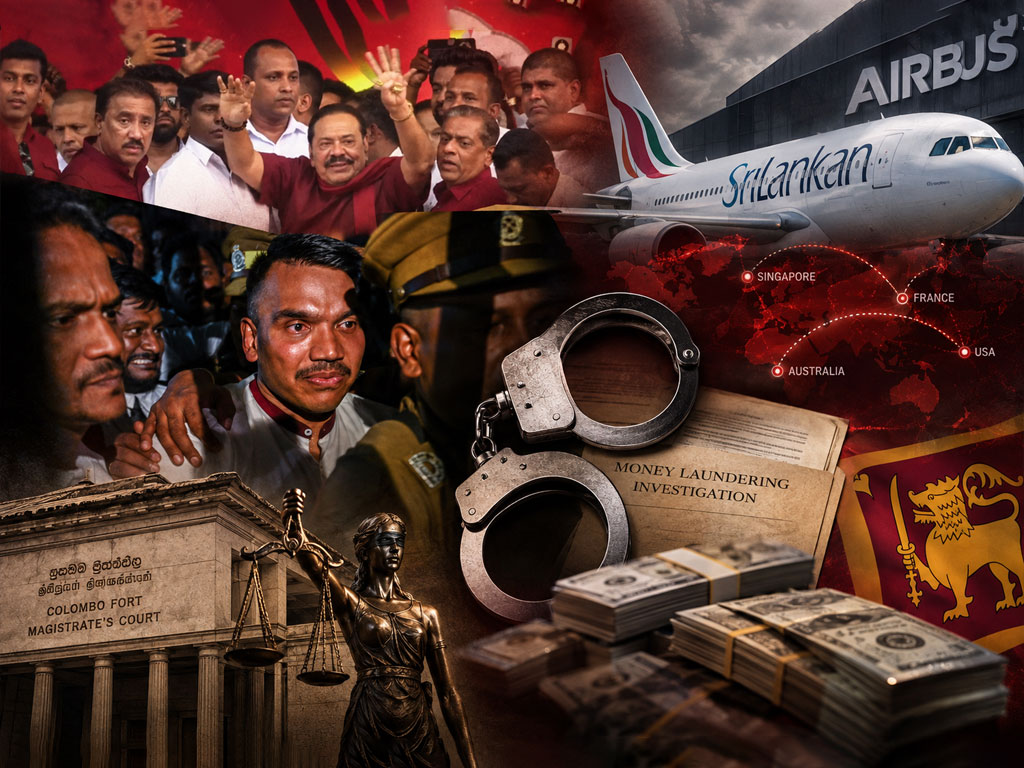
The Namal Rajapaksa Airbus case raises legal and political questions as prosecutors allege a Rs. 100 million payment linked to the aircraft deal.
The Namal Rajapaksa Airbus case is no longer merely about an alleged financial trail. It has also become part of a wider political question surrounding one of Sri Lanka’s most influential political families.
Is the latest legal battle capable of generating political sympathy and another Rajapaksa resurgence? Or could the evidence being presented in court further damage the political standing of the family?
Those questions have gained prominence after Colombo Fort Magistrate Pasan Amarasena ordered Parliamentarian Namal Rajapaksa to remain in remand custody until September 23. The order relates to a CID money laundering investigation arising from alleged financial irregularities connected to the SriLankan Airlines Airbus procurement. The Magistrate is also due to rule on Rajapaksa’s bail application on September 23.
Rajapaksa has not been convicted of the allegations. He remains entitled to the presumption of innocence, while his lawyers have strongly challenged the prosecution’s position.
Yet the political consequences of the investigation could extend beyond the courtroom.

The Alleged Money Trail Behind the Airbus Case
At the centre of the investigation is an alleged financial network associated with the controversial 2013 aircraft procurement.
Prosecutors told court that Airbus allegedly paid EUR 1.454 million to BIZ Solutions Inc., a Singapore company associated with Priyanka Niyomali Wijenayake, wife of former SriLankan Airlines Chief Executive Officer Kapila Chandrasena.
According to submissions reported from the September 16 proceedings, investigators allege that US$800,000 subsequently reached an account belonging to a company associated with businessman Nimal Perera. Perera has alleged in a sworn affidavit that the equivalent of approximately Rs. 100 million ultimately went to Namal Rajapaksa.
Prosecutors have also placed before court allegations concerning transactions involving Shameendra Rajapaksa, son of former Minister Chamal Rajapaksa. These claims remain allegations under investigation and have not been established as findings of guilt.
The Namal Rajapaksa Airbus case has therefore moved beyond the type of corruption allegation frequently debated on Sri Lanka’s political stage. Investigators say evidence has been gathered through international cooperation.
Deputy Solicitor General Janaka Bandara, appearing for investigators, explained the parallel nature of the proceedings before court:
“Your Honour, this investigation begins regarding the purchase of wide-body aircraft for SriLankan Airlines. In connection with this incident, the Bribery Commission is conducting investigations under the Bribery Act. Today, the Criminal Investigation Department is presenting facts before court regarding the suspect under the Money Laundering Act. In connection with the very same incident, the Bribery Commission is conducting one part of the investigation and the Criminal Investigation Department another part. But this is being done as a joint investigation. All extracts related to this incident have been submitted to the Attorney General.”
The CID money laundering proceedings are separate from the bribery-related investigation, although both arise from the Airbus transaction.
International Evidence Enters the Investigation
The Deputy Solicitor General also described international cooperation and the alleged structure of the financial transactions.
“In connection with the investigation, a broad investigation was conducted through virtual legal channels from Australia, France, Singapore, and the United States of America. This is going into the final stage. Airbus company in France entered into an agreement with the Airline company in Lanka to obtain 16 wide-body aircraft. At a time when 2 of them had been received by Lanka, the Airbus company had created additional companies and obtained a sum of EUR 1.454. That amount is US$ 2 million. The sole ownership of the company named Biz Solutions belonged to Priyanka Niyomali… From Priyanka Niyomali’s Singapore company Biz Solutions, a sum of EUR 160,400 was sent to the account of Shameendra Rajapaksa, son of then Minister Chamal Rajapaksa. The manner in which 13 million was given by cheques and 6 million in cash to a company of his has also been revealed during the investigations conducted in connection with the incident.”
The prosecution says Australia, Singapore, France and the United States assisted investigators. Prosecutors have also referred to emails allegedly exchanged between Airbus officials and Namal Rajapaksa.
Those claims will ultimately have to be tested through the judicial process.
Another serious issue raised before court concerned the safety of witnesses.
The Deputy Solicitor General referred specifically to businessman Nimal Perera:
“It has been informed by affidavit that a witness in this incident, one Nimal Perera, after giving a statement under Article 127, has gone to Australia due to the influence exerted. He has stated that he cannot even remain in Australia. Also, Your Honour, officials of the Airbus company have come to Sri Lanka and given statements on several occasions. Also, according to the relevant evidence documents in the forensic audits conducted, the manner in which Namal Rajapaksa, a suspect in this incident, acted has been revealed through emails that were inside the Airbus company…”
According to reporting of the proceedings, prosecutors told court that Perera had cited threats and that other witnesses feared coming forward. The defence contests the case against Rajapaksa.
Defence Says Namal Rajapaksa Should Receive Bail
The defence has pushed back strongly against the prosecution’s arguments.
Rajapaksa remains legally presumed innocent unless and until a court determines otherwise.
President’s Counsel Anil de Silva, appearing for Rajapaksa, argued that his client should receive bail and challenged suggestions that he might leave Sri Lanka.
“Your Honour, my client can be granted bail. He cannot go to Australia and hide. Because he does politics in Lanka. Therefore, he cannot be placed in the same position as the other suspects in this case. Also, he cannot be remanded according to the wishes of the government. There are principles of the articles of the Bail Act. Action must be taken accordingly. It was because there is a meeting that the Colombo Chief Magistrate’s Court remanded him. Also, the person named Nimal Perera deposited money into the account and left. We are not at fault for that. The existence of a case will be a big issue for us. Therefore, grant bail to my client.”
Reporting from the September 16 hearing similarly records the defence arguing that Rajapaksa is an active politician who remains in Sri Lanka and rejecting the prosecution’s arguments concerning possible witness interference.
After considering both sides, Magistrate Amarasena ordered Rajapaksa remanded until September 23, when the court is expected to deliver its decision on bail.
Could the Case Reshape Rajapaksa Politics?
The courtroom battle also unfolds against the Rajapaksa family’s long and consequential role in Sri Lankan politics.
That history gives the present proceedings a political dimension separate from the legal question of whether prosecutors can prove their allegations.
Supporters of Rajapaksa have portrayed the proceedings through a political lens, while his lawyers have challenged the prosecution’s case. Investigators, meanwhile, maintain that their case is based on witness statements, financial records, documentary material and international assistance. CIABOC has said its investigation relied on a statement from a Sri Lankan businessman, information from Airbus officials and other evidence collected during the probe.
The competing narratives create the central political question surrounding the Namal Rajapaksa Airbus case.
Could remand and prosecution generate sympathy among Rajapaksa supporters and strengthen a narrative that the family is being politically targeted?
Or could continued disclosure of alleged financial transactions and international evidence further weaken public confidence in the Rajapaksa political project?
Neither outcome can be assumed from the present proceedings.
The answer will depend partly on how the legal process develops and partly on how Sri Lankan voters interpret those developments. Those are separate questions. A court determines criminal liability based on evidence and law, while voters make their own political judgments.
September 23 Becomes the Next Legal Test
The significance of September 23 should therefore be kept in perspective.
The Fort Magistrate’s Court is expected to decide Rajapaksa’s bail application on that date. It will not amount to a final determination of the allegations against him.
The prosecution will still have to establish its allegations through the appropriate legal process. The defence will have the opportunity to challenge the evidence and advance Rajapaksa’s case.
Politically, meanwhile, the investigation leaves Sri Lanka with a question that cannot yet be answered.
Will the proceedings eventually become part of a narrative that helps mobilise Rajapaksa supporters? Or will the evidence emerging through the judicial process contribute to a different public assessment of the family’s political legacy?
For now, neither the “rise” nor the “fall” of the Rajapaksas can be established from a remand order.
What can be established is that the Airbus investigation has placed Namal Rajapaksa, alleged international financial transactions and the wider Rajapaksa political legacy under renewed public and judicial scrutiny. What follows will depend on the evidence presented in court and, in the political sphere, the judgment of Sri Lankan voters.