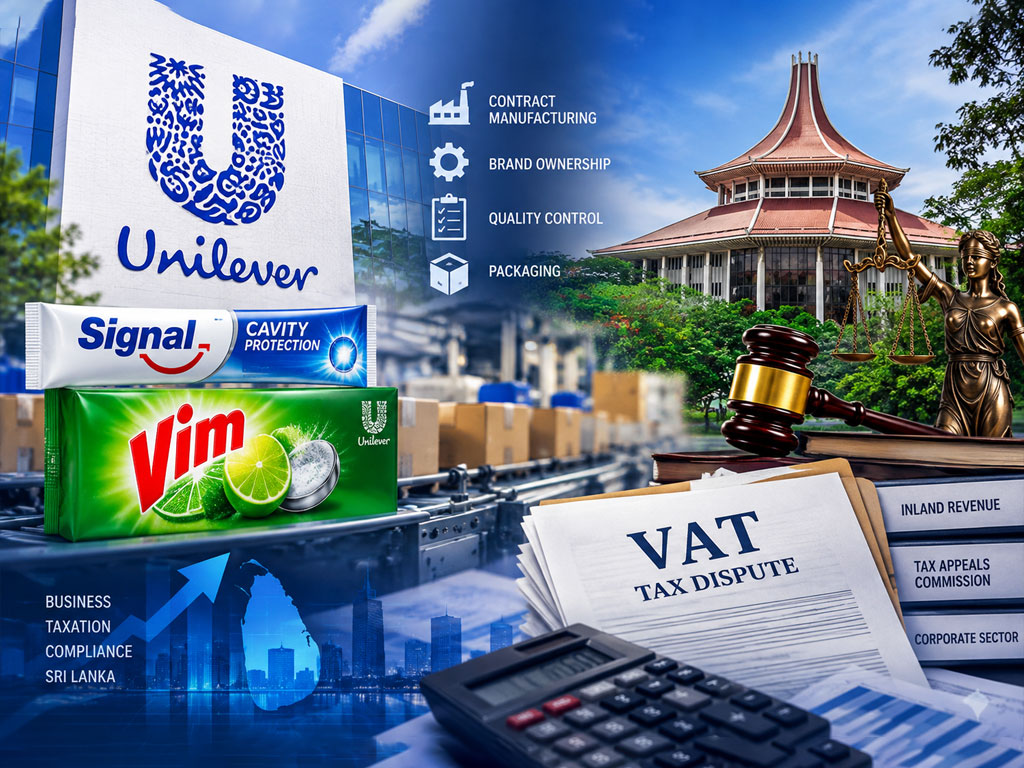
The Unilever VAT dispute clarifies when outsourced production can make a brand owner a manufacturer, with implications for Sri Lankan businesses.
The Unilever VAT dispute has delivered an important warning to Sri Lankan businesses: a company may qualify as a manufacturer even without physically operating the factory producing its goods.
On September 14, 2026, the Supreme Court dismissed an appeal by Unilever Sri Lanka Limited in its long-running Value Added Tax dispute. The three-member bench comprised Justices Mahinda Samayawardhena, Menaka Wijesundera and Sampath Abayakoon. The court upheld the earlier Court of Appeal judgment and dismissed the appeal with costs.
However, the significance extends beyond one company’s VAT liability. The judgment clarifies how Sri Lankan tax law can treat a business as a “manufacturer” when another company carries out the physical production.
For businesses using outsourced or contract manufacturing, that distinction could have significant tax consequences.

Signal and Vim at Centre of Unilever VAT Dispute
The legal battle concerned familiar Unilever products manufactured by third parties under contractual arrangements.
Polypak Secco Limited manufactured Signal toothbrushes, while R.M. Chemicals Ceylon (Private) Limited manufactured Vim scourer bars. The companies supplied those products to Unilever, which then marketed and sold them.
Unilever’s central argument was straightforward. The two contractors physically manufactured the products, while Unilever bought and subsequently sold the finished goods.
Therefore, Unilever maintained that the contractors were the manufacturers and that its activities amounted to buying and selling.
That distinction mattered because Section 3 of the VAT Act provides an exemption relating to certain wholesale and retail supplies. The legal question was whether Unilever could rely on that treatment or whether it was itself the manufacturer.
The courts ultimately rejected Unilever’s interpretation.
A Factory Is Not the Only Test
The Supreme Court’s reasoning focused on the commercial substance of the contractual relationship.
The court found that a business does not necessarily need to own a factory or machinery, employ the production workforce or physically manufacture the goods itself to qualify as a manufacturer under the VAT Act.
Instead, the contractual arrangements became critical.
The products were manufactured according to specifications and quality requirements prescribed by Unilever. The company also retained significant rights concerning production standards, packaging and the products’ commercial identity.
Consequently, the relationship went beyond an ordinary transaction in which a trader simply purchases finished products from an independent manufacturer.
The earlier Court of Appeal proceedings similarly examined whether the contractors transferred exclusive ownership of the products to Unilever. The court concluded that Unilever should be regarded as the manufacturer for the relevant VAT purposes.
The Supreme Court has now upheld that approach. Justice Samayawardhena concluded that Unilever was a manufacturer for purposes of Section 3(1)(a), read with Section 83 of the VAT Act.
This makes the ruling particularly relevant to businesses that separate brand ownership and commercial control from physical production.
Administrative Delay Did Not Defeat the Assessment
Another important element of the dispute concerned the Tax Appeals Commission.
Unilever challenged the determination on the basis that the Commission had exceeded the statutory period available for reaching its decision.
The Court of Appeal had previously rejected the argument that this delay automatically invalidated the determination. Its decision affirmed the Tax Appeals Commission’s finding that Unilever was the manufacturer and that the determination was not time-barred.
The issue highlights a broader distinction in statutory interpretation between time requirements that invalidate subsequent action when breached and provisions that direct an authority to act within a period without automatically nullifying what follows.
For businesses involved in tax appeals, the consequences of administrative delay therefore depend on the wording and legal interpretation of the relevant legislation.
Contract Manufacturing Faces a New Tax Question
The wider importance of the Unilever VAT dispute lies in outsourced manufacturing.
Contract manufacturing allows one company to control a brand and product while another company handles physical production. Such arrangements are common across consumer goods and many other industries.
The judgment means businesses cannot determine VAT status solely by asking who owns the factory or operates the machinery.
Instead, the contractual and commercial relationship matters.
A company that controls product specifications, quality requirements, packaging and commercial identity may potentially fall within the statutory definition of manufacturer even when another entity performs the physical production.
The decision therefore gives businesses using contract manufacturing a reason to review their agreements and VAT treatment carefully.
It does not mean every brand owner using a third-party factory automatically becomes a manufacturer for every tax purpose. The legal outcome will depend on the applicable legislation and the facts and contractual arrangements involved.
However, the Unilever judgment demonstrates that outsourcing physical production does not, by itself, prevent manufacturer status under the VAT Act.
Four other appeals between the same parties involving separate taxable periods are also expected to abide by the Supreme Court’s ruling.
What the Ruling Means for Sri Lankan Companies
The practical lesson is significant.
Companies that previously structured their operations around a distinction between brand ownership and physical manufacturing may need to examine whether their contracts create sufficient control for them to qualify as manufacturers under tax law.
Simply describing another company as the manufacturer in a commercial agreement may not necessarily determine the VAT outcome.
The court will look at the rights, responsibilities and commercial relationship created by the agreement.
For corporate tax planning, that means businesses should examine who determines specifications, who controls quality, who controls packaging and branding, and what rights the physical producer has over the finished goods.
The judgment consequently places greater emphasis on the economic and contractual substance of outsourced manufacturing arrangements.
VAT Changes Add Another Layer of Concern
The ruling also arrives during significant changes to Sri Lanka’s VAT framework.
The original article links the decision to the removal of the Simplified VAT system and argues that businesses treated as manufacturers could face greater working-capital pressure when operating through ordinary VAT payment and refund mechanisms.
That broader liquidity effect, however, is not itself a finding made by the Supreme Court in the Unilever judgment. It is a potential commercial consequence that would depend on each company’s tax position, supply arrangements and access to refunds.
The distinction is important.
The court decided the legal question concerning Unilever’s status as a manufacturer for the relevant transactions. Businesses must separately assess how that interpretation interacts with current VAT rules and their individual cash-flow arrangements.
For companies heavily dependent on contract manufacturing, that assessment could become increasingly important.
A Warning Beyond Unilever
Ultimately, the Unilever VAT dispute establishes a significant principle for Sri Lankan corporate tax practice.
Physical possession of machinery or ownership of a factory does not alone determine who qualifies as the manufacturer.
The Supreme Court looked instead at the rights and control created through the contractual relationship and upheld the finding that Unilever was the manufacturer for the relevant VAT purposes.
That is the difficult lesson for businesses built around outsourced production.
A company may move manufacturing outside its own factory walls, but that does not necessarily move the corresponding tax responsibilities with it.
For Sri Lanka’s corporate sector, the judgment is therefore more than the conclusion of one long-running tax appeal. It is a reminder that commercial agreements, operational control and tax obligations must be examined together rather than treated as separate realities.