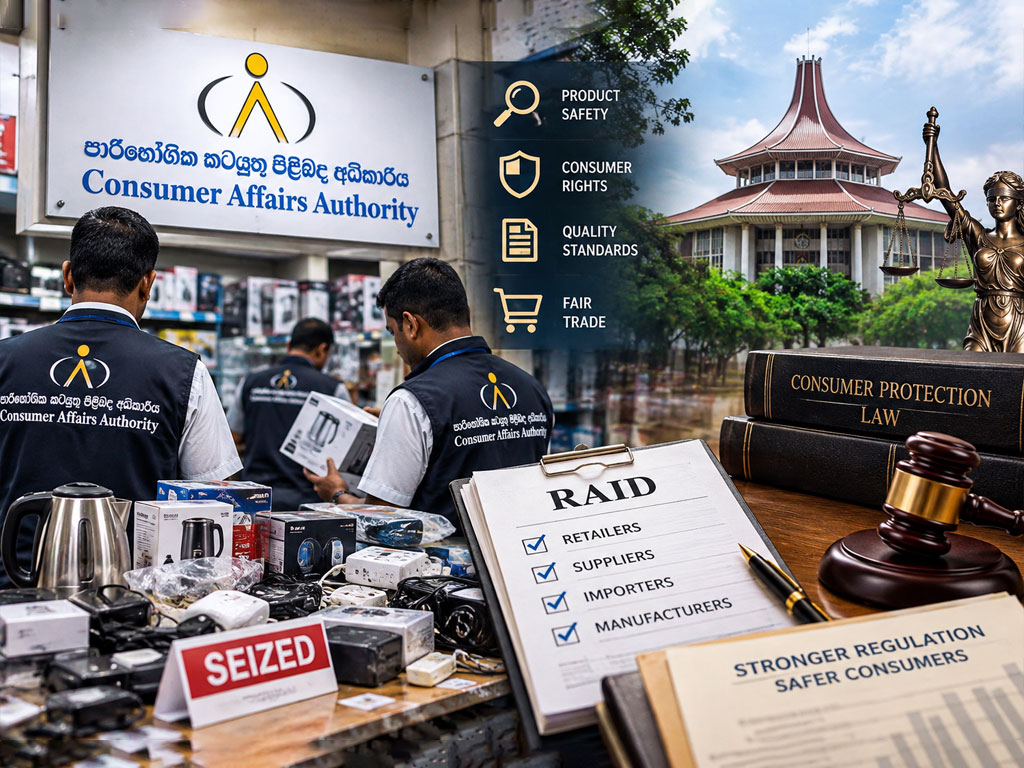
Consumer Affairs Authority raids have targeted electrical goods nationwide, but questions remain over penalties, transparency and lasting enforcement.
Recent Consumer Affairs Authority raids targeting electrical and electronic goods across Sri Lanka have drawn significant attention. However, critics are asking a more important question: what happens after the raids end?
The Consumer Affairs Authority (CAA) says it has conducted more than 1,000 island-wide raids involving electrical and electronic goods during 2026. A special programme alone resulted in 204 raids and more than 1,150 items being taken as case productions or into official custody for further legal action.
The enforcement drive has targeted issues including warranties, invoices, product labels, safety standards and the ability of traders to establish where their goods originated. The CAA has also said investigations can extend beyond retailers to suppliers, distributors, importers and manufacturers.
But the scale of the operation raises another question. Will these raids produce meaningful long-term consumer protection, or become another enforcement exercise that generates publicity without changing behaviour?

Are Consumer Affairs Authority Raids Enough?
One criticism concerns whether the penalties available under Sri Lanka’s consumer protection framework provide a sufficient deterrent.
No matter how extensive a raid appears, critics argue that enforcement achieves little if an offender can return to business after paying a relatively modest fine.
The Consumer Affairs Authority Act No. 9 of 2003 provides the legal framework for consumer protection, regulation of internal trade and enforcement action. Section 60 deals with offences and penalties, while other provisions give the Authority powers covering inspections, searches and forfeiture.
However, the broader concern remains whether the consequences are strong enough to discourage repeat violations.
If traders calculate that the financial benefit of non-compliance outweighs the potential punishment, raids alone may not create meaningful deterrence.
Therefore, critics argue that Sri Lanka needs a stronger long-term regulatory framework. Depending on the seriousness and recurrence of an offence, they suggest policymakers should consider tougher sanctions, including mechanisms affecting the ability of proven repeat offenders to continue operating.
Such measures would require an appropriate legal basis and safeguards rather than unilateral punishment.
Why Are Some Business Names Not Revealed?
A second question concerns transparency.
Why does the Consumer Affairs Authority not publicly identify every establishment subjected to enforcement action?
The CAA’s recent announcement provided extensive information about the number of raids, products examined and alleged violations. Yet the publicly reported information did not provide a comprehensive list identifying all traders involved.
There may be legitimate legal reasons for withholding names before charges or findings are established. A raid or investigation does not itself prove wrongdoing.
However, consistency is essential.
If authorities publicly identify some businesses but withhold the identities of others in comparable circumstances, consumers are entitled to ask what policy determines disclosure.
A clear publication policy could help address those concerns. It could establish when a business may legally be named, whether identification occurs after charges or conviction, and what information the public should receive about completed enforcement action.
Without consistent standards, selective disclosure can create perceptions of unequal treatment even where legitimate reasons exist.
Stronger Regulation Needs More Than Publicity
The central issue surrounding the Consumer Affairs Authority raids is therefore not whether enforcement should continue. It should. The question is how enforcement translates into measurable consumer protection.
The CAA’s current operation covers extension cords, multi-sockets, plug tops, switch sockets, power cords, LED bulbs, chargers, electrical adapters, torches, electric scales, kettles, irons and power tools. Authorities are also checking invoices, labels, warranties and mandatory standards.
These are practical consumer-protection concerns.
However, successful regulation should ultimately be measured by outcomes rather than the number of raids alone.
That means transparent information about prosecutions, penalties and repeat violations becomes important when legally permissible. It also means examining whether existing sanctions actually discourage non-compliance.
Sri Lanka’s consumer law already gives the CAA substantial regulatory and investigative responsibilities. The Authority’s statutory objectives include protecting consumers and regulating internal trade.
The challenge is ensuring those powers deliver lasting results.
If weaknesses exist in the present penalties, Parliament may need to consider whether stronger sanctions are justified. If transparency rules remain unclear, the Authority should establish consistent standards for releasing information while respecting due process.
Finally, accountability must apply to both traders and regulators.
Businesses accused of violating consumer law deserve due process, while consumers deserve effective enforcement and clear information about risks in the marketplace.
That is why the success of these Consumer Affairs Authority raids cannot ultimately be judged by photographs of seized goods or impressive enforcement statistics.
The real test is what happens next: whether investigations produce lawful action, whether penalties deter repeat offences, whether businesses face consistent treatment, and whether consumers become safer as a result.
Without those outcomes, critics will continue to question whether high-profile raids represent sustained regulation or merely temporary enforcement publicity.