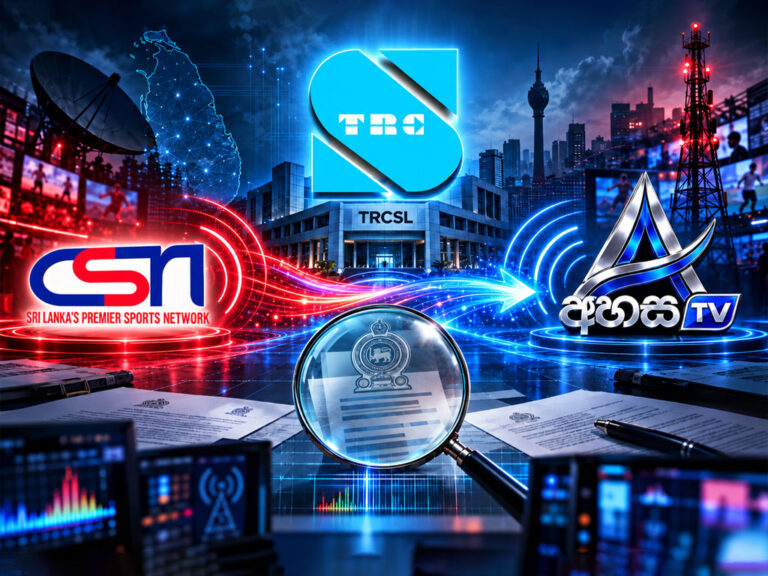
Ahasa TV CSN frequency claims face scrutiny after a TRCSL letter said no change to Carlton Sports Network’s registered name had been notified.
COLOMBO — Fresh questions have emerged over the proposed operation of Ahasa TV after an official letter from the Telecommunications Regulatory Commission of Sri Lanka stated that it had not been notified of any change to the registered name of Carlton Sports Network (Pvt) Ltd, or CSN.
The letter has been cited by anti-corruption activist Jamuni Kamanta Thushara as supporting calls for a wider investigation into whether a broadcasting frequency previously associated with CSN is being used, transferred or commercially operated under the Ahasa TV name.
The claims involve allegations of an arrangement reportedly worth Rs. 23.8 million a month and approximately Rs. 5.71 billion over 20 years.
Those allegations, including claims involving Business Media International, Nilanga Karunaratne and Yoshitha Rajapaksa, have not been established in court on the basis of the material supplied for this article.
The TRCSL letter itself, as reproduced in the source material, confirms only that the regulator had not been notified of a change in the name of Carlton Sports Network (Pvt) Ltd. It does not, by itself, establish that an unlawful sub-lease, money-laundering operation or secret agreement exists.

Citizen Group Seeks Investigation
On September 28, 2026, Jamuni Kamanta Thushara, Chairman of the organisation Citizen Power Against Bribery, Corruption and Waste, wrote to the Director General of TRCSL requesting an investigation into the alleged use of a broadcasting frequency associated with CSN.
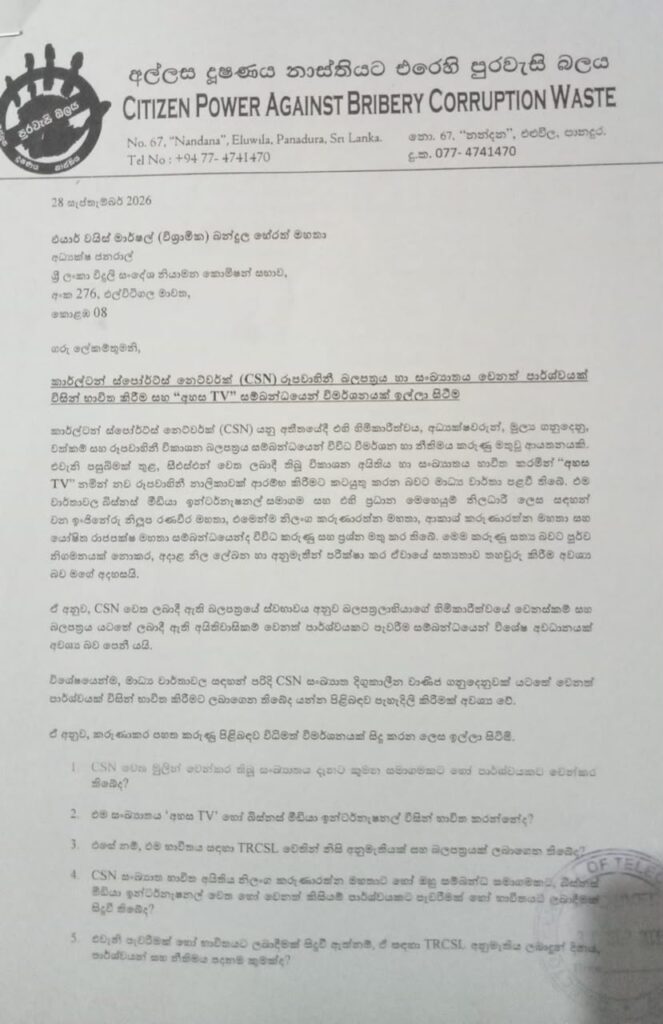
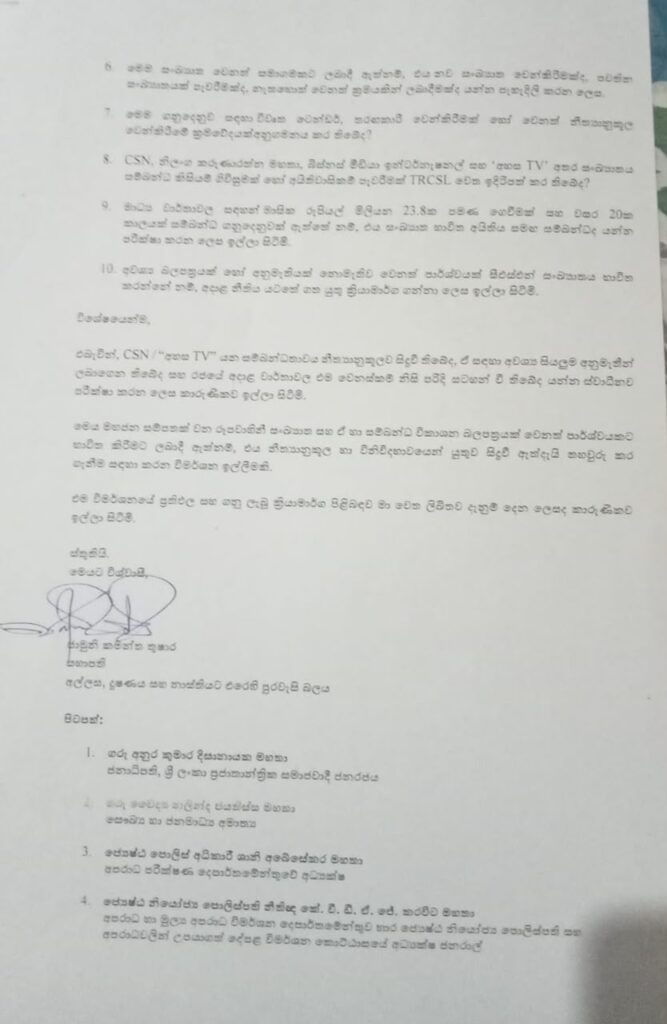
Copies of the letter were also reportedly sent to President Anura Kumara Dissanayake, Media Minister Dr. Nalinda Jayatissa, Criminal Investigation Department Director Senior Superintendent of Police Shani Abeysekara, and Senior Deputy Inspector General of Police in charge of criminal and financial crimes investigations, Attorney-at-Law K. V. D. A. J. Karavita.
Among the questions raised were:
- How is the public frequency previously granted to CSN being used by “Ahasa TV” or “Business Media International”?
- Has the appropriate TRCSL licensing process or an open tender procedure been followed?
- Has any agreement involving CSN, Nilanga Karunaratne and Yoshitha Rajapaksa been submitted to TRCSL?
- Does the reported Rs. 23.8 million monthly payment and alleged 20-year arrangement amount to an unauthorised sub-leasing of a public frequency?
The questions remain requests for investigation rather than established findings.
TRCSL Says No CSN Name Change Was Notified
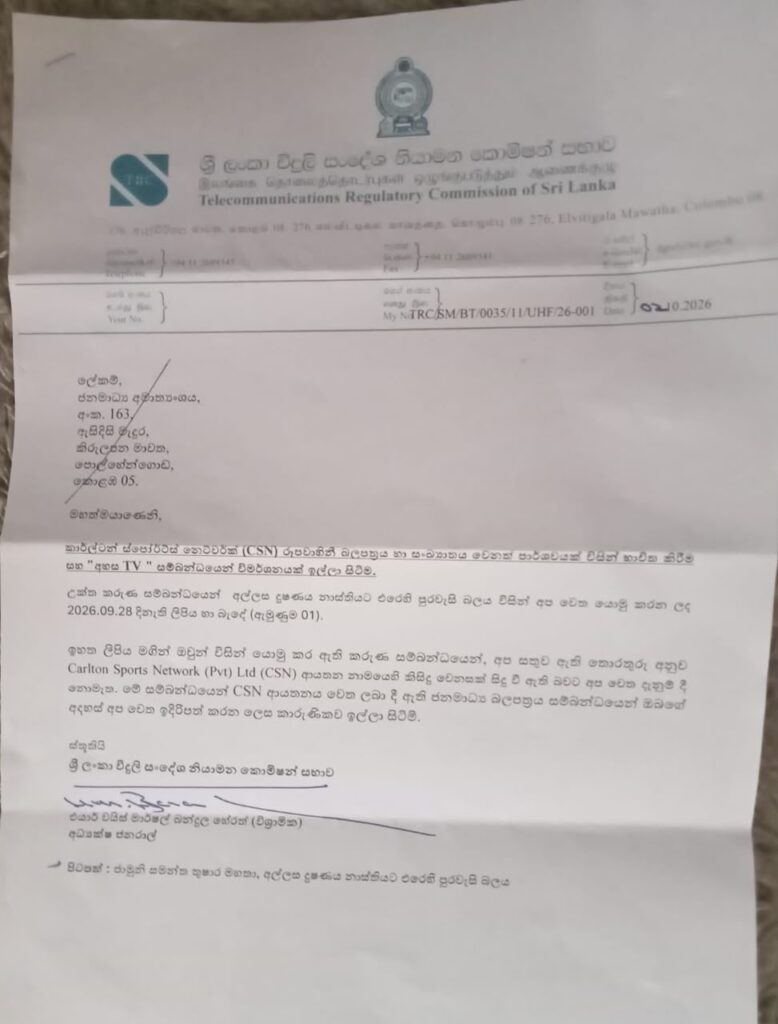
The most significant documentary development cited in the source is a letter dated October 2, 2026, from TRCSL Director General Air Vice Marshal (Retd) Bandula Herath to the Secretary to the Ministry of Media.
The letter bears reference number TRC/SM/BT/0035/11/UHF/26-001.
According to the reproduced text, Herath stated:
“…According to the information we have, it has not been notified to us that any change has occurred in the name of the institution Carlton Sports Network (Pvt) Ltd (CSN). Please kindly submit your views to us regarding the media licence granted to the CSN institution in this regard.”
That response is important because it indicates that, within the information available to TRCSL at the time of the letter, the regulator had not been formally notified that Carlton Sports Network had changed its institutional name.
It does not necessarily answer every question surrounding Ahasa TV.
In particular, the letter as supplied does not establish who owns Ahasa TV, whether it has a separate corporate registration, whether any commercial agreement exists between separate entities, or whether such an agreement would breach the conditions attached to a broadcasting licence.
Those matters would require examination of licensing records, contractual documents and regulatory approvals.
Claims of Sub-Leasing Require Further Evidence
The source article argues that Ahasa TV is effectively CSN operating under a different label and that a frequency allocated to CSN is being commercially sub-leased.
That is a serious allegation.
The TRCSL letter supports one narrower point: the regulator had not been notified of a change to the name Carlton Sports Network (Pvt) Ltd.
It does not, on its own, prove the existence of an illegal sub-lease.
Establishing such a breach would require evidence that the licence holder transferred, rented, assigned or otherwise allowed another party to exercise rights over the frequency contrary to the terms of the licence or applicable regulations.
If Business Media International or any other company is involved, investigators would also need to establish its contractual and operational relationship with CSN.
Until that is done, claims of illegality should remain allegations.
Reported Arrangement Valued at Rs. 5.71 Billion
The financial claims surrounding the alleged arrangement are substantial.
According to figures cited in the source:
- Monthly payment: Rs. 23.8 million
- Annual value over 12 months: Rs. 285.6 million
- Claimed value over 20 years: approximately Rs. 5.71 billion
The source also alleges that 50 per cent of the amount would be paid to Yoshitha Rajapaksa.
If that claim were accurate, the figures would amount to:
- Rs. 11.9 million per month
- Approximately Rs. 2.85 billion over 20 years
No agreement establishing such a payment structure is reproduced in the material supplied for this article.
Accordingly, the figures should be treated as allegations requiring documentary verification.
Questions Over Source of Funds
The source article also raises questions over how an arrangement of this scale would be financed.
It links those concerns to Nilanga Karunaratne and refers to the financial scale of the alleged media transaction in comparison with income from Sri Lanka’s vanilla export sector.
It further asks whether funds collected from members of the public or other sources could be involved.
No evidence establishing misuse of deposits, unlawful fundraising or money laundering is contained in the supplied article.
Those claims therefore require investigation by the appropriate authorities before any conclusion can be reached.
A financial inquiry would ordinarily need to trace the source of funds, identify beneficial ownership, examine banking records and determine whether payments correspond with legitimate contractual obligations.
Calls for FIU Scrutiny of Broadcasting Licences
The source says the Government is considering changes to the regulatory framework governing the issue and renewal of broadcasting licences.
Under the proposals described, financial scrutiny by the Financial Intelligence Unit of the Central Bank would become part of the licensing process in addition to existing security clearances.
Three areas are highlighted:
- Source of funds: Examination of whether money invested in establishing or operating a channel comes from lawful and identifiable sources.
- Ultimate beneficial ownership: Identification of individuals who ultimately control or benefit from companies holding broadcasting licences.
- Prohibition of sub-leasing: Preventing licence holders from renting, transferring or handing over frequencies to third parties without lawful authority.
According to the source, a frequency could be cancelled and returned to the State if an unauthorised sub-leasing arrangement were established.
These proposed reforms, if adopted, would represent a significant shift in how broadcast licences are assessed, particularly where ownership structures and financing are concerned.
Public Frequencies Carry a Public Interest Obligation
Broadcast frequencies are a limited national resource.
That makes transparency over their allocation, ownership and commercial use particularly important.
A company holding a licence should be able to demonstrate that it is complying with regulatory conditions, while regulators should be able to establish who ultimately controls and benefits from the licence.
Equally, allegations of wrongdoing must be tested against actual licence conditions, corporate records and contracts rather than political inference.
The TRCSL letter has therefore provided an important piece of the regulatory picture, but not a complete answer.
What Must Be Established Next
Several questions remain unresolved.
Authorities would need to establish whether Ahasa TV is a separately licensed broadcaster, whether it is operating through facilities or frequencies licensed to CSN, and whether any commercial arrangement exists between CSN and another entity.
If a lease or revenue-sharing agreement exists, regulators would also need to determine whether it is permitted under the applicable licensing conditions.
The reported Rs. 23.8 million monthly figure and the alleged 20-year arrangement would require documentary confirmation, as would claims concerning any payments to Yoshitha Rajapaksa.
Likewise, allegations involving money laundering or undisclosed beneficial ownership can only be determined through financial investigation.
The clearest fact emerging from the material presently available is the statement attributed to the TRCSL Director General that the regulator had not been notified of a change in the name Carlton Sports Network (Pvt) Ltd.
Whether that fact forms part of an unlawful frequency arrangement is a separate question that remains to be established.
SOURCE:- HARI DESHAYA