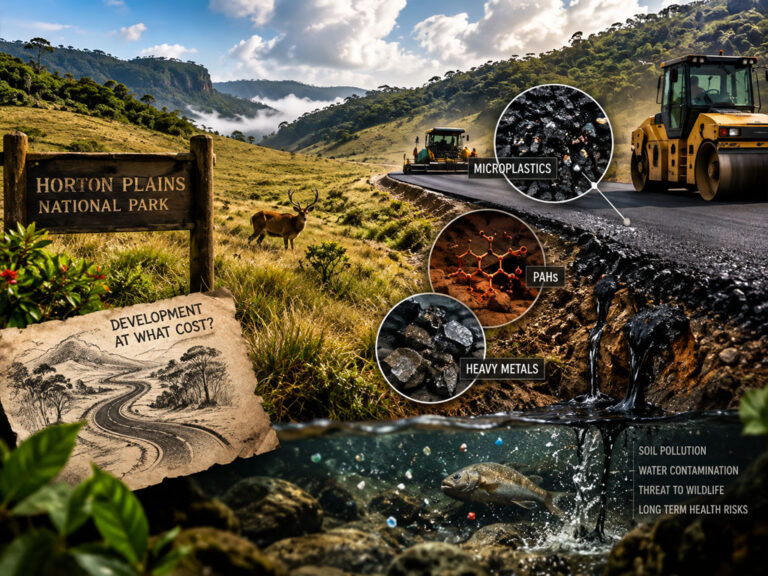
Horton Plains road plans raise deeper questions about asphalt pollution, microplastics, development ideology and the environmental case for depaving.
A new Horton Plains road project has reopened a much larger question about what Sri Lanka calls development, and what asphalt leaves behind in the environment.
A road towards Horton Plains is being prepared for development. Yet Horton Plains is a sensitive geographical environment where materials used for road construction must first be transported into the area.
The issue goes beyond simply laying a road.
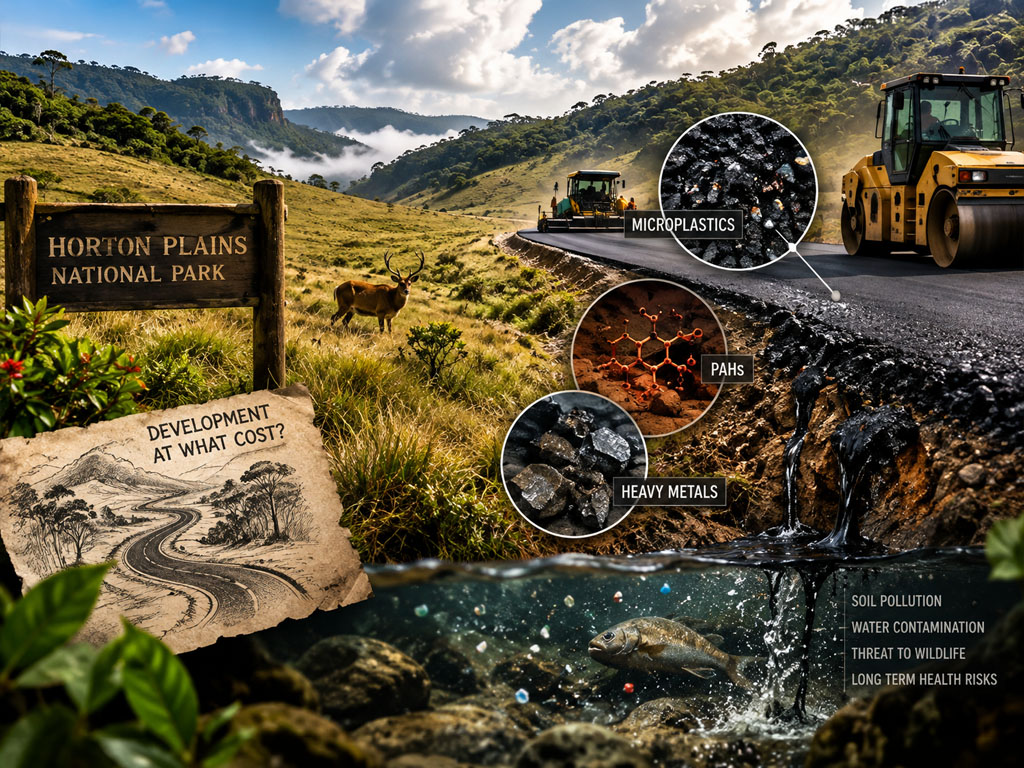
Asphalt or bitumen does not remain static after application. Vehicle friction, sunlight and water continuously weather the surface. Material from that surface can then enter the surrounding environment in different ways.
The Cabinet recently approved a Rs. 791.68 million contract to improve the Blackpool-Ambewela-Pattipola-Horton Plains Road, covering the B512 stretch from kilometre 5+200 to kilometre 12+000. The road suffered damage during Cyclone Ditwah. Four bids were received, with Asset Engineering (Pvt) Ltd identified as the lowest responsive bidder.

Horton Plains Road and What Asphalt Leaves Behind
Bitumen is a petroleum-derived material with considerable chemical complexity. Among the compounds associated with asphalt are Polycyclic Aromatic Hydrocarbons, commonly known as PAHs.
The environmental question concerns what happens as paved surfaces age, deteriorate and interact with traffic.
Road traffic also produces particles through tyre wear. These include microplastics and chemicals associated with tyres, including 6PPD-quinone. Such contaminants have raised particular concerns about their effects on aquatic ecosystems.
Heavy metals, including vanadium, nickel and lead, may also be associated with road-related pollution and can eventually reach surrounding soil and waterways.
Other pollutants can, of course, carry greater acute toxicity. Agricultural pesticides and PFAS, often called “Forever Chemicals,” provide examples.
However, asphalt presents a different problem because of its enormous geographical presence.
Roads cover vast areas and connect landscapes continuously. Consequently, the environmental burden associated with paved surfaces is not confined to one factory, plantation or industrial zone.
It travels through the same landscapes that roads themselves connect.
That makes the Horton Plains road debate about more than one construction project. It raises a broader question about how societies understand infrastructure.
When a Black Carpet Becomes a Symbol of Development
Applying asphalt can be understood not only as an engineering decision, but also as a physical intervention imposed upon nature by the prevailing socio-economic system.
Yet infrastructure expansion has become so closely associated with “progress” that questioning it can appear equivalent to opposing development itself.
Modern capitalism depends upon an unobstructed and increasingly rapid movement of goods and services.
The smooth black carpet road has therefore become a physical symbol of that economic ambition.
Society has learned to interpret the smooth surface as “progress.” In this ideological framework, the road becomes linked to circulation, productivity and development.
What becomes harder to see is the road as a material object.
It ages. It wears away. Traffic continuously interacts with it. Tyres deteriorate upon it. Particles and chemicals enter the surrounding environment.
Yet people do not simply see “tar.”
They see “development.”
This distinction matters because “progress” can function as a master signifier. It gives a positive meaning to infrastructure before society examines all its consequences.
Modern Waste Does Not Simply Disappear
Industrial capitalism has also fundamentally changed the meaning of waste, particularly since around the 1960s.
Traditional organic waste could often return to the soil. Modern waste is different.
Today, disposing of certain materials requires scientists, specialists and sophisticated waste-management systems.
Yet psychologically, society often behaves as though discarded material enters another empty world.
Once something disappears from sight, we imagine it has disappeared altogether.
The same logic operates with asphalt.
People readily discuss visible mountains of garbage. Educated citizens may carefully place a toffee wrapper in a bin. Yet far less public discussion surrounds the particles and chemicals continuously generated by road traffic and paved surfaces.
It is not necessarily that society cannot see the problem.
Rather, our established language of development makes the problem easier to treat as invisible.
The pollution that emerges from asphalt can therefore become what psychoanalytic theory might describe as a remainder that cannot be fully absorbed into the symbolic construction of “development.”
It remains beneath the smooth surface of that story.
Later, contamination of soil, water or air returns as a symptom.
Science then attempts to interpret and manage that symptom within another specialised symbolic framework.
Are We Treating Symptoms Instead of Causes?
This pattern can already be seen elsewhere.
When air becomes dangerously polluted, society develops air filters or supplies oxygen. When drinking water becomes contaminated, people increasingly depend upon filtration systems.
The technical solution manages the consequence.
It does not necessarily challenge the structure that produced it.
From this perspective, mainstream environmentalism can itself become ideological.
Paper bags, restrictions on polythene and household waste separation may all have environmental value. However, they can also allow society to feel environmentally responsible while much larger structural interventions escape similar scrutiny.
The argument is provocative: “Environmentalism is a new type of opium given to the people.”
The criticism here is directed at environmentalism when it focuses overwhelmingly on individual behaviour while leaving major infrastructure systems largely unquestioned.
Asphalt has become normal precisely because modern society presents roads as indispensable signs of progress.
Plastic Roads and the Problem With ‘Green’ Alternatives
Several countries have experimented with incorporating waste materials into road construction.
A project in Wales used recycled disposable nappies in road material. India has also developed roads using plastic waste, while projects elsewhere have explored incorporating sanitary or recycled materials into asphalt.
Similar approaches have appeared in Sri Lanka.
The environmental criticism is that such solutions may not fundamentally challenge the production of plastic waste.
Instead, they can transform discarded plastics into another material that eventually interacts with the environment.
A deeper environmental awakening therefore requires abandoning the romantic assumption that nature remains somewhere untouched, waiting for humanity to return.
We already live within a heavily modified world.
The question is what we do with that reality.
Depaving Challenges the Asphalt City
Western countries have increasingly experimented with removing unnecessary asphalt and concrete.
The process is commonly called “depaving” or “desealing.”
Portland, Oregon, became an important centre of the modern grassroots depaving movement. The nonprofit Depave says it has worked with communities since 2008 to remove underused pavement and replace it with permeable, living landscapes.
The movement has spread beyond Portland. Portland authorities themselves describe depaving as part of a wider international movement, with related approaches appearing in the United Kingdom, France, Australia and Canada.
However, the central official arguments for depaving usually concern stormwater, urban heat and access to green space.
Depave, for example, says excessive pavement contributes to heat islands and stormwater runoff. Removing impermeable surfaces allows rainwater to enter the ground while creating opportunities for vegetation and habitat.
That distinction matters.
The official objective is generally not a declaration that all asphalt itself is toxic.
Instead, authorities often focus on the measurable urban consequences of impermeable surfaces.
Sponge Cities and the Economics of Flooding
Cities covered extensively with asphalt and concrete cannot absorb rainfall as effectively as permeable landscapes.
As a result, intense rainfall can generate greater surface runoff and contribute to urban flooding.
Removing unnecessary pavement can allow the ground to absorb more water. Green infrastructure can also reduce urban temperatures.
This thinking supports the broader “Sponge City” concept.
Portland’s clean-energy programme, for example, describes excessive pavement as contributing both to urban heat and stormwater problems. Its depaving projects aim to replace impermeable surfaces with greener and more resilient spaces.
From the perspective developed here, however, these interventions still primarily treat visible symptoms.
They respond to flooding.
They respond to heat.
But the deeper argument concerns the chemical and material consequences of a transport system built around enormous quantities of asphalt and vehicle traffic.
Why Not Simply Declare Asphalt Toxic?
This is where the ideological question becomes more difficult.
If governments formally framed asphalt itself as a poison being continuously introduced across the biosphere, the consequences would extend far beyond one flooded city.
Such a position would force societies to question highways, logistics networks and newly constructed roads around the world.
It would also challenge infrastructure that supports the circulation of capital.
Instead, existing systems tend to address particular symptoms.
Water cannot drain, so engineers introduce permeable surfaces.
Cities become hotter, so planners create green spaces.
In that interpretation, depaving becomes a technical bandage rather than a rejection of the underlying economic structure.
Even when asphalt disappears, transport and parking requirements remain.
Professor Elena Granata of the Politecnico di Milano has captured this changing approach to urban planning by arguing that today’s virtuous mayor is no longer the one who lays asphalt, but the one who removes it.
Yet even this shift can become another version of the same development story.
The old fantasy of progress through asphalt and concrete becomes a new fantasy of “sustainable progress through green infrastructure.”
The underlying demand remains efficient circulation.
“Green technology” can therefore become not an alternative outside capitalism, but another symbolic form operating within it.
Why Depaving Is Harder in Sri Lanka
Sri Lanka faces another difficulty.
Alternatives emerging in wealthier capitalist economies cannot simply be transferred into the country’s economic and political environment.
Sri Lankan politics has long treated road construction as a highly visible measurement of development.
A smooth black carpet road offers something immediately recognisable. Politicians can point to it. Communities can use it. Voters can physically see what public money produced.
Within that political imagination, removing asphalt can appear almost incomprehensible.
The established ideology of development does not easily allow the land to breathe again.
Capital accumulation and contract politics add another dimension.
Large infrastructure projects do more than transport people and goods. They also generate substantial financial flows involving construction, procurement, lending and contracting.
International financing from institutions such as the Asian Development Bank, World Bank and other foreign lenders can support major infrastructure programmes.
Large road projects consequently create networks of contracts and economic interests.
Small-scale depaving, natural drainage and decentralised ecological restoration do not necessarily generate financial flows of the same scale.
That creates a structural incentive to keep building.
The debate surrounding the Horton Plains road therefore reaches far beyond whether one section should receive another layer of asphalt.
It asks what Sri Lanka means when it says “development.”
If a black carpet road automatically represents progress, its environmental cost becomes difficult even to discuss. If infrastructure is instead examined as a living material system, one that ages, wears and interacts with water, soil and ecosystems, the question changes.
The issue is no longer simply whether Sri Lanka can build another road.
It is whether society can imagine progress without automatically covering the earth beneath it.