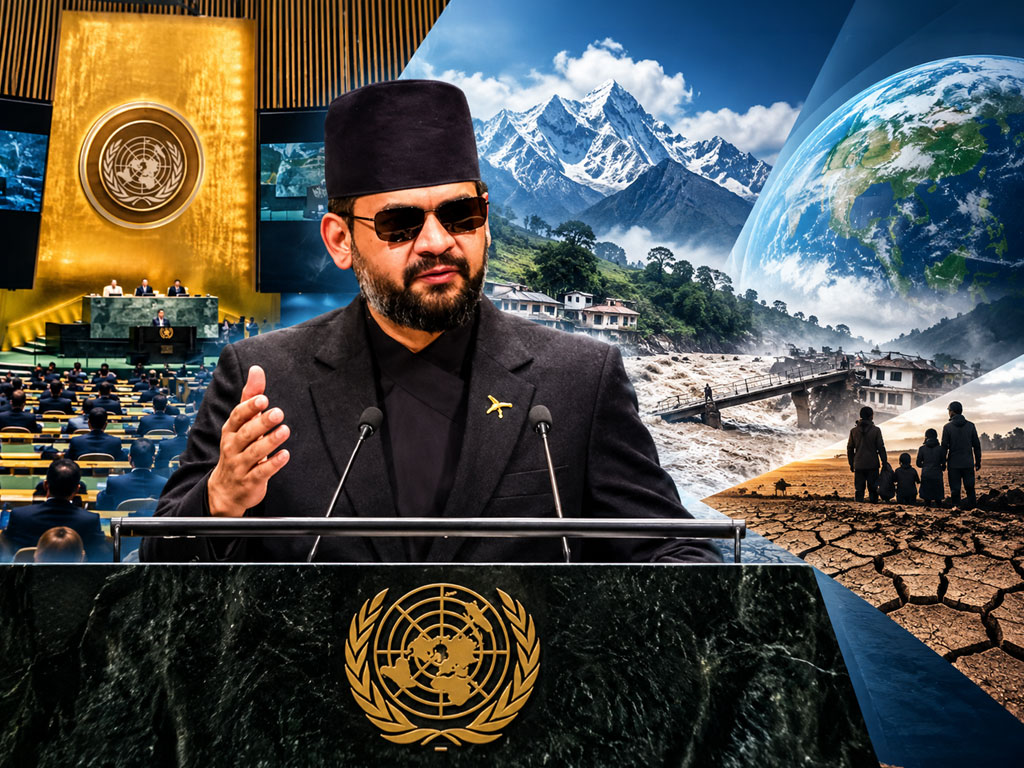
Balen Shah UN speech urges grant-based climate finance, warning that Nepal and South Asia are paying for crises they did not create.
NEW YORK — Nepalese Prime Minister Balendra “Balen” Shah used his first address to the United Nations General Assembly to challenge a global system that, he argued, forces vulnerable countries to shoulder the financial burden of climate disasters they did little to cause.
Addressing the 81st session of the UN General Assembly on September 24, Shah drew on the catastrophic Bhotekoshi-Trishuli disaster to make a broader case for climate justice, grant-based financing and stronger regional cooperation.
Nepal contributes less than 0.1% of global greenhouse gas emissions, Shah said, yet the country faces increasingly severe consequences from a warming climate. At least 1,400 people were killed in the recent disaster, while reconstruction needs are estimated at about 10% of Nepal’s gross domestic product.
His central argument was straightforward: countries that contributed little to global warming should not be pushed deeper into debt when climate-related disasters destroy their infrastructure.
“When a climate-driven disaster destroys the infrastructure of a poor country, the answer cannot simply be another mega loan or a patchwork of small grants,” Shah told the Assembly.

Climate Crisis Crosses National Borders
Shah described a warming climate as destabilising the fragile Himalayan ecosystem, with melting permafrost increasing the danger of ice-rock avalanches, floods, landslides and other cascading disasters.
The devastation, he said, had crossed the Nepal-China border and continued downstream towards India.
“Climate change does not recognize borders,” Shah said, adding that glaciers and floods do not travel with passports or visas.
The scale of the disaster formed the basis of his appeal for a different approach to international climate finance.
Rather than relying heavily on loans for reconstruction, Shah called for stronger grant-based support, including through existing climate-finance mechanisms.
He argued that climate justice must address who ultimately pays for the consequences of global warming, particularly when poorer and more vulnerable countries have contributed comparatively little to the problem.
The speech did not explicitly describe this system as “neo-colonialism” or “climate terrorism,” as suggested in the supplied commentary. Those descriptions are interpretations of Shah’s argument rather than terminology he used in the verified text of his UN address. The central criticism in his speech was instead directed at inequities in climate finance, global economic arrangements and the international response to disasters.
‘Flawless Logistics for War’
Shah also widened his criticism beyond climate change, contrasting disruptions to essential supplies with the efficiency of global military logistics.
He described Nepalese farmers struggling to obtain fertiliser and families facing fuel shortages while missiles, rifles and ammunition move rapidly across borders.
“We have built a world with flawless logistics for war and broken logistics for food,” he said.
Shah explicitly extended that argument beyond Nepal.
Bangladesh, Bhutan, India, the Maldives, Pakistan and Sri Lanka were among the countries he named as facing consequences from climate pressures and wars they did not start.
“Ask Sri Lanka,” he said as he listed countries confronting similar pressures.
For Sri Lanka, the reference gave Shah’s speech particular regional relevance. His argument was not that South Asian countries face identical circumstances, but that they can be exposed to economic consequences arising from climate change, conflict and disruptions originating beyond their borders.
Grants, Not Another Debt Burden
Climate finance formed one of the strongest themes of Shah’s address.
Nepal faces an immense reconstruction challenge following the Bhotekoshi-Trishuli disaster. Shah argued that forcing a poorer country to assume additional debt after climate-related destruction risks compounding the economic damage caused by the disaster itself.
He called for greater grant-based financing and argued that existing international mechanisms remain inadequate for the scale of the challenge confronting vulnerable countries.
Shah also criticised the bureaucracy surrounding access to climate assistance.
“When the house is burning, we do not ask the family to complete fifty forms. We act,” he said.
His argument placed both the quantity and accessibility of climate financing under scrutiny: assistance, he suggested, has limited value if vulnerable countries cannot obtain it quickly enough when disaster strikes.
Nepal, India and China Climate Mechanism Proposed
Shah also proposed a Himalayan Climate Resilience Mechanism led by Nepal, India and China.
The initiative would involve sharing satellite data and technical expertise, monitoring dangerous glacial lakes, strengthening early-warning systems and coordinating cross-border disaster assistance.
That proposal reflects the geographical reality underpinning Shah’s climate argument. Himalayan environmental risks do not remain within national borders, and disasters originating in mountain regions can affect communities across several countries.
His speech therefore combined demands for changes to global climate financing with a call for stronger regional cooperation among three neighbouring states.
The supplied commentary interprets this proposal as a call for countries in the region to reduce their dependence on the West. Pasted text The verified speech itself does not frame the proposed Nepal-India-China mechanism in those terms. Shah instead presented it as a practical regional response to shared climate threats.
His broader message nevertheless challenged the distribution of costs within the international system: Nepal and other vulnerable countries, he argued, should not bear disproportionate economic consequences for climate change and geopolitical crises to which they contributed comparatively little.
For Sri Lanka and its South Asian neighbours, Shah’s address brought that argument directly into the region, linking climate vulnerability, debt, supply disruptions and international financing to a larger question of how the costs of global crises are shared.