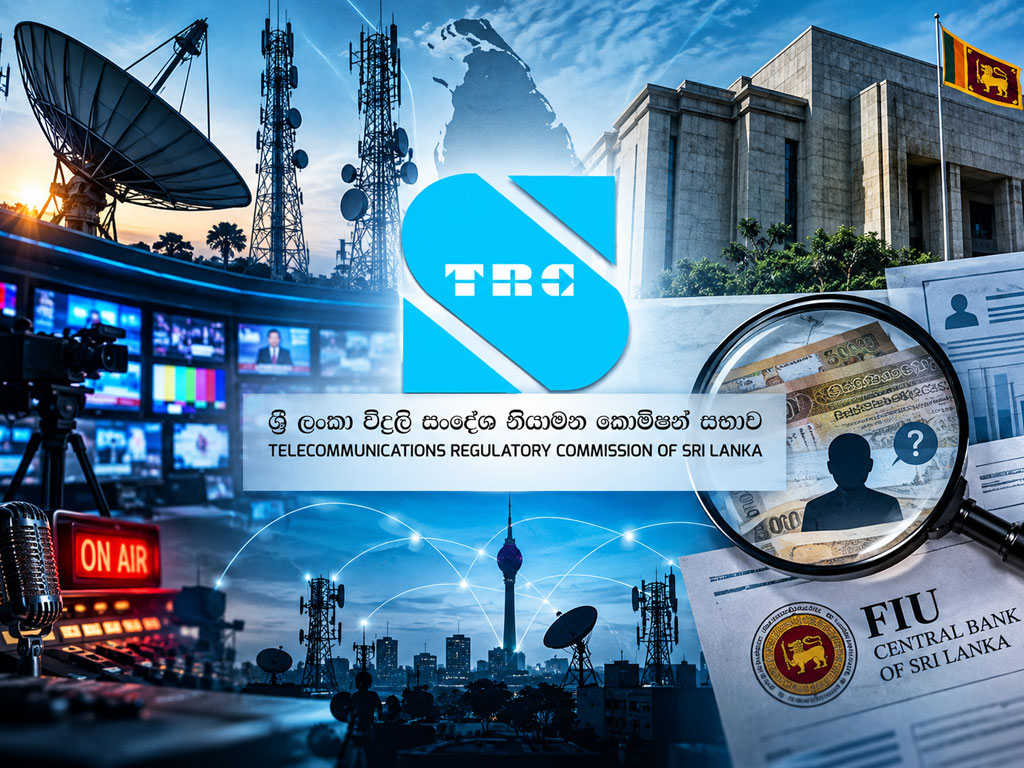
TRCSL broadcast licence reforms could require Central Bank FIU financial checks alongside security clearance for frequency licences.
COLOMBO — The government is considering tighter financial scrutiny of television and radio frequency licence holders, including mandatory checks by the Central Bank’s Financial Intelligence Unit (FIU), as part of proposed changes aimed at preventing illicit funds from entering Sri Lanka’s broadcasting sector.
Under the proposal described in the information available to The Morning Telegraph, financial scrutiny would be added to the security clearance currently associated with the licensing process, with the government considering changes to the regulatory framework governing the issue and renewal of broadcast frequencies.
The proposed reforms are intended to examine the source of funds behind broadcasting operations and identify the ultimate beneficial owners of companies seeking access to frequencies.
The plan has not yet been enacted into law, and The Morning Telegraph has not located a publicly available government decision or draft legislation setting out the proposed FIU clearance mechanism in detail.

Financial Scrutiny Proposed Alongside Security Checks
According to the proposal, the government wants financial risks to receive greater attention when licences are issued or renewed.
Existing security scrutiny has traditionally focused on matters such as terrorism, extremism and criminal records, according to the supplied information. The proposed framework would broaden that approach by adding scrutiny of potential money laundering, large-scale financial fraud and the source of investment behind broadcasting companies.
A key element under consideration is a financial assessment involving the Central Bank’s FIU.
Such scrutiny would seek to establish whether capital used to acquire, invest in or operate a television or radio channel comes from lawful sources. It would also seek to identify the ultimate beneficial owners behind companies where ownership may otherwise be obscured through nominee arrangements.
The proposal frames protection of the national economy as an element of national security, arguing that major financial crime can have consequences extending beyond individual businesses.
Three Regulatory Measures Under Consideration
Three principal changes are identified in the proposed framework:
- Broader security scrutiny: The scope of security checks would be widened beyond conventional national-security concerns to take account of conduct considered harmful to the country’s economy.
- Mandatory FIU financial scrutiny: Applicants and existing licence holders would face examination of the lawful source of funds used to acquire, invest in and operate broadcasting businesses. The proposal also envisages verification of ultimate beneficial ownership and annual examination of assets and liabilities.
- Ban on frequency sub-leasing: Licence holders would be prohibited from renting, selling or transferring frequencies to third parties through undisclosed management or similar arrangements. An operator unable to continue using an assigned frequency would instead be required to return it to the state.
The proposal also envisages legal provisions allowing authorities to cancel an assignment and recover a frequency if prohibited sub-leasing is established.
TRCSL’s published framework already treats frequency licences as regulatory permissions rather than private contractual rights. Its official guidance says a radio spectrum licence is permission to operate radio communications equipment and should not be regarded as a contract or bilateral agreement. TRCSL also states that radio spectrum licences are normally issued for one year.
Spectrum Managed as a Limited Resource
Sri Lanka’s radio spectrum is managed through a regulatory framework administered by the Telecommunications Regulatory Commission of Sri Lanka.
TRCSL says frequency assignments are made according to spectrum engineering principles and national regulatory policies. Its published policy describes the assignment process as open, transparent and non-discriminatory, while scarce and highly valued spectrum may be allocated through mechanisms including auctions or competitive bidding.
The regulator separately maintains licensing procedures specifically covering FM sound broadcasting and UHF, VHF and television broadcasting.
Those existing procedures provide the regulatory foundation upon which any additional financial scrutiny would have to operate.
The proposed reforms would go further by connecting access to broadcast frequencies with examination of the financial background and ownership of the businesses using them.
Supporters of the approach argue that this could prevent broadcasting licences from being used to legitimise funds generated through unlawful activities, including illegal financial schemes and unauthorised deposit-taking operations.
Such concerns remain part of the rationale presented for the proposed changes; the supplied material does not identify particular broadcasters or establish that existing licence holders have engaged in money laundering.
Any mandatory FIU clearance, expanded security assessment or prohibition requiring legislative changes would ultimately depend on the government completing the relevant legal and regulatory process.
Until those changes are formally approved and published, the measures remain proposals rather than requirements currently imposed on all broadcast frequency licence holders.