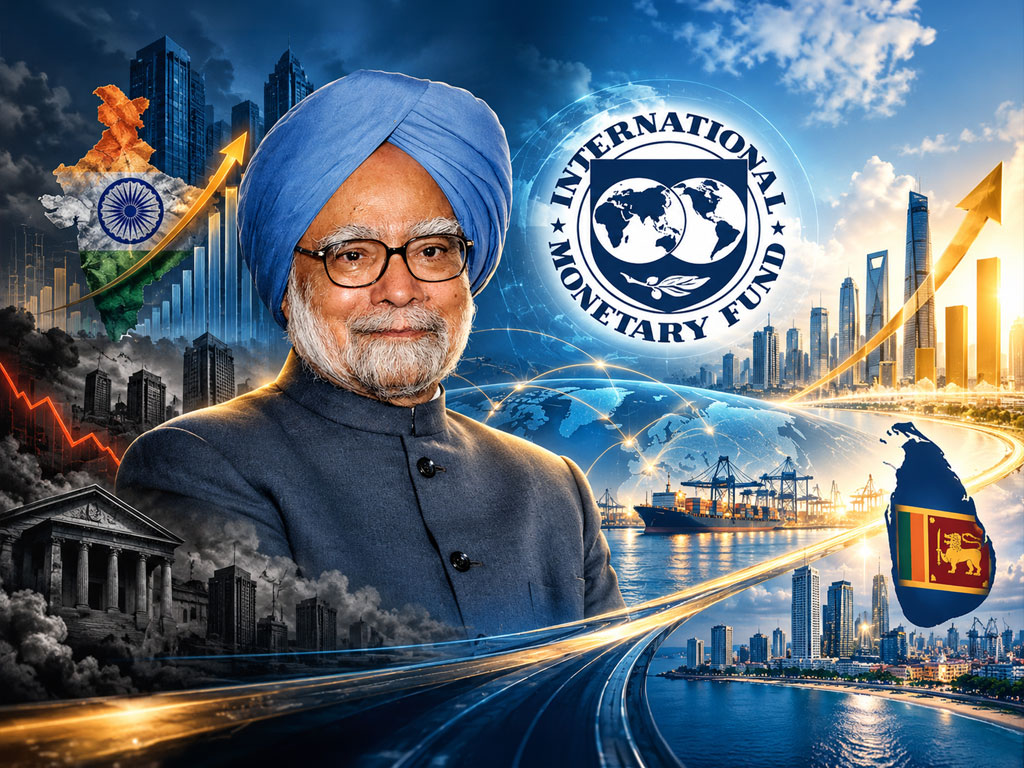
India IMF reforms in 1991 turned crisis financing into structural change. Kana Kananathan examines what Sri Lanka can learn from that experience.
By former Ambassador Kana Kananathan
Sri Lanka should study closely what India did under Prime Minister P. V. Narasimha Rao and Finance Minister Dr. Manmohan Singh when a severe balance-of-payments crisis brought the Indian economy close to the edge in 1991.
India turned to the International Monetary Fund for emergency assistance, but it did not allow the IMF programme itself to become the country’s long-term economic strategy.
The Fund helped provide breathing space. India’s own reforms did the harder work.
That distinction is crucial for any country trying to emerge from a balance-of-payments crisis. India did not escape repeated dependence on the IMF by rejecting the institution. It used international support as a bridge while restructuring its economy, rebuilding foreign-exchange earning capacity and creating conditions in which another borrowing programme was no longer necessary.
For Sri Lanka, currently progressing through its own IMF-supported reform programme, that remains an important lesson.

The Manmohan Singh Moment Began in 1991
A historical distinction is important.
India’s decisive economic transformation did not begin when Manmohan Singh became Prime Minister in 2004. Its foundations were laid much earlier, during his tenure as Finance Minister from 1991 to 1996 under Prime Minister P. V. Narasimha Rao.
India entered 1991 facing one of the gravest economic crises in its post-independence history.
Foreign-exchange reserves had fallen to dangerously low levels. The Gulf War had driven up oil prices and disrupted remittance flows. Fiscal imbalances had deteriorated, external confidence was weakening and India had barely enough foreign exchange to finance a few weeks of essential imports.
The depth of the crisis was symbolised by what happened to the country’s gold.
India sold approximately 20 tonnes of gold abroad with a repurchase arrangement and subsequently moved roughly another 47 tonnes of gold overseas to raise emergency foreign exchange.
For a country in which gold carries enormous cultural as well as financial significance, the episode became an enduring symbol of how precarious the situation had become.
Yet 1991 also became the starting point of one of the most consequential economic transformations in modern Indian history.
IMF Support Bought Time, Not a Growth Model
India entered two IMF Stand-By Arrangements in 1991.
The first was approved in January for SDR 551.925 million. A larger arrangement followed on October 31, worth SDR 1.656 billion, and remained in place until June 30, 1993.
The critical point is what India did with that period of external support.
Rao and Singh did not treat IMF financing as a substitute for economic reform.
They used the space created by emergency financing to attack structural weaknesses that had accumulated over decades.
Industrial licensing was substantially dismantled.
Import restrictions began to be reduced.
Indian firms were progressively exposed to greater competition.
Foreign investment rules were liberalised.
Export competitiveness received greater attention.
The role of the State began to move away from controlling large parts of productive economic activity towards creating conditions for greater efficiency, competition and investment.
India’s question gradually changed from “How much can we borrow?” to “How can we earn enough foreign exchange that emergency borrowing becomes unnecessary?”
That is the difference between stabilising a crisis and transforming the economy that produced it.
Competitiveness Became Central
Singh’s 1991 Budget argued that India needed greater competitiveness to improve productivity, efficiency and cost management.
Foreign investment was viewed not simply as a source of capital, but also as a means of obtaining technology, managerial knowledge and access to international markets.
The reforms therefore went beyond fiscal restraint.
They sought to change how India produced, traded and interacted with the world economy.
That point is especially relevant to Sri Lanka because fiscal consolidation alone cannot produce a sustainable external balance.
A country can reduce expenditure, increase taxes and stabilise public finances, yet still remain vulnerable if it cannot generate sufficient foreign exchange from exports, services, tourism, investment and other productive inflows.
The Rupee Adjustment Was Painful but Necessary
Exchange-rate policy was another central part of India’s response.
In July 1991, the Indian rupee was adjusted downward in two stages by approximately 18 to 19 per cent.
The Reserve Bank of India later recorded that one objective was to restore export competitiveness.
India subsequently introduced the Liberalised Exchange Rate Management System, or LERMS, in 1992, creating a dual exchange-rate mechanism.
That transitional system was replaced in March 1993 by a unified market-determined exchange rate.
The process was difficult.
But policymakers recognised that maintaining an unrealistic exchange rate while foreign-exchange reserves were disappearing would merely postpone adjustment.
Exchange-rate policy increasingly became part of a broader strategy involving exports, capital inflows, competitiveness and external stability.
Reserves Recovered Dramatically
The change in India’s external position over the following decade was remarkable.
Official Reserve Bank of India data show foreign-exchange reserves of approximately USD 10.1 billion at the end of March 1993.
By March 2004, reserves had risen to about USD 113 billion.
India was not, as sometimes claimed, the holder of the world’s largest foreign-exchange reserves at that point. RBI records show that it ranked sixth globally and fifth among emerging market economies in March 2004.
That correction does not diminish the scale of the transformation.
A country that had struggled to finance essential imports in 1991 had accumulated more than USD 100 billion in reserves little more than a decade later.
More importantly, India did not enter another IMF borrowing arrangement after the 1991-93 programme.
Its outstanding IMF credit was repaid gradually over the following years, reaching zero by 2001.
By 2003-04, the direction of the relationship had changed even further. India was participating in IMF financing operations as a creditor, with the Reserve Bank reporting lending of approximately USD 561 million to the Fund under its Financial Transactions Plan during that financial year.
The symbolism was striking: a country that had once needed emergency support was now supplying resources to the international financial system.
Structural Reform Changed the Direction of the Economy
India’s transformation cannot be attributed to a single minister, a single Budget or the IMF alone.
The Rao Government initiated the decisive reforms, with Singh playing a central role in economic policy.
Successive governments continued, modified and expanded many of them.
The direction established in 1991 was nevertheless clear.
India moved away from excessive licensing, heavy protectionism and pervasive State control towards greater competition, private enterprise, foreign investment and integration with global markets.
Structural change mattered because stabilisation by itself could only stop the immediate crisis.
Reforms changed the underlying economic engine.
Foreign-exchange resilience was strengthened through exports, services, remittances, productive investment and capital inflows.
The ultimate objective was not merely to possess enough reserves to survive the next month.
It was to build an economy capable of generating foreign exchange on a sustainable basis.
What Sri Lanka Must Learn
Sri Lanka faces a different economy, political system and global environment.
India’s 1991 reforms cannot simply be copied.
The underlying principle, however, remains highly relevant.
An IMF programme can help restore confidence, rebuild reserves, improve fiscal discipline and create breathing room during a crisis.
What it cannot permanently do is earn foreign exchange on behalf of a country.
That task belongs to the domestic economy.
Sri Lanka must therefore increase exports of goods and services, attract productive foreign direct investment, improve productivity, create competitive industries, strengthen entrepreneurship and establish an environment in which both domestic and overseas investors are willing to commit capital for the long term.
This is where the lesson from Manmohan Singh becomes especially important.
Stabilisation Is Not Transformation
Sri Lanka has made considerable progress since the depths of its economic crisis.
The IMF completed the combined fifth and sixth reviews of the country’s Extended Fund Facility programme in May 2026, citing generally strong performance and progress in restoring macroeconomic stability.
Yet the Fund continues to emphasise that the next stage must involve growth-enhancing structural reform.
Trade liberalisation, regulatory modernisation, labour-market reform, digitalisation, improved infrastructure and a more supportive environment for private investment remain central priorities.
The IMF has also highlighted Sri Lanka’s comparatively weak export performance and historically low foreign direct investment.
That is where the danger lies.
A country can successfully stabilise its public finances and still fail to transform the productive economy.
If exports remain weak, investment remains subdued and foreign-exchange earning capacity does not improve sufficiently, external pressure can eventually return.
Investors Need Predictability
Sri Lanka’s investment environment has long suffered from policy inconsistency, bureaucratic delays and complex approval procedures.
United States investment-climate assessments have repeatedly identified unpredictable policy changes, regulatory burdens, contract implementation problems and weak inter-agency coordination as deterrents to investment.
The Board of Investment is formally intended to provide one-stop services to investors, but past assessments have noted that multiple clearances across government agencies often prevent that concept from functioning as effectively as intended.
An investor should not have to navigate one institution after another simply to begin a legitimate project.
Every unnecessary approval, unexplained delay and duplicated procedure creates an additional reason for capital to choose another destination.
That is a problem Sri Lanka can address without waiting for another economic crisis.
Sri Lanka Needs a Genuine One-Stop Investment System
I have personally observed one-stop investment centres operating in Delhi, Tamil Nadu, Bangalore and several African countries.
Their value lies in bringing government to the investor rather than forcing the investor to travel through government.
Sri Lanka should adopt that principle decisively.
If the Board of Investment is serious about attracting both foreign and domestic capital, it should establish a fully empowered one-stop system, physically or digitally integrating all major approval agencies into a single decision-making platform.
Representatives of the relevant institutions should be available through that system with defined responsibilities and deadlines.
An investor should knock on one government door, not ten.
This approach would complement reforms already being pursued through measures such as the National Single Window for trade facilitation and wider digitalisation of public administration.
Speed alone is not enough. Decisions must also be predictable, transparent and legally durable.
State-Owned Enterprises Send an Important Signal
Policy towards State-Owned Enterprises is another area investors will watch closely.
Sri Lanka has reassessed some earlier plans for divestment and has instead considered restructuring certain enterprises while retaining State ownership.
The choice between privatisation, restructuring and continued public ownership is ultimately a policy decision for the Government.
What matters economically is whether State enterprises consume public resources, distort competition or prevent capital from moving towards more productive uses.
The IMF’s current reform framework emphasises reducing the Government’s commercial role where necessary to improve resource allocation and foster competition.
Private investors will judge Sri Lanka not only by public statements welcoming investment, but by whether policy creates a level and predictable environment in practice.
Avoiding the Return to the Same Cycle
Sri Lanka’s post-crisis challenge can be expressed simply.
The country must move from IMF-supported stabilisation to investment-led and export-driven growth.
Failure to make that transition risks reproducing a familiar pattern:
- External crisis
- IMF programme
- Fiscal adjustment
- Temporary stability
- Weak investment and exports
- Renewed foreign-exchange pressure
- Further external borrowing
India’s experience shows that such a cycle can be broken.
Not instantly, and not without difficult reforms.
But it can be broken when crisis financing is treated as temporary support for deeper change rather than as the change itself.
The Real Measure of IMF Success
Manmohan Singh understood in 1991 that restoring stability was only the beginning.
India used its crisis to liberalise parts of its economy, improve competitiveness, rebuild reserves, attract capital and create new sources of foreign-exchange earnings.
The IMF programme ended in 1993.
India continued reforming.
That is the more important sequence.
Sri Lanka should not judge the success of its current programme solely by whether each review is completed, whether another tranche is released or whether macroeconomic indicators improve during the programme period.
The stronger test comes afterwards.
Can the country generate enough foreign exchange through exports, services and investment to meet its obligations without returning repeatedly to emergency borrowing?
Can it create institutions that investors trust?
Can it convert temporary stability into durable growth?
India’s experience offers no formula that Sri Lanka can copy line by line.
It offers something more useful: a principle.
The strongest exit from dependence on the IMF is not political rhetoric against the Fund. It is building an economy strong enough that another rescue programme is unnecessary.
That should be the ultimate measure of Sri Lanka’s economic recovery.
(The writer of the article, Ambassador Kana Kananathan, is an Executive Director of the Imperial Hotel Group in Kampala, as well as a businessman, a former diplomat and an expert with more than four decades of experience on the African continent. A long-term resident of Africa, he served as Sri Lanka’s High Commissioner to Uganda and Kenya with concurrent accreditation to 22 African nations, and also served as Permanent Representative to UN-Habitat and the United Nations Environment Programme. He is also an international election observer across Africa and has worked closely with African governments, building lasting relationships with African leaders. He also served as an economic and investment advisor to former President Professor Alpha Condé of the Republic of Guinea.)
SOURCE:- SRI LANKA LEADER