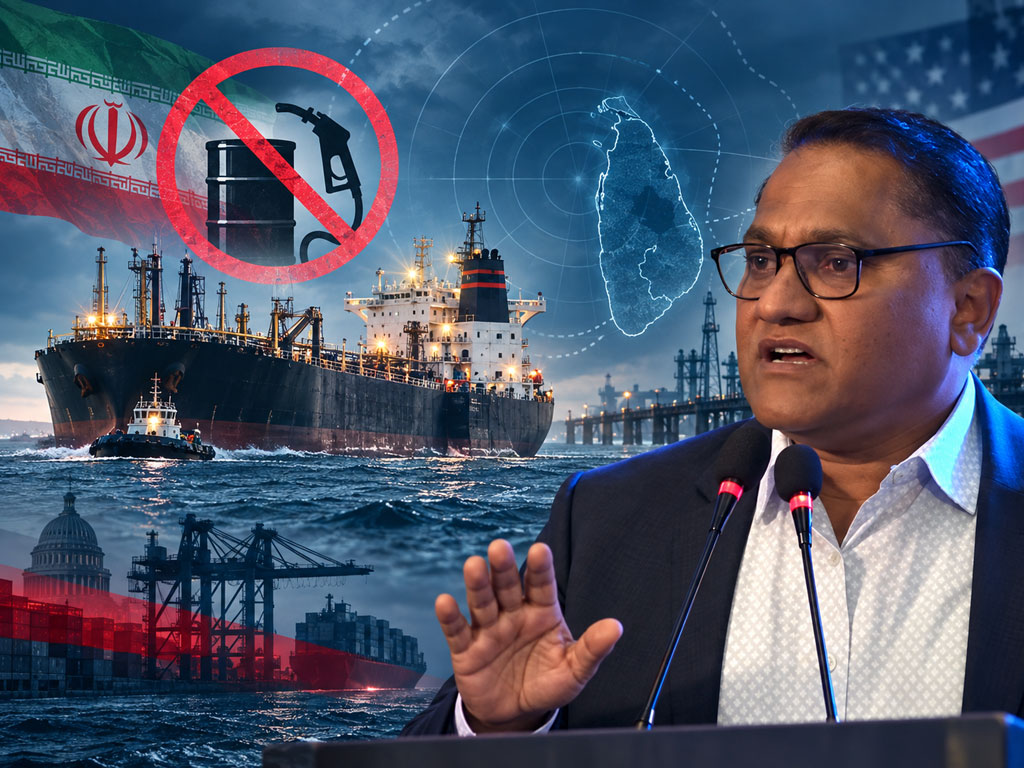
Iranian vessels off Sri Lanka will not receive Government supplies, while local companies have been warned to consider US sanctions exposure.
COLOMBO — Sri Lanka has declined an Iranian request to provide food, drinking water and other supplies to oil tankers stranded in international waters near the island, while warning local maritime service providers to carefully assess their exposure to United States sanctions before dealing with sanctioned vessels.
Foreign Minister Vijitha Herath has stressed, however, that Washington has not instructed or pressured the Sri Lankan Government to deny supplies.
He said Sri Lanka was making its own decisions while protecting its sovereignty, independence and neutrality, and would respond if a genuine humanitarian emergency placed seafarers’ lives at risk.
The issue has emerged as dozens of vessels remain in international waters near Sri Lanka amid severe disruption to shipping caused by the crisis in and around the Strait of Hormuz.

Dozens of Ships Remain Outside Sri Lankan Waters
Herath said around 47 vessels are currently positioned in international waters beyond Sri Lanka’s 12-nautical-mile territorial sea.
An earlier account provided by the Minister identified 15 of those vessels as Iranian. In a subsequent public statement, he referred to approximately 19 Iranian vessels among the 47.
The distinction is important because none of the vessels is currently within Sri Lanka’s territorial waters.
Several Iranian or Iran-linked tankers have reportedly remained in the region for an extended period after disruption to shipping through the Strait of Hormuz prevented or complicated their return.
Some are understood to be empty oil tankers that had already discharged their cargoes.
Sri Lankan authorities have been monitoring the vessels, but the Government maintains that their presence in nearby international waters does not, by itself, place them under Sri Lankan jurisdiction.
Government Declines Iranian Request for Supplies
Iranian authorities had sought assistance in obtaining basic provisions for some of the stranded vessels, including food and drinking water.
The Sri Lankan Government declined to provide those supplies.
Herath has said that, because the tankers remain outside Sri Lanka’s territorial waters, the Government is not providing logistical or commercial services to them.
Private maritime companies would ordinarily provide food, water, fuel and other supplies to vessels operating near Sri Lankan ports and shipping routes.
That is where the sanctions issue becomes more complicated.
Private Companies Warned Over US Sanctions Exposure
A number of Iranian vessels and entities are subject to United States sanctions.
Sri Lankan companies considering commercial dealings with such vessels have therefore been advised to establish whether a particular ship or counterparty is sanctioned before providing goods or services.
Herath warned that private businesses must understand the consequences of dealing with sanctioned entities and exercise appropriate caution.
Potential exposure to US secondary sanctions can have serious commercial consequences. Depending on the applicable sanctions programme and the transaction involved, companies may face restrictions affecting access to dollar transactions, correspondent banking relationships or the wider US financial system.
Such consequences are not automatic simply because a company services an Iranian vessel. They depend on the vessel, entity, transaction and sanctions provisions involved.
For Sri Lankan maritime suppliers, due diligence is therefore critical.
No US Order to Sri Lanka, Minister Says
Herath has rejected suggestions that the Government’s decision was taken under direct pressure from Washington.
He said the United States had issued no directive ordering Sri Lanka to deny food or water to the vessels and had not pressured the Government over its handling of the situation.
Earlier, the US Embassy had communicated with Sri Lankan authorities concerning the presence of Iranian vessels near the island and asked whether the Government was aware of and monitoring them.
That communication led the Foreign Ministry to inform the Defence and Ports authorities, after which monitoring was coordinated.
The Government has drawn a distinction between such communication and an instruction from Washington on whether Sri Lanka should supply the vessels.
Herath said decisions would continue to be taken in accordance with Sri Lanka’s national interests and international maritime law.
Humanitarian Assistance Remains Possible
The Government’s refusal to provide routine commercial supplies does not mean Sri Lanka has ruled out humanitarian intervention.
Herath has said assistance would be considered if the lives or safety of crew members were genuinely at risk.
International maritime law recognises obligations concerning persons in distress at sea, while the United Nations Convention on the Law of the Sea permits coastal states to maintain territorial seas extending up to 12 nautical miles.
Sri Lanka has already cited humanitarian considerations in dealing with another Iranian vessel following an attack, demonstrating that sanctions and geopolitical tensions do not remove the need to respond where lives are endangered.
The Government’s present position therefore separates two issues: commercial servicing of vessels subject to sanctions and humanitarian assistance to seafarers in genuine distress.
Sri Lanka Between Sanctions and Maritime Neutrality
The presence of Iranian tankers near Sri Lanka places Colombo in a sensitive position.
The country must preserve its commercial links with the international financial system while also maintaining diplomatic relations with Iran and presenting itself as a neutral maritime state.
For private-sector suppliers, the immediate question is narrower. Any company considering supplying a vessel must establish its sanctions status and assess the financial and legal consequences before proceeding.
For the Government, the approach is equally clear: it says it will not commercially supply sanctioned vessels merely because they are anchored near Sri Lanka, but it rejects suggestions that this position was dictated by the United States.
Should conditions aboard any of the vessels deteriorate into a genuine emergency, humanitarian obligations could become the next test of how Sri Lanka balances sanctions risk, maritime law and its stated policy of neutrality.