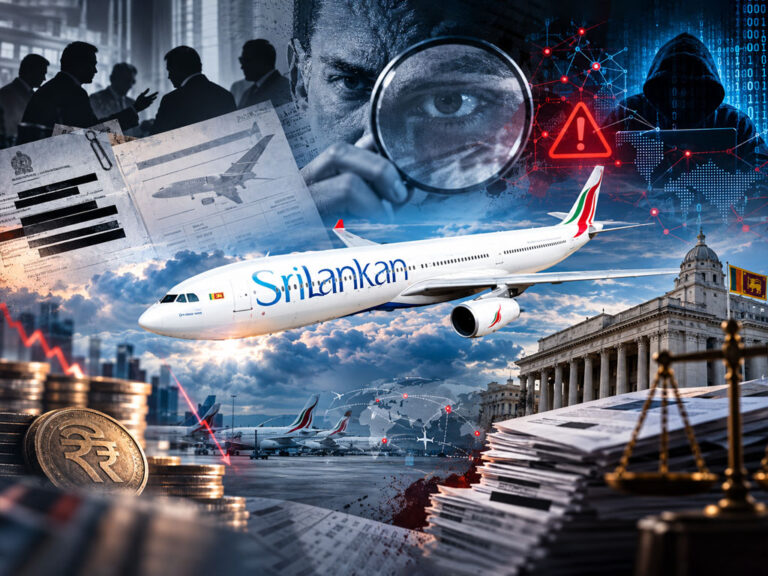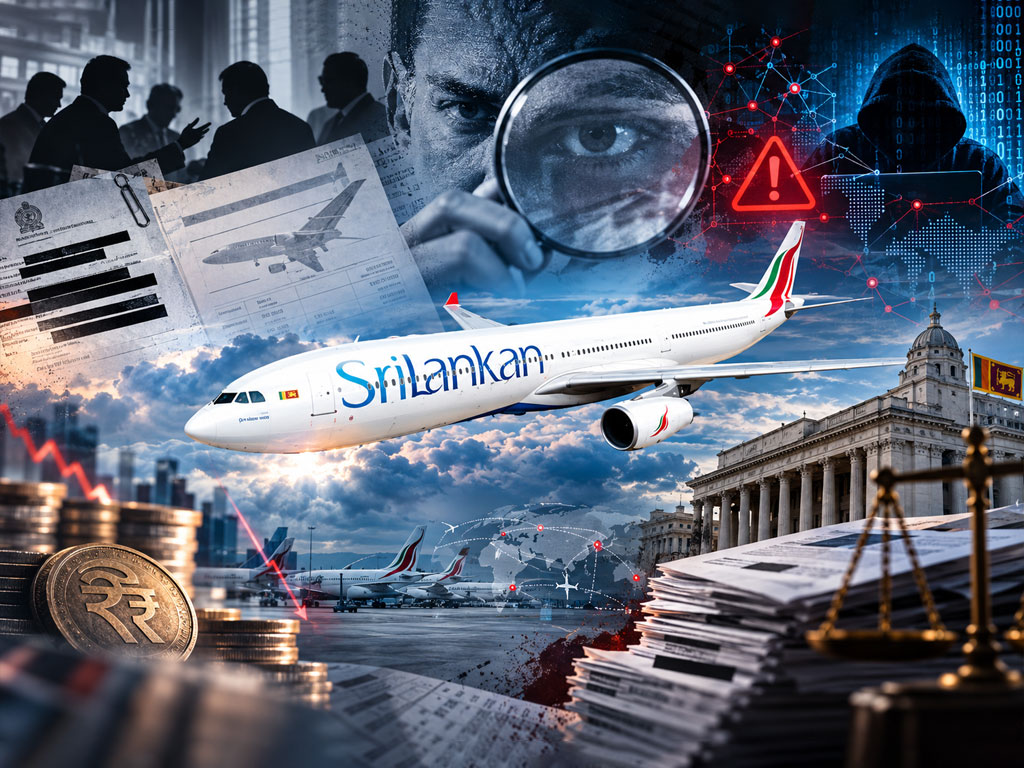
SriLankan Airlines accountability questions span unpaid political bills, aircraft leases, cyber fraud, tax arrears and unresolved investigations.
COLOMBO — Allegations surrounding unpaid political event bills, controversial aircraft leases, cyber fraud and billions of rupees in statutory arrears continue to raise questions over accountability at SriLankan Airlines and its related entities, even as the carrier undergoes restructuring.
The concerns cited in the material supplied to The Morning Telegraph span several years and involve findings or allegations linked to previous inquiries, parliamentary scrutiny and criminal investigations.
They do not, on their own, establish criminal liability against any individual named in this report. But they do raise a broader question that has followed SriLankan Airlines for years: whether repeated inquiries into financial and governance failures have led to meaningful accountability.

Unpaid Political Event Bills at SriLankan Catering
One area highlighted is SriLankan Catering, which featured in findings associated with the Presidential Commission of Inquiry into alleged misuse of State resources and the Commission to Investigate Allegations of Serious Fraud and Corruption.
According to the source material, information relating to 26 alleged irregularities within the company had been verified through earlier investigations.
Among the allegations is that luxury food and beverages were supplied for high-level political events during past election periods without proper billing or payment documentation being prepared.
If accurate, that would raise questions over who authorised the use of resources belonging to a State-linked company and whether public funds were used for partisan political activity.
The source does not establish who approved those transactions or whether any individual has been convicted in connection with them.
That absence is precisely why the records and findings of the previous investigations remain important.
Aircraft Leases and Commission Payments
Aircraft leasing has also been a recurring source of controversy.
The supplied material states that parliamentary committees were told of substantial commission payments connected to aircraft leases allegedly arranged at rates above prevailing market values.
It further questions the use of Regional Sales Agents, or RSAs, where commissions were reportedly paid even on tickets purchased directly by passengers through the airline’s official website.
Such arrangements, if accurately described, would warrant scrutiny of the commercial justification, contractual terms and approval process behind the payments.
The source also raises the continued delay in legal action against former officials who were in management at the time, including former Chairman Nishantha Wickremasinghe.
No conclusion should be drawn from delay alone.
A delay in prosecution does not prove either wrongdoing or institutional protection. It does, however, leave unresolved questions where inquiries or parliamentary reviews have already identified matters requiring further examination.
Cyber Fraud Exposed Weaknesses in Financial Controls
A separate allegation concerns a cyber fraud in which the electronic communications system of an external service provider was reportedly compromised.
According to the source, funds belonging to SriLankan Airlines were then transferred to a fraudulent foreign bank account.
The Criminal Investigation Department and authorities in the United Arab Emirates are said to have investigated the incident.
Yet the material states that key information has not been publicly disclosed, including:
- the amount of money lost;
- the internal verification failures that allowed the transfer;
- whether any airline officials were found to have breached procedure; and
- what steps were taken to recover the funds.
For a national airline handling substantial international payments, the incident raises obvious questions about internal financial controls, supplier verification and cyber-risk management.
Whether the loss resulted from fraud alone or from procedural failures within the airline requires evidence that has not been made available in the source material.
Rs. 24.6 Billion Embarkation Levy Arrears
Perhaps the most striking financial figure in the source is the claim that SriLankan Airlines has not remitted Rs. 24.6 billion in embarkation levy collections due to the Civil Aviation Authority of Sri Lanka.
The levy is collected from passengers and is described in the source as money received on behalf of the Government.
If the figure is current and accurate, the size of the arrears would raise serious questions about cash management, statutory obligations and the financial relationship between the airline and the wider aviation sector.
The source argues that withholding such funds has affected the financial stability of the sector.
That broader impact would require confirmation from the relevant authorities, but the underlying issue remains significant: funds collected for a statutory purpose should be accounted for transparently and remitted according to the applicable legal and regulatory framework.
Restructuring Cannot Replace Accountability
SriLankan Airlines has also restructured a US$175 million international bond, a move described in the source as providing temporary relief from its debt burden.
Financial restructuring may ease immediate pressure, but it does not answer questions about past governance, procurement, financial controls or accountability.
The resignation of Chairman Sarath Ganegoda has added another layer of uncertainty over leadership at the airline.
At the same time, the source refers to files previously forwarded by the Committee on Public Enterprises to the Commission to Investigate Allegations of Bribery or Corruption.
The public-interest question is whether those referrals resulted in substantive investigations, prosecutions or closure based on evidence.
Without clarity, repeated committee reports and referrals risk becoming administrative records rather than mechanisms of accountability.
What Needs to Be Clarified
Several matters now deserve a clear response from SriLankan Airlines and the relevant public authorities:
- Were political event catering bills left unpaid, and if so, who authorised the expenditure?
- What findings were made on the 26 alleged irregularities cited in previous investigations?
- Were aircraft leases concluded above market rates, and how were commission structures approved?
- Were Regional Sales Agents paid commissions on direct online ticket sales, and on what contractual basis?
- What was the financial loss in the reported cyber fraud?
- Were internal verification procedures breached in that transaction?
- How much of the allegedly outstanding Rs. 24.6 billion embarkation levy remains unpaid?
- What action has followed referrals made by COPE to anti-corruption authorities?
- Have any previous investigations been formally concluded, and if so, with what findings?
These are not questions that should be answered through political accusation or assumption.
They should be answered through audited records, inquiry reports, contractual documents and formal investigative findings.
SriLankan Airlines remains one of the country’s most prominent State-linked institutions.
Its restructuring may determine whether it becomes financially sustainable.
But financial sustainability alone will not resolve the legacy of past allegations.
If previous inquiries identified misconduct, those findings should be pursued through due process. If allegations were unsupported, the individuals concerned should be cleared.
What should not continue is uncertainty.
A national airline cannot rebuild public confidence through restructuring alone. It also needs a clear record of accountability for how public resources were used, how major commercial decisions were approved and what happened when controls failed.